

Immediate Income Annuity: How It Works and What It Pays
An immediate income annuity is a contract in which you give an insurance company a lump sum and it pays you a steady income, usually starting within a year. For many people turning 65, the real question is whether that guaranteed check belongs in the same plan as their Medicare coverage. At Core Insurance Solutions, we look at both together: the income you can count on and the health care costs it has to cover. Our Lifetime Income Solutions service is part of that review.
Core Insurance SolutionsPlan Retirement Income Around MedicareCore Insurance Solutions provides personalized Medicare guidance to help Lakeland seniors consider coverage alongside retirement healthcare costs.VisitTL;DR
- An immediate income annuity (often called a single premium immediate annuity, or SPIA) swaps one lump sum for regular payments, guaranteed for life or a set period.
- Payments typically begin within a year of purchase, and for a fixed immediate annuity often within 30 days.
- Your monthly amount depends on your age, sex, the premium, the payout option and the rates when you buy. Older buyers generally receive more per dollar.
- The money is generally not available as a lump sum once income starts, so size the purchase around what you can set aside for good.
- Plan it alongside Medicare premiums, drug costs and taxes, because that is where retirement income gets spent.
Table of Contents
- What an immediate income annuity is
- Why the payment can be higher than interest on savings
- How much will it pay? A worked way to estimate
- Payout options, in plain language
- How the payments are taxed
- What it means for Medicare costs
- Risks to understand before you buy
- Who an immediate income annuity tends to fit
- What to compare before you choose
- How we help
- Our perspective
- FAQ
- Sources
What an immediate income annuity is
FINRA, the securities industry regulator, describes an immediate annuity as a contract in which you pay an insurance company a lump sum in exchange for regular income payments. Payments can be monthly, quarterly, semiannual or annual, and are generally guaranteed to last as long as you live or for a set period such as 10 or 20 years.
The SEC’s Investor.gov says that with an immediate annuity you make a single payment and typically start receiving income within one year of purchase. That is the difference from a deferred annuity, which has a growth phase first. An immediate annuity has no accumulation phase at all.
The “single premium” in the longer name simply means one payment up front. You do not add to the contract later.
When payments begin
According to FINRA, a fixed immediate annuity often begins paying within 30 days and always within 13 months. You choose the payment frequency and the start date within that window when you apply. If you want income to line up with the month a pension ends or a work paycheck stops, that is the date to plan around.
Why the payment can be higher than interest on savings
A bank deposit or bond pays you interest and leaves the principal intact. An immediate annuity pays you income that includes a return of your own money, plus interest, plus what insurers call mortality credits: money released by contract holders who do not live as long as average, which supports the payments of those who do. That pooling is why a lifetime payout can exceed what you could safely withdraw from the same sum on your own without risking running out.
The tradeoff is the one FINRA describes. The guarantee comforts people worried about market swings, but fixed payments typically trail stock and bond returns in strong markets. The right choice depends on how much of your income you want to be certain.
How much will it pay? A worked way to estimate
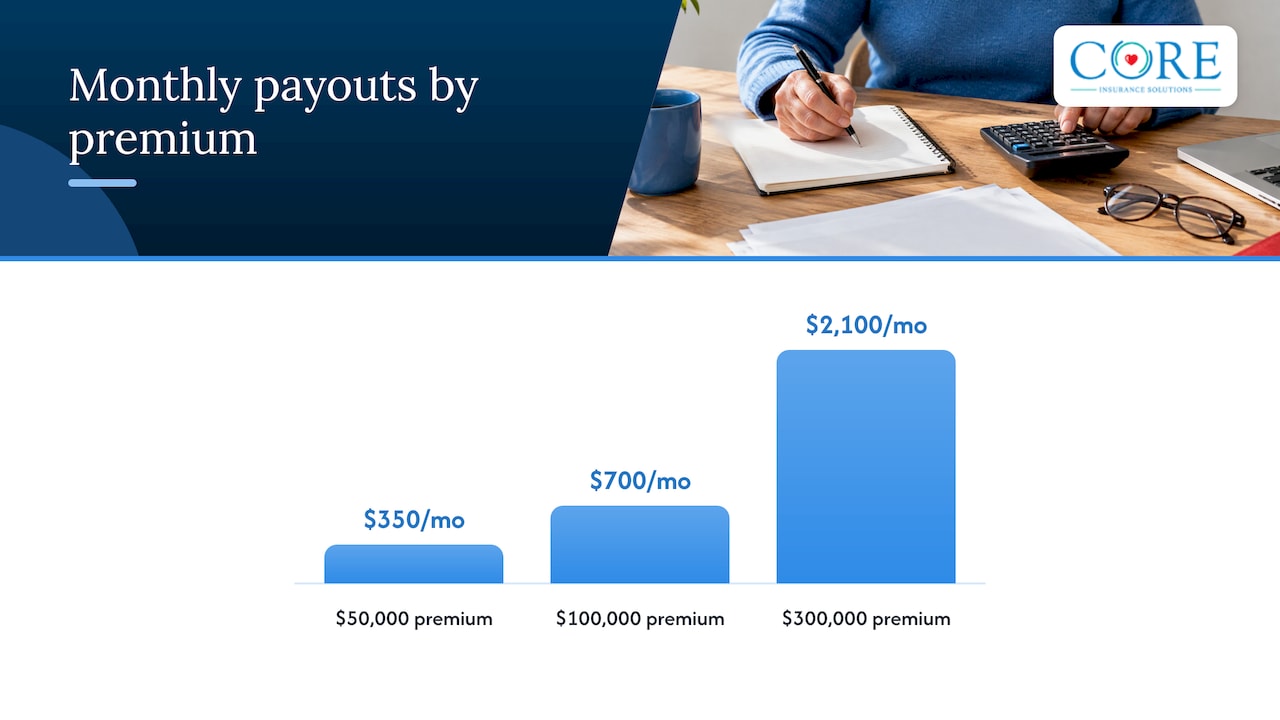
People often ask what $100,000 or $300,000 would pay per month. No single figure is correct, because insurers reprice with interest rates and publish new quotes constantly. What stays constant is the arithmetic: the payout scales with the premium. If a quote for your age and option were, say, $700 a month per $100,000 (a hypothetical figure for illustration), then $300,000 would produce about $2,100 a month, and $50,000 about $350.
What moves the number:
- Age at purchase. The older you are, the fewer expected years of payments, so the monthly figure rises.
- Sex. Women on average live longer, so life-only payouts are typically a little lower for the same age and premium.
- Payout option. A life-only payout is the highest for a given premium because nothing is promised after you die. Adding a guaranteed period, a refund feature or a surviving spouse’s benefit lowers the monthly amount.
- Inflation protection. A cost-of-living rider raises payments over time, but starts you at a lower amount.
- Interest rates and the insurer. Rates when you buy are locked in for the life of the contract, and different insurers quote different amounts for the same facts.
Because quotes differ by insurer, FINRA advises shopping around and being comfortable with the company as well as the product. Quotes are a snapshot: ask for a current, written quote with your exact details rather than relying on any figure you see published.
Payout options, in plain language
The option you choose matters as much as the premium. The common ones:
| Option | What it does | Who it tends to suit |
|---|---|---|
| Life only | Pays for as long as you live, then stops | Someone who wants the highest income and has no one depending on it |
| Life with period certain | Pays for life, but if you die early, a beneficiary receives the remaining payments through the guaranteed period | Someone who wants income for life and some protection for heirs |
| Period certain only | Pays for a fixed number of years, such as 10 or 20 | Someone bridging a gap, like the years before another income begins |
| Life with refund | If payments received are less than the premium, the difference goes to a beneficiary in a lump sum or as installments | Someone who wants the premium protected |
| Joint and survivor | Continues payments to a spouse after the first death, at a chosen percentage | Couples who both rely on the income |
For couples, the survivor percentage is the key decision. A higher percentage means a lower starting check but less of a drop if one spouse dies. Our guide to annuity payout options walks through how each one pays.
How the payments are taxed
Taxes depend on where the premium came from.
- After-tax money (a non-qualified annuity). Each payment is part return of your own money and part earnings. Under the tax rule known as the exclusion ratio, you recover your cost without tax spread across the payments, and only the earnings portion is taxed as income. IRS Publication 575 (1999 edition) explains that the amount excluded as recovery of cost cannot exceed your total cost, and that unrecovered cost at death can be deducted on your final return. The Society of Actuaries describes the exclusion ratio as a deliberately favorable rule for nonqualified contracts.
- Pre-tax money (a traditional IRA or 401(k) rollover). Payments are generally taxed as ordinary income, because you never paid tax on the money going in.
- Roth IRA money. Qualified Roth distributions are generally tax-free, and the same generally holds when the Roth funds the annuity.
Because your situation and the current tax rules matter, confirm the details with a tax professional before you move retirement account money.
What it means for Medicare costs
This is the part most annuity guides skip, and the part we deal with every day. Guaranteed income does not stand alone. It has to pay for Part B and Part D premiums, Medigap or Medicare Advantage costs, copays, and prescriptions.
Three connections are worth planning around:
- Premium surcharges. Taxable income can affect the income-related monthly adjustment amount (IRMAA) added to Medicare premiums at higher income levels. How an annuity is funded changes how much of each payment is taxable. Our IRMAA briefing explains how the thresholds work.
- Fixed income against rising health costs. A level payment buys less each year, and health care tends to be the cost that grows. Our look at healthcare costs in retirement helps you decide how much monthly income to lock in.
- Cash for surprises. A large share of your savings in an annuity means less cash for a deductible, a hospital stay or a dental bill. Keeping reserves outside the annuity is part of choosing the premium.
If you are turning 65 in Florida, our Medicare checklist for turning 65 puts enrollment timing next to these income decisions.
Risks to understand before you buy
FINRA lists the main ones, and they are worth understanding rather than skipping:
- Liquidity. Once income starts, you generally cannot take back the lump sum. Some options pay undistributed principal to beneficiaries at death, but that is different from access during your life. The insurance industry’s retirement guide from the Insured Retirement Institute makes the same point, saying immediate annuities are not liquid once income starts.
- Inflation. Fixed payments lose purchasing power unless you buy a cost-of-living or fixed-increase rider, which costs extra.
- Insurer strength. The guarantee is only as good as the issuing insurer. State insurance departments oversee these contracts, and state guaranty funds provide backup up to limits that vary by state, according to the same industry guide. Look at the insurer’s financial strength ratings when you compare.
None of these is a reason to avoid income annuities. They are the questions that decide how much to put in, which option to choose and which insurer to use.
Who an immediate income annuity tends to fit
FINRA notes that healthy people who expect longer-than-average lives may benefit most from lifetime income. In practice, the profile looks like this:
- You are at or near retirement and want part of your income to arrive no matter what the market does.
- You have covered your emergency cash and near-term spending separately.
- You want to cover fixed costs, such as Medicare premiums, supplement premiums and housing, with income that does not change.
- You would like to simplify decisions for a spouse or for adult children who help manage your finances.
It tends to fit less well if you might need the whole sum soon, or if the amount is most of your savings. A mix is common: an annuity covering baseline costs, with other savings left available for flexibility.
What to compare before you choose
- Your monthly gap. Add up Social Security, pensions and other dependable income, then subtract fixed costs including health care. The shortfall is the income you may want guaranteed.
- Payout option. Decide whether a spouse or heirs need to be protected, and accept the lower check that comes with it.
- Insurer ratings and quotes. Compare written quotes from several insurers for identical facts, since results differ.
- Funding source. Know whether the premium comes from after-tax savings or a retirement account, because that decides your tax bill.
- Inflation rider. Decide whether a rising payment is worth a lower starting one.
- Medicare fit. Check how the income interacts with premiums and the plan you will choose.
How we help
Our work starts with a Holistic Health Needs Assessment, a look at your medical history, your preferences and your budget. The Medicare plan you choose and the income you lock in are decisions that depend on each other, so we treat them as one conversation. We offer unbiased carrier comparisons, prescription cost optimization and annual policy audits, and our Lifetime Income Solutions service covers the income side. Our services come at no direct cost to you, and we have helped over 2,000 families with their coverage.
To see what that review looks like, visit our services page, or start with the Medicare plans we work with in Lakeland.

We do not offer every plan available in your area. For all options, visit Medicare.gov or call 1-800-MEDICARE.
Our perspective
Most retirees we meet in Polk County do not ask us about annuities first. They ask whether they can afford their Part D drugs, whether a Medigap plan or Medicare Advantage makes more sense, and what happens when a bill is denied. The income question follows from those answers.
That is why we think of a lifetime income decision as part of a health coverage plan. If your premiums, copays and prescriptions are predictable, you know how much dependable income you need. If you try to choose the annuity first, you are guessing at the number that matters most.
Our approach is to assess your health needs, compare carriers without leaning on one, minimize prescription costs, and audit your coverage every year so the plan keeps fitting you. Lifetime Income Solutions is the piece that makes sure the paycheck side of retirement is working with the health side.
Core Insurance Solutions
FAQ
What is an immediate income annuity?
It is an insurance contract you fund with one lump sum, in return for regular payments that begin soon after purchase. The payments can last for your lifetime or a set number of years. Investor.gov notes that income typically starts within a year.
How much does a $100,000 immediate annuity pay per month?
There is no fixed answer. The amount depends on your age, sex, payout option, the insurer and the rates on the day you buy. Payouts scale with the premium, so a $300,000 purchase pays roughly three times what $100,000 does under the same terms. Ask for a written quote with your own details.
Can I get my money back after payments begin?
Generally not as a lump sum. FINRA explains that the trade is access to your principal in exchange for guaranteed income. Options such as a guaranteed period or a refund feature can direct unpaid amounts to a beneficiary, at the cost of a lower monthly payment.
Does annuity income affect my Medicare costs?
Taxable income can count toward the income-related surcharges on Medicare premiums, so how the annuity is funded matters. It also needs to cover your premiums and drug costs month after month. We can review both with you before you decide.
Sources
- FINRA: Immediate Annuities, Money Now and for the Rest of Your Life
- Investor.gov: Annuities
- IRS Publication 575 (1999)
- Society of Actuaries: How Are Nonqualified Annuities Taxed?
- Insured Retirement Institute: 2025 Retirement Guide