

Medicare After Retirement: What to Do and When
Retiring does not switch Medicare on for you in every case, and the timing of your sign-up decides whether you pay penalties for years. The fastest way through is to match your retirement date to your enrollment window, pick the coverage layers that fit your doctors and prescriptions, and review them every year. If you live in Lakeland or anywhere in Polk County, our local agents at Core Insurance Solutions can build that plan with you at no direct cost to you.
Core Insurance SolutionsFind Medicare Coverage That FitsCore Insurance Solutions offers personalized Medicare guidance, unbiased carrier comparisons, and annual policy audits for seniors in Lakeland.VisitTL;DR
- Your Initial Enrollment Period lasts 7 months: 3 months before the month you turn 65, the birthday month, and 3 months after.
- If you leave a job with employer coverage, you generally have 8 months to enroll in Part B without a lifetime penalty.
- Original Medicare has no yearly cap on out-of-pocket spending, so most retirees add a Medigap plan or choose Medicare Advantage, plus drug coverage.
- In 2026 the standard Part B premium is $202.90 a month and Part D out-of-pocket drug spending is capped at $2,100.
- Review your coverage every fall, between October 15 and December 7.
Table of Contents
- Who gets Medicare, and when
- Retiring at 65 versus working past 65
- What Medicare covers after you retire
- Medigap or Medicare Advantage: choosing your second layer
- What Medicare costs in 2026
- Lowering prescription costs
- The yearly review most retirees skip
- Common mistakes after retirement
- How we help Lakeland-area retirees
- Our perspective
- FAQ
- Sources
Who gets Medicare, and when
Medicare Parts A and B are available to people 65 or older, and to some people with disabilities or end-stage renal disease. For age-based, premium-free Part A you need to be 65 and eligible for monthly Social Security or Railroad Retirement benefits. If you have been receiving those benefits at least 4 months before you turn 65, Part A starts automatically. Otherwise you sign up through Social Security.
Eligibility also depends on status: you must be a U.S. citizen or national, a lawful permanent resident, a Cuban-Haitian entrant, or a lawfully residing Compact of Free Association migrant. Social Security states these groups, and receiving SSI alone does not qualify you.
The Initial Enrollment Period is seven months long. If you miss it, the General Enrollment Period runs January 1 to March 31 each year, and Part B coverage begins the month after you enroll. Our Medicare enrollment timeline lays out the months around your birthday.
Retiring at 65 versus working past 65
Your situation at 65 changes the rules.
You are already retired. Sign up when first eligible. Medicare.gov explains that waiting risks a coverage gap and a monthly Part B penalty that grows the longer you wait. That penalty is an extra 10% for each full 12-month period you could have enrolled but did not, and it generally lasts as long as you have Part B.
You are still working with employer coverage. You can often delay Part B without penalty. The catch is what happens when the job ends. The CMS fact sheet for people nearing retirement says that if you do not enroll in Part B within 8 months of losing coverage based on current employment, you may face a lifetime late penalty. You could then enroll only in the General Enrollment Period, with coverage not starting until July.
Two details trip people up:
- COBRA and retiree plans do not count as current employment. Coverage you keep after leaving a job does not stop your Part B clock.
- HSA contributions. Premium-free Part A can reach back 6 months, so if you have a health savings account, the same CMS fact sheet says to stop contributing 6 months before you apply. Our partner-free explainer on how HSAs fit with therapy and other care costs shows what an HSA can pay for once you are enrolled.
For a walk-through of the handoff from a work plan, see our guide to Medicare after employer insurance ends.
What Medicare covers after you retire
Medicare comes in layers, and each one does a different job. According to the CMS introduction to Medicare:
| Part | What it helps cover |
|---|---|
| Part A (Hospital Insurance) | Inpatient hospital care, skilled nursing facility care, hospice, some home health care |
| Part B (Medical Insurance) | Doctors’ services, outpatient care, home health care, durable medical equipment, some preventive services such as certain vaccines and cancer screenings |
| Part C (Medicare Advantage) | Part A and Part B benefits through Medicare-approved private companies, often with extra benefits and usually including drug coverage |
| Part D | Prescription drugs |
Once Parts A and B start, you have Original Medicare. Medicare.gov notes that after your deductible you pay your share of costs, and that there is no limit on yearly out-of-pocket spending unless you add supplemental coverage such as Medigap, Medicaid, or employer, retiree or union coverage. That gap is why the next decision matters.
Medigap or Medicare Advantage: choosing your second layer
You generally pick one of two routes.
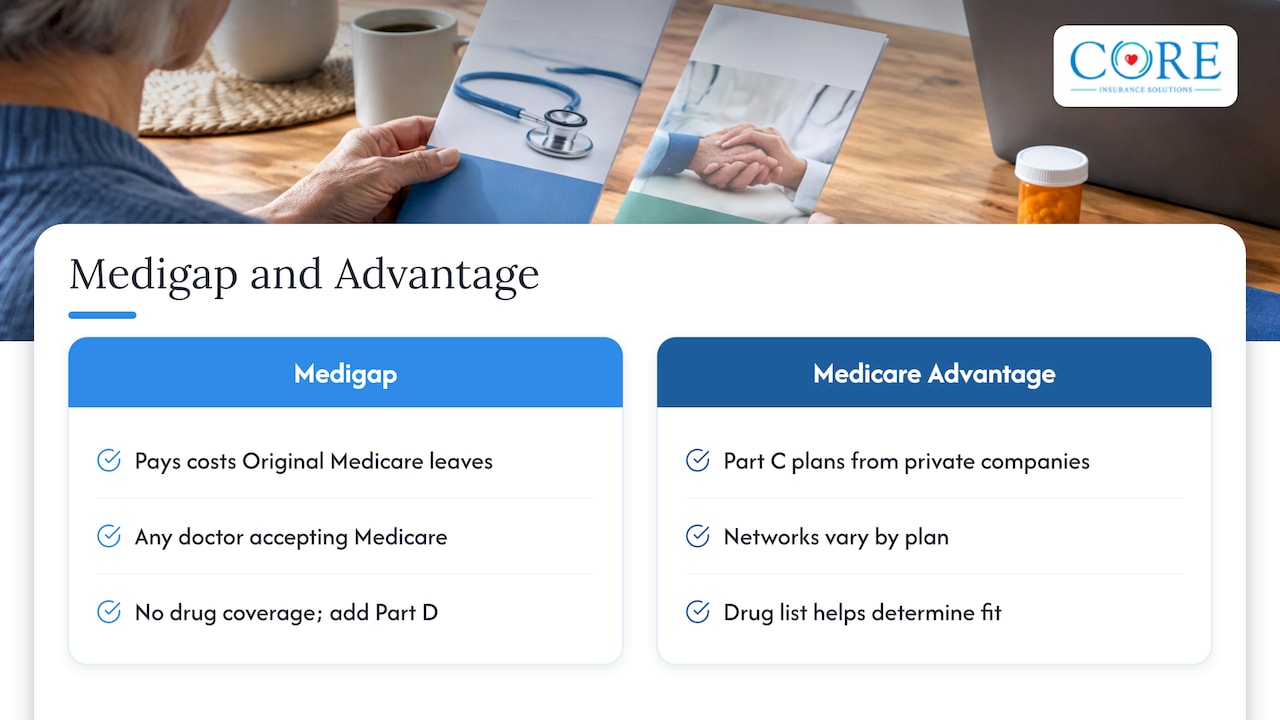
Medigap (Medicare Supplement). Private insurance that pays costs Original Medicare leaves behind, like copayments and deductibles. The CMS example: Medicare pays 80% of a doctor’s service and Medigap can cover the remaining 20%. You can see any doctor who accepts Medicare. Medigap does not cover prescription drugs, so you add a separate Part D plan. CMS describes both options.
Medicare Advantage. Part C plans are offered by Medicare-approved private companies as HMOs, PPOs or private fee-for-service plans, and you need both Part A and Part B to join. Networks, copays and extra benefits differ by plan, so your doctors and your drug list decide which one fits.
Timing matters for Medigap. Medicare.gov warns that if you do not buy a Medigap policy within 6 months of first getting Part A and Part B, you may not be able to buy one later, or may pay more. Our page on Medigap vs. Medicare Advantage in Florida compares the two side by side, and our Medigap plans in Lakeland page shows what we enroll people in locally.
What Medicare costs in 2026
The numbers below are CMS figures for 2026. They reset each year, so check the new amounts each November when CMS publishes them.
- Part B premium: $202.90 a month for the standard amount, up $17.90 from $185.00 in 2025.
- Part B deductible: $283 for the year, up from $257.
- Higher-income surcharge (IRMAA): total Part B premiums range from $202.90 to $689.90 across income tiers, and Part D adds $14.50 to $91.00 on top of plan premiums.
- Part D drug cap: yearly out-of-pocket spending on covered drugs is capped at $2,100 in 2026. After that you pay no copayment or coinsurance for covered drugs for the rest of the year.
Part A is premium-free for most people who have at least 10 years (40 quarters) of work history. Your Part B premium is typically taken out of your Social Security check, so plan your retirement budget around net income.
Income from a one-time event, such as selling a business or home, can push you into a higher IRMAA tier, so retirement-year income is worth planning. Costs outside the plan also add up. Services like a bone density scan have their own price tags, and this guide to DEXA scan costs with and without insurance shows how widely such bills can vary. For a budgeting view, read our healthcare costs in retirement article.
Lowering prescription costs
Drugs are where retirees can often save the most with a little attention.
- Check Extra Help. This federal program helps people with limited income and resources pay Part D premiums, deductibles and coinsurance. Medicare.gov notes you can qualify even if you have creditable retiree drug coverage.
- Confirm your coverage is creditable. If you keep employer or retiree drug coverage instead of joining Part D, it needs to be creditable, meaning expected to pay at least as much as standard Medicare drug coverage. Otherwise a Part D late enrollment penalty can apply.
- Match the plan to your list. Each Part D and Medicare Advantage drug plan has its own formulary (list of covered drugs) and pharmacy network. The same medicine can cost very different amounts from plan to plan.
- Re-check each fall. Formularies and premiums change every year.
This is the work our Prescription Cost Optimization service is built around: we look at your actual medications against the plans we offer, rather than guessing from a brochure.
The yearly review most retirees skip
Medicare Open Enrollment runs October 15 to December 7 every year, and any change takes effect January 1. Costs and benefits can change each year, and so can your health, drugs and doctors. If you do nothing, your coverage generally continues automatically, which is fine only if the plan still fits.
If your plan lost a doctor from its network, raised a copay or dropped a drug you take, the fall window is your chance to switch. Our guides to enrollment periods (IEP, AEP, OEP and SEP) and special enrollment period triggers explain when you can change outside the fall window.
Common mistakes after retirement
- Assuming Medicare starts on its own when you stop working, when many people must apply.
- Treating COBRA or retiree coverage as a reason to delay Part B.
- Missing the 6-month Medigap window after Part B begins.
- Skipping a drug-plan check, then paying a penalty or full price for a medicine.
- Never reviewing the plan after the first year.
More detail is in how to avoid Medicare enrollment mistakes and our explanation of the Part B penalty.
How we help Lakeland-area retirees
Core Insurance Solutions is a local brokerage serving Lakeland, Plant City, Winter Haven, Auburndale, Bartow and the rest of Polk County. We offer Medicare Advantage, Medicare Supplement, Part D drug plans, dental, vision and hearing, hospital indemnity and critical illness coverage. We start with a Holistic Health Needs Assessment, then run an Unbiased Carrier Comparison across the carriers we work with, covering your doctors, drugs and budget. After you enroll, our Annual Rate Watch and Policy Audits keep the plan matched to your needs, and our Claims Advocacy and Support is there if a claim goes sideways. Our service comes at no direct cost to you, and we have helped more than 2,000 families.

See what our services include, view the carriers we work with, or start at coreforseniors.com. We do not offer every plan available in your area. For all your options, you can call 1-800-MEDICARE or visit Medicare.gov.
Our perspective
Most of the retirees we meet are not confused by Medicare itself. They are surprised by the order of decisions: Part B timing first, then the second layer, then drugs, then the yearly review.
We think the right plan starts with the person, not the plan list. That is why we begin with a health needs assessment: your doctors, your medications, how you use care and what you want to keep predictable. Then we compare carriers side by side, so the plan we help you enroll in answers your situation.
Enrollment is the start of the relationship, not the end. Annual policy audits and prescription reviews are how a plan that fit in your first year keeps fitting in your tenth, and we stay on your side if a claim needs resolving.
Core Insurance Solutions
FAQ
Is every U.S. citizen entitled to Medicare at 65?
Most are eligible at 65, but premium-free Part A depends on your work history or your spouse’s, and you still need to sign up unless you already receive Social Security. Citizens, nationals, lawful permanent residents, Cuban-Haitian entrants and COFA migrants can qualify. Social Security lists the groups.
What is the biggest mistake people make when enrolling?
Missing the window. Waiting past your Initial Enrollment Period without qualifying employer coverage can bring a lifetime Part B penalty and a gap in coverage. The second most common is skipping the Medigap window, since after 6 months you may be unable to buy a policy or may pay more.
Do I need Part D if I take few medications?
If you do not join a Medicare drug plan and lack creditable drug coverage, a late enrollment penalty can apply when you join later. Even if you take few drugs now, a Part D or Medicare Advantage plan with drug coverage helps protect against a surprise.
Can I change my coverage after I enroll?
Yes. Everyone with Medicare can change health and drug plans during Open Enrollment, October 15 to December 7, with changes starting January 1. Certain life events also open a special enrollment period.
Sources
- CMS: Original Medicare (Part A and B) eligibility and enrollment
- Social Security: Sign up for Medicare
- Medicare.gov: When can I sign up for Medicare?
- CMS: Medicare decisions for those over 65 and planning to retire
- CMS: Introduction to Medicare
- Medicare.gov: How does Medicare work?
- Medicare.gov: Retiree insurance and Medicare
- CMS: 2026 Medicare Parts A and B premiums and deductibles
- Delaware Department of Insurance: Welcome to Medicare 2026
- Medicare.gov: Remember key Medicare dates
- HSA and therapy costs guide
- DEXA scan cost guide