

U.S. Seniors: Cover Medicare Now or Defer 8–12 Years with SPIA vs FIA
If you need the highest guaranteed paycheck starting almost immediately, a single premium immediate annuity, or SPIA, usually wins. If you want flexibility, a death benefit for your heirs, and growth potential alongside guaranteed income, a fixed indexed annuity (FIA) paired with a lifetime withdrawal rider is typically the better fit. Many retirees in Lakeland and across Polk County use both: a SPIA for the income floor, an FIA for growth and legacy.
TL;DR:
- A SPIA generally provides higher guaranteed income per dollar, with payments starting within 12 months and no access to principal after purchase.
- An FIA with a GLWB rider offers growth potential linked to market indices, flexible income start timing, and benefits for heirs, but with annual rider fees of 1.0% to 1.25%.
- Combining a SPIA for immediate essential expenses and an FIA for deferred growth is a common, flexible strategy for retirement income planning.
- It is essential to compare net rollup rates and rider costs, as advertised figures often overstate actual guaranteed income after fees.
- Insurer credit ratings and current quotes are critical, since payouts from the same FIA can shift significantly with interest rate changes over time.
Core Insurance SolutionsGet Medicare Guidance That FitsCore Insurance Solutions helps Lakeland seniors compare Medicare options around their medical needs, prescriptions, preferences, and ongoing coverage support.Explore Medicare guidance
Table of Contents
- SPIA vs FIA: Comparing Income Mechanics, Timing, and Fees
- How a SPIA Works and When It Makes Sense
- FIA Income Riders: Rollups, Step-Ups, and What They Actually Cost
- SPIA vs FIA: A Quick Pros-and-Cons Checklist
- Choosing Between SPIA and FIA: Steps to Take Before You Buy
- Blending SPIA and FIA for a Floor-Plus-Growth Strategy
- How Core Insurance Solutions Helps You Evaluate Guaranteed Income
- A Word on Insurer Strength and Quote Timing
- Get a Personalized SPIA vs FIA Comparison
- Sources
- FAQ
SPIA vs FIA: Comparing Income Mechanics, Timing, and Fees
A SPIA and an FIA solve the same problem, guaranteed retirement income, through completely different mechanics. A SPIA pools your money with other annuity holders and pays you based partly on mortality credits: people who die earlier subsidize payments for those who live longer. That pooling is why a SPIA often produces more income per dollar than any other single strategy, according to a comparison of SPIA, DIA, FIA with GLWB, and TIPS for retirement income planning.
An FIA works differently. Your money sits in an account tracked against a market index, and if you add a guaranteed lifetime withdrawal benefit (GLWB) rider, the insurer tracks a separate “income account value” that grows on a rollup schedule, separate from your actual cash value.
The practical differences:
- Timing: SPIA income typically starts within 12 months of purchase; FIA income can start immediately or be deferred for years to build a larger income base.
- Liquidity: A SPIA is generally irrevocable once purchased. An FIA retains an accessible account value, minus any surrender charge.
- Legacy: SPIAs offer little to nothing for heirs unless you add a period-certain option. FIAs typically pass remaining account value to beneficiaries.
- Fees: SPIAs usually carry no explicit annual fee. FIA income riders commonly run 1.0% to 1.25% annually, charged against the income account value.
How a SPIA Works and When It Makes Sense
A SPIA converts a lump sum into guaranteed payments, and insurers price those payments using a formula built on your age, gender or joint-life status, and current interest rates. A 70-year-old man will generally get a higher monthly payout than a 70-year-old woman purchasing the identical policy, purely because of shorter average life expectancy tables. A SPIA typically starts payments within a year of purchase, which is what makes it attractive to someone who needs income now, not eventually.
Here’s what to know before you sign:
- Payout options are locked in at purchase. Life-only pays the most but stops at death. Joint-life covers a spouse but pays less. Period-certain guarantees payments for a set number of years even if you die early.
- The decision is generally irrevocable. Once the contract is issued, you cannot unwind it to get your principal back.
- Tax treatment depends on funding source. Money from a qualified account (like an IRA) is fully taxable as ordinary income; money from a nonqualified account is taxed only on the growth portion using an exclusion ratio.
- It fits best as an income floor. Financial writers consistently frame SPIAs as tools for covering essential, non-negotiable expenses, not for building wealth or leaving an inheritance, as noted in Annuity.
FIA Income Riders: Rollups, Step-Ups, and What They Actually Cost
An FIA with a GLWB rider tracks two separate numbers, and mixing them up is the single most common mistake buyers make. Your actual account value grows (or stays flat) based on index-linked interest, subject to caps or participation rates. Your income account value, the number that determines your future guaranteed withdrawals, grows on a contractual rollup schedule that has nothing to do with market performance.
That rollup rate typically runs 4% to 8% annually, compounded, for a set number of years, usually 10 to 20, or until you start withdrawals.
Statistic to remember: rider fees on FIA income benefits commonly land in the 1.0% to 1.25% range per year, deducted from the income account value, not your cash account. That fee compounds over a decade of deferral and materially changes your net guaranteed income.
A few other mechanics worth knowing:
- Step-ups can lock in a higher income base in years the market performs well, permanently raising your future guaranteed withdrawal.
- Surrender periods typically run 7 to 10 years; withdrawing more than the free amount early triggers a penalty.
- Caps and participation rates limit how much index gain actually credits to your account, often well below the index’s raw return.
- FIAs generally preserve a death benefit equal to the remaining account value, something a standard SPIA cannot offer.
SPIA vs FIA: A Quick Pros-and-Cons Checklist
Matching the product to your priorities is easier when you see the trade-offs side by side.
SPIA:
- Pro: Highest guaranteed income per premium dollar in most quote comparisons.
- Pro: Simple, one-time decision with no ongoing fees to track.
- Con: Irreversible once purchased. You cannot access the lump sum again.
- Con: Weak legacy value and no built-in inflation adjustment unless you pay extra for one.
FIA with GLWB:
- Pro: Growth potential tied to an index, with downside principal protection.
- Pro: Flexibility to defer, adjust, or in some cases surrender before income starts.
- Pro: Death benefit preserves value for heirs.
- Con: More moving parts, rollup rates, caps, fees, that require real comparison shopping.
- Con: Starting income is usually lower than a comparable SPIA at the same age.
Pro Tip: Ask for the “net rollup after fees” figure on every FIA quote, not just the advertised rollup rate. Advertised numbers describe the income account, not what actually reaches your bank account, and rider costs quietly eat into that gap over a 10 to 15 year deferral period.
Choosing Between SPIA and FIA: Steps to Take Before You Buy
Before comparing a single quote, map out what you actually need income to cover.
- List your essential monthly expenses, housing, food, Medicare premiums, prescriptions, and subtract any guaranteed income you already have from Social Security or a pension.
- Identify the gap. If guaranteed sources don’t cover essentials, that gap is a strong argument for SPIA-style income.
- Assess liquidity needs and health risk. If you expect major medical costs or want funds available for long-term care, an FIA’s accessible account value matters more.
- Request quotes and ask five specific questions: What’s the rollup rate? What’s the annual rider fee? What are the caps or participation rates? When does income actually start? What’s the death benefit if I stop withdrawals early?
- Run the numbers through a retirement calculator to stress-test both scenarios against inflation and different withdrawal ages.
Blending SPIA and FIA for a Floor-Plus-Growth Strategy
Advisors frequently recommend splitting retirement savings rather than picking one product exclusively, using a SPIA for an income floor paired with an FIA-GLWB for supplemental income. A common approach: put enough into a SPIA at retirement to cover essential expenses immediately, then let the FIA portion defer for 8 to 12 years so the rollup rate has time to build a larger income base before you ever need to touch it.
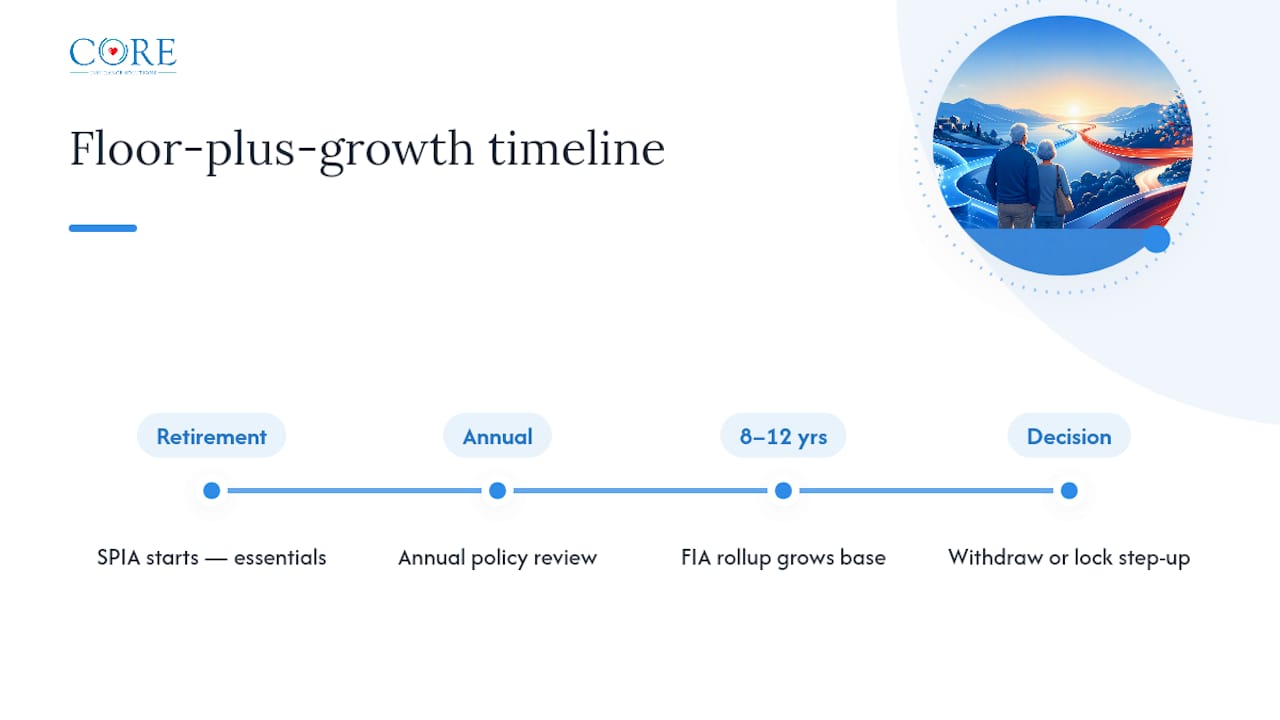
The FIA doesn’t sit untouched forever, though. An annual policy review checks whether caps, participation rates, or rider terms have shifted, and whether it’s time to activate withdrawals or lock in a step-up.
How Core Insurance Solutions Helps You Evaluate Guaranteed Income
Choosing between a SPIA and an FIA isn’t just a math problem, it’s tied to your health outlook, Medicare costs, and prescription budget. A holistic health needs assessment is recommended before any income strategy is suggested, since clients with different health needs may require different income floors and legacy considerations.
What that looks like in practice:
- Unbiased comparisons across major carriers, not a single company’s product menu.
- Annual policy audits that catch rider fee changes, rollup adjustments, and better available options.
- Side-by-side quote runs that isolate rider fees, caps, and net income after costs.
Core Insurance Solutions has helped many families in the Lakeland area coordinate retirement income with their broader Medicare and health coverage picture, including how guaranteed payments line up with Medicare Part B decisions.
A Word on Insurer Strength and Quote Timing
Guaranteed income is only as solid as the insurer behind it. Check credit ratings from agencies like AM Best before buying, and get current quotes: real-quote comparisons show GLWB payouts can shift meaningfully as interest rates move, so a quote from two years ago tells you very little today.
— Core Insurance Solutions
Get a Personalized SPIA vs FIA Comparison
Running these numbers alone means comparing rollup rates, rider fees, and payout tables from carriers that all format their quotes differently. Core Insurance Solutions does that comparison work for you, pulling current quotes across major carriers and laying out the net income difference in plain terms, then folding that decision into your broader Medicare and prescription drug budget so nothing gets planned in isolation.

Start with the free Medicare 101 webinar replay to see how guaranteed income and Medicare costs typically interact, then schedule a one-on-one policy audit through Core Insurance Solutions’ services page to get quotes run against your specific health profile and budget. All guidance follows Medicare Marketing Guidelines, so what you get is a straight comparison, not a sales script.
Sources
For deeper reading, see the academic comparison of SPIA, DIA, FIA, and TIPS and run your own numbers with a retirement calculator.
This article is general information, not a substitute for advice from a qualified financial advisor. Consult a qualified financial professional about your own circumstances before acting on anything here.
- Generating Real Retirement Income: comparing SPIA, DIA, FIA, GLWB, and TIPS
- How much income can you get from an indexed annuity? | Kiplinger
FAQ
What’s the main difference between a SPIA and an FIA?
A SPIA pays guaranteed income almost immediately using mortality credits, while an FIA grows an account tied to a market index and, with a GLWB rider, converts a separate income account into lifetime withdrawals later.
Is a SPIA or FIA better for retirement income?
Neither wins universally. A SPIA typically produces higher immediate income per dollar, while an FIA with a GLWB offers flexibility, growth potential, and a death benefit, according to academic comparisons of both strategies.
How much do FIA rider fees typically cost?
FIA income rider fees commonly run 1.0% to 1.25% annually, deducted from the income account value rather than your actual cash balance.
Can you combine a SPIA and an FIA?
Yes. Many retirees use a SPIA to cover essential expenses immediately and an FIA with a GLWB rider deferred for years to build supplemental income and preserve value for heirs.
Does Core Insurance Solutions help compare SPIA and FIA quotes?
Yes, Core Insurance Solutions runs unbiased comparisons across major carriers and performs annual policy audits so your annuity strategy stays aligned with current rates and your health and Medicare costs.


