

U.S. Seniors: Avoid $6,936, Adviser Ready 2026 IRMAA Briefing
The standard Medicare Part B premium for 2026 is $202.90 a month, but roughly 7 to 8 percent of beneficiaries pay more because their income crosses the first IRMAA threshold: $109,000 for individuals or $218,000 for joint filers. Once you cross that line, surcharges on Part B and Part D can add $1,148 to nearly $6,936 per person, per year, based on income reported on your 2024 tax return.
TL;DR:
- About 92 to 93 percent of beneficiaries pay only the standard Medicare Part B premium of $202.90 in 2026, avoiding IRMAA surcharges.
- IRMAA brackets are based on 2024 tax return data, meaning plans made two years ahead can prevent unexpected increases caused by recent income events.
- A small increase of just one dollar over the threshold can result in hundreds of dollars more in annual Medicare costs, emphasizing careful income management and planning.
- Filing an appeal using documentation of life-changing events can potentially reduce or eliminate IRMAA surcharges within roughly 60 days.
Core Insurance SolutionsPlan Your Medicare Costs With ConfidenceCore Insurance Solutions provides personalized Medicare guidance, income-aware comparisons, prescription cost assistance, and claims advocacy for Lakeland seniors.Explore Medicare guidance
Table of Contents
- Irmaa Medicare 2026: Quick Numbers and Official Brackets
- How Does the Two-Year Lookback Rule Work?
- What Will IRMAA Actually Cost You in 2026?
- What Triggers IRMAA and How Can You Avoid It?
- How Do You Check or Appeal an IRMAA Determination?
- What Do Real IRMAA Scenarios Look Like?
- How Core Insurance Solutions Approaches IRMAA Planning
- Get Help Planning Around 2026 IRMAA Costs
- Sources
- FAQ
Irmaa Medicare 2026: Quick Numbers and Official Brackets
The Centers for Medicare & Medicaid Services sets IRMAA brackets each year using modified adjusted gross income from two years prior, and the 2026 figures follow that same structure with updated thresholds. The standard Part B premium is $202.90 and the annual deductible is $283. If your 2024 MAGI stayed under $109,000 (single) or $218,000 (joint), you pay only that base amount.
Cross the threshold, though, and the math changes fast. The Part D national base beneficiary premium for 2026 is $38.99, and that figure sits on top of whatever surcharge your income tier triggers. Medicare.gov and CMS jointly publish the tiered breakdown, and the Railroad Retirement Board confirms the same numbers for retirees covered under RRB rather than Social Security Administration.
Here’s how the 2026 brackets break down by MAGI and monthly surcharge:
Roughly 92 to 93 percent of Medicare beneficiaries fall into the first row and never see a surcharge. The rest, about 7 to 8 percent nationally, get hit with anywhere from a modest bump to nearly triple the standard Part B cost. For anyone on the edge of a bracket, that gap is worth watching closely every single year, not just at enrollment.

How Does the Two-Year Lookback Rule Work?
Modified adjusted gross income for IRMAA purposes is your Adjusted Gross Income plus tax-exempt interest, the kind you’d report from municipal bonds. It shows up on Form 1040, and Social Security pulls that figure directly from IRS records rather than asking you to self-report it.
The lag is the part that trips people up. Social Security uses your MAGI from two years before the current premium year, so 2026 premiums are based on 2024 tax returns, the most recent complete filing the IRS has processed and shared with SSA by the time premiums are set. That delay means a Roth conversion or a big capital gain today won’t touch your premium until two years from now, which is exactly why advisors say you need to plan Medicare costs at least two years ahead, not one.
A few situations complicate the standard lookback:
- If SSA has no 2024 return on file, it may reach back further to a 2023 return, extending your exposure window by an extra year.
- Railroad Retirement Board beneficiaries follow the same income rules and lookback period as Social Security enrollees, just administered through RRB rather than SSA.
- Married couples filing separately face a steeper, compressed bracket structure designed to prevent income splitting from avoiding IRMAA.
- If your income dropped after a documented life event, you can request SSA use a more recent tax year instead of the automatic two-year-old return.
IRMAA also behaves like a cliff, not a slope. Land at $109,001 in MAGI and you pay the full $284.10 total Part B premium for the entire year, not a prorated amount based on how far over you went. That one extra dollar can cost you hundreds annually.
What Will IRMAA Actually Cost You in 2026?
Multiply the monthly surcharge by twelve and the abstract brackets turn into real annual numbers, and the gap between tiers gets a lot more concrete once you do that math.
A single retiree who crosses into Tier 1 pays about $1,148 more per year than someone at the standard rate, while a retiree in the top tier pays nearly $6,936 more, per person. That per-person detail matters because IRMAA is assessed individually, even though it’s based on joint MAGI. A married couple where both spouses are on Medicare and both cross into Tier 3, for instance, faces roughly $9,252 in combined annual surcharges, not $4,626.
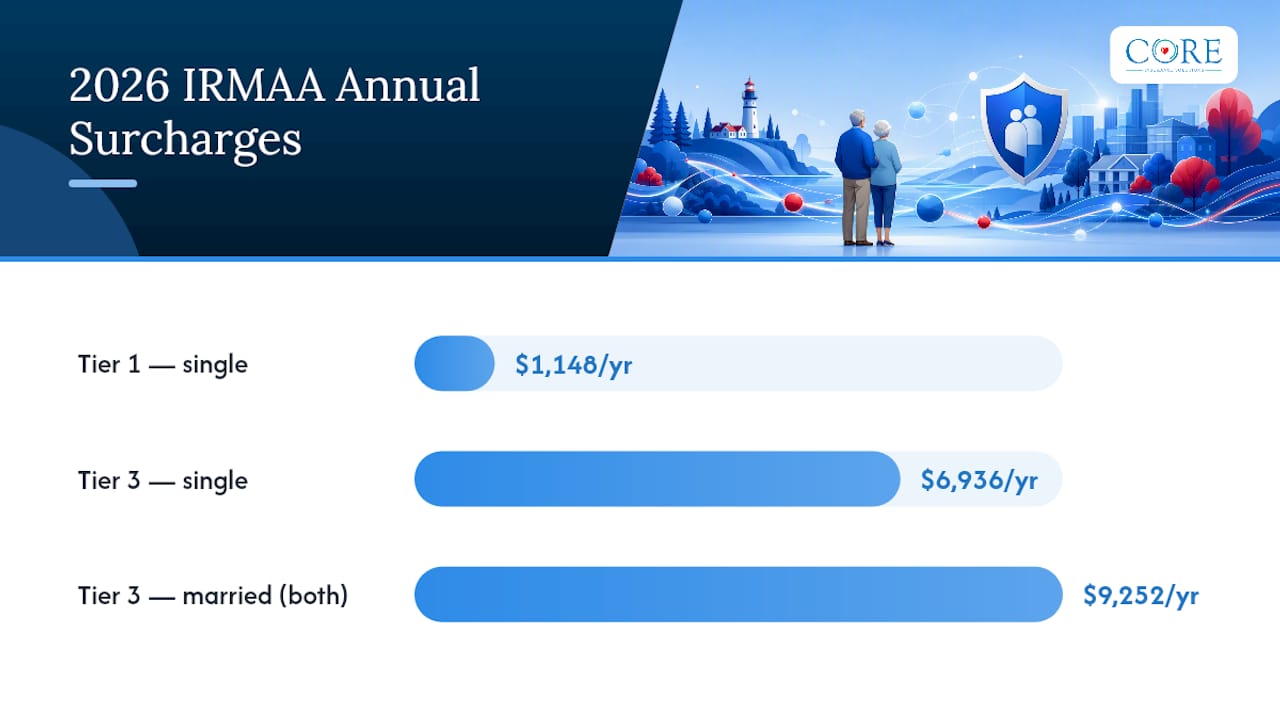
That’s the detail people miss most often: IRMAA doesn’t care that you’re filing jointly when it comes time to bill you. It looks at your joint income to determine the tier, then charges each enrolled spouse separately at that tier’s rate. A Medicare Premium Estimator can help you model both the individual and household numbers before you make a decision that might push your MAGI into a higher bracket.
What Triggers IRMAA and How Can You Avoid It?
Most people who get an unwelcome IRMAA notice didn’t do anything reckless. They sold a rental property, converted a chunk of a traditional IRA to a Roth, or took a larger-than-usual required minimum distribution, and none of those show up as a Medicare problem until two years later.
The usual culprits behind a MAGI spike include:
- Roth IRA conversions, which count as ordinary income in the year you convert.
- Required minimum distributions from traditional IRAs and 401(k)s once you hit RMD age.
- Capital gains from selling stock, a second home, or a business.
- The taxable portion of Social Security benefits, which rises as other income rises.
- Interest from municipal bonds, which is federal tax free but still counts toward MAGI for IRMAA.
A few planning moves can soften the impact. Qualified Charitable Distributions let you send IRA funds directly to a charity to satisfy your RMD without the distribution ever touching your AGI. Spreading a large Roth conversion across several smaller years, harvesting tax losses to offset gains, and timing asset sales around lower income years can all help keep you under a bracket line.
Pro Tip: If you’re planning a Roth conversion, run the numbers on how it affects your MAGI two years out, not just this year’s tax bill. A conversion that saves you money on future taxes can still cost you thousands in IRMAA surcharges if it pushes you even one dollar over a threshold.
Every one of these tactics has trade-offs involving taxes, estate planning, or cash flow, so none of them should be decided in isolation. Coordinate with a tax professional and a Medicare advisor before making a move that touches your MAGI.
How Do You Check or Appeal an IRMAA Determination?
You’ll find your IRMAA status in your Social Security online account or on the notice SSA mails when your premium is set to change. Medicare.gov also reflects your current premium once it’s finalized. If your income dropped because of a qualifying event, you don’t have to accept the higher tier.
- Locate your IRMAA determination notice from SSA, which arrives by mail before your new premium year begins.
- Confirm whether a qualifying life event applies: marriage, divorce, death of a spouse, work reduction or stoppage, loss of pension income, or an employer settlement payment.
- Complete Form SSA-44, attaching documentation of the life event and, where possible, a more current income estimate.
- Submit the form to your local Social Security office or mail it to the address listed on the form itself.
- Expect a decision within about 60 days, though straightforward cases sometimes move faster.
- If approved, SSA adjusts your premium going forward, and Part B refunds for overpayment typically show up in your Social Security check or as a credit; Part D surcharge corrections flow through your plan’s premium billing.
Skipping this step when you actually qualify for a reduction means paying a higher premium for a full year over what could have been a one-page form.
What Do Real IRMAA Scenarios Look Like?
Numbers on a chart are one thing. Seeing them play out against an actual retiree’s situation is what makes the brackets click.
- Single retiree, MAGI $115,000. This lands in Tier 1, adding $81.20 a month to Part B and $14.50 to Part D, for $1,148 extra per year compared to the standard premium.
- Married couple, both enrolled, joint MAGI $290,000. That falls in Tier 2 ($274,001 to $342,000), so each spouse pays $2,887.60 more annually, a combined household hit of $5,775.20.
- Retiree with a one-time Roth conversion pushing MAGI to $350,000. This trips Tier 4, costing $6,363.60 for that year, even though the retiree’s normal income sits closer to $80,000. A well-timed SSA-44 filing after the fact won’t help here since there’s no qualifying life event, just a planned conversion, which is exactly why timing conversions across the two-year lookback matters so much.
- Widow whose spouse passed away, MAGI dropped from $220,000 to $95,000. Filing Form SSA-44 with a death certificate and updated income estimate could move her from Tier 1 back to the standard premium, saving $1,148 annually.
How Core Insurance Solutions Approaches IRMAA Planning
IRMAA decisions rarely happen in isolation from the rest of a person’s Medicare coverage, which is why Core Insurance Solutions builds every client relationship around a Holistic Health Needs Assessment rather than a quick premium quote. Reviewing carrier options, prescription costs, and income timing together catches problems a single-issue conversation misses. Unbiased Carrier Comparison and Prescription Cost Optimization both factor into whether a plan change makes sense before an income event locks in a higher IRMAA tier.
The firm has helped many families work through Medicare decisions, including the income timing questions that drive IRMAA exposure. Annual Rate Watch policy audits mean MAGI-sensitive decisions get revisited every year, not just once at enrollment.
— Core Insurance Solutions
Get Help Planning Around 2026 IRMAA Costs
Reading a bracket table tells you where you stand today. It doesn’t tell you whether a Roth conversion next spring, a home sale, or an RMD strategy will push you into a higher tier two years from now, and that’s where a second set of eyes pays for itself. Core Insurance Solutions works through those income timing questions as part of a broader Medicare review, not a one-time transaction, at no direct cost to you.

The firm’s Holistic Health Needs Assessment looks at your full picture, income, prescriptions, current coverage, before recommending a plan change that could affect your MAGI down the road. If you’re choosing a Part D plan for 2026 and want to weigh how the national base premium and any IRMAA surcharge factor into your total cost, the team can walk through Medicare Part D plan options in Lakeland with you directly. All guidance follows Medicare marketing rules, and no comparison is made against other agencies or brokers. Schedule a consultation to review your specific income situation and coverage options before your next enrollment decision.
This article is general information, not a substitute for advice from a qualified financial advisor. Consult a qualified financial professional about your own circumstances before acting on anything here.
Sources
FAQ
What Are the Current IRMAA Brackets for 2026?
The first 2026 IRMAA threshold is $109,000 for individuals and $218,000 for joint filers, with five tiers above that reaching total Part B premiums as high as $689.90 a month. Part D surcharges range from $14.50 to $91.00 monthly depending on your tier.
What Income Level Triggers Medicare IRMAA?
MAGI above $109,000 for a single filer or $218,000 for joint filers triggers IRMAA for the 2026 premium year, based on your 2024 tax return. Every dollar over the threshold applies the full surcharge for that tier, with no partial or prorated amount.
How Do You Calculate MAGI for Medicare IRMAA?
MAGI for IRMAA is your Adjusted Gross Income from Form 1040 plus any tax-exempt interest, such as municipal bond income. Social Security pulls this figure directly from your 2024 tax return to determine your 2026 premium tier.
Where Can You Find the Official 2026 Medicare IRMAA PDF?
The Medicare.gov 2026 costs PDF lists official Part D premiums and IRMAA surcharges, while CMS’s fact sheet covers Part B premiums, the deductible, and the full bracket structure.
Can You Appeal an IRMAA Determination if Your Income Dropped?
Yes, if the drop resulted from a qualifying life event like retirement, divorce, or a spouse’s death, you can file Form SSA-44 with documentation. Decisions typically take about 60 days, and approved appeals can lower your premium and refund any overpayment.


