

Retirement Income Annuities: A Guide for People 55+
A retirement income annuity turns a portion of your savings into a predictable, insurer-backed paycheck that arrives for life or a set number of years. It works alongside Social Security to cover essential bills, no matter what the stock market does.
Two decisions shape everything else: when payments start, and how they’re structured.
- Immediate vs. deferred: an immediate annuity pays within a year of purchase; a deferred annuity, including a Qualified Longevity Annuity Contract (QLAC), waits years before the checks begin.
- Fixed vs. variable vs. indexed: fixed means a set payout, variable ties income to investment performance, and indexed sits somewhere in between.
Working with a licensed agent, such as those at Coreforseniors, or reviewing IRS guidance on QLAC limits before you sign anything protects you from a decision you can’t undo.
Key Takeaways
A retirement income annuity works by trading a portion of your liquid savings for a guaranteed, insurer-backed payment stream that covers essential expenses regardless of market conditions.
| Point | Details |
|---|---|
| Match the type to your timeline | Choose immediate annuities for income now, deferred or QLAC contracts for income you won’t need for a decade or more. |
| Deferral raises payouts | Waiting longer to start payments increases your monthly income because the insurer expects fewer payout years. |
| Riders cost money upfront | A COLA or joint-and-survivor rider lowers your starting payment in exchange for future protection. |
| Check the insurer, not just the pitch | Credit ratings and state guaranty fund coverage matter more than marketing language when comparing offers. |
| Get a local, unbiased comparison | Coreforseniors helps Lakeland-area retirees compare carriers and QLAC suitability alongside their Medicare and healthcare planning. |
Where to Verify Annuity Rules and Ratings
- SSA’s comparison of Social Security and private annuities
- Fidelity’s guide to how income annuities work
- Investopedia’s overview of guaranteed lifetime annuities
- Annuity
- Confirm any insurer’s AM Best, S&P, or Moody’s rating and your state’s guaranty association coverage before signing.
This article is general information, not a substitute for advice from a qualified financial advisor. Consult a qualified financial professional about your own circumstances before acting on anything here.
Table of Contents
- What Is a Retirement Income Annuity and How Does It Work?
- How Are Payouts Calculated, and What Do QLACs Mean for Your Taxes?
- Is a Retirement Income Annuity Worth It for You?
- Which Riders and Features Actually Change What You’ll Get Paid?
- What Should You Ask Before Buying an Annuity?
- How Much Monthly Income Does a Lump Sum Actually Buy?
- Get Help Comparing Retirement Income Annuities in Lakeland, FL
- Sources
What Is a Retirement Income Annuity and How Does It Work?
A retirement income annuity is an insurance contract. You hand an insurer a lump sum, or a series of premiums, and in exchange the company promises to pay you on a schedule, either for life or for a defined period. That payment stream sits outside the stock market, which is the entire point for a retiree who can’t afford a repeat of 2008 hitting their grocery budget.
Retirees run into four main flavors, and salespeople don’t always explain the difference clearly:
- Immediate annuity (SPIA): you fund it once and payments start within 12 months. This is the classic choice for someone retiring now who wants income immediately.
- Deferred income annuity (DIA): you fund it now but delay payments to a future date, often 10 to 20 years out. A QLAC is a deferred annuity funded from IRA or 401(k) money with special tax treatment.
- Fixed annuity: the insurer guarantees a specific payout. No surprises, no upside either.
- Variable or indexed annuity: payments fluctuate with an underlying investment or index. More potential upside, more risk that a bad year cuts your check.
Payout structure matters just as much as the type. A single-life payout stops when you die. A joint-and-survivor option keeps paying your spouse after you’re gone, usually at a reduced rate. Period-certain guarantees payments for a fixed stretch (say, 20 years) even if you die early, and your beneficiary collects the rest. Return-of-premium guarantees your heirs get back at least what you paid in, minus any income already received.
How Are Payouts Calculated, and What Do QLACs Mean for Your Taxes?
Four things drive your monthly check: how much you put in, your age when payments start, your gender (insurers use actuarial tables that reflect life expectancy), and the interest rate environment when you buy. A 70 year old buying today locks in a rate tied to current bond yields, and that rate is baked into the contract for life.
Waiting to start payments raises your income, sometimes dramatically. The SSA’s analysis of private annuities notes that deferring to age 80 or 85 can meaningfully boost late-life income, because the insurer expects to pay you for fewer years. That makes deferred annuities a strong hedge against outliving your money, but a poor fit if you need cash flow now.
QLACs deserve special attention because Congress built specific rules around them:
- You can fund a QLAC only from qualified retirement accounts like a traditional IRA or 401(k).
- There’s a lifetime funding limit set by the IRS, and it adjusts periodically.
- Payments can be deferred to as late as age 85, and QLAC money is excluded from your required minimum distribution calculation until payments begin.
Money grows tax-deferred inside the annuity. When distributions start, the taxable portion depends on how you funded it: annuitizing a traditional IRA means the full payment is taxable as ordinary income, while a non-qualified annuity funded with after-tax dollars only taxes the earnings portion.
Pro Tip: If you’re 73 or older and worried about RMDs pushing you into a higher tax bracket, ask whether shifting a slice of your IRA into a QLAC before your required withdrawals begin makes sense for your specific accounts.
Is a Retirement Income Annuity Worth It for You?
The case for annuitizing part of your savings comes down to a trade: you give up flexibility in exchange for certainty. Here’s what you gain:
- Predictable income that doesn’t care what the S&P 500 did last Tuesday.
- Longevity protection. If you live to 95, the insurer keeps paying, even after your principal is technically exhausted.
- Market insulation for that specific slice of your retirement income, which lowers the stress of sequencing risk early in retirement.
Here’s what you give up:
- Liquidity. Once your money funds the annuity, it’s largely locked in. Fidelity is blunt about this: annuitized funds should be treated as dedicated income, not a rainy-day fund.
- Fees and commissions that vary by product and aren’t always obvious in the sales pitch.
- Insurer credit risk. Your payments are only as reliable as the company backing them, since annuities aren’t federally insured the way bank deposits are.
- Limited inheritance value unless you specifically pay for a rider that protects it.
A practical rule many advisors use: annuitize enough to cover your essential fixed expenses, rent or mortgage, utilities, groceries, insurance premiums, after subtracting Social Security. Leave the rest in investments where you keep flexibility. Fidelity’s own guidance on lifetime income echoes this: annuities work best as one piece of a diversified plan, not the whole strategy.
Pro Tip: Add up your monthly essential expenses first, then see how much Social Security actually covers. The gap between those two numbers is a reasonable starting point for how much income annuity you might need.
Which Riders and Features Actually Change What You’ll Get Paid?
Riders sound like fine print until you realize they can shrink your monthly check by hundreds of dollars. A cost-of-living adjustment (COLA) rider raises your payment annually, but insurers charge for that protection by starting you at a lower initial payout, sometimes 20% to 30% lower than a level-payment contract.

Advisors also flag a subtlety buyers miss: COLA riders typically apply a fixed percentage increase rather than tracking actual inflation. If inflation runs hotter than your rider’s fixed bump for several years running, your purchasing power still erodes, just more slowly than with no rider at all.
The common add-ons worth understanding:
- Return-of-premium or cash-refund: guarantees your heirs recover unpaid premium if you die early, at the cost of a smaller monthly check.
- Guaranteed periods: ensures payments continue for a minimum number of years regardless of when you pass away.
- Joint-and-survivor: extends payments to a spouse, usually reducing the payout by 10% to 25% depending on ages.
Marketing language varies wildly between insurers, but two things don’t: credit rating and state guaranty fund coverage. An annuity’s promise is only as good as the company’s ability to pay it, which is why checking AM Best, S&P, or Moody’s ratings matters more than comparing glossy brochures.
Once you annuitize principal, it’s typically gone from your accessible balance sheet for good. Surrender charges in the early years can eat 5% to 10% of your withdrawal if you need the money back, and heirs may receive nothing unless you paid for a specific rider protecting them.
What Should You Ask Before Buying an Annuity?
Walk into any conversation with an agent or advisor prepared. Follow this sequence:
- Define the goal. Are you covering essential bills, or supplementing discretionary spending?
- Pick the portion to annuitize. Most planners suggest starting with the gap between Social Security and essential expenses.
- Compare quotes across insurers, not just one company’s pitch, and weigh credit ratings alongside payout size.
- Review the actual contract illustration, not a marketing summary, before signing anything.
Once you’re at the table, ask these questions directly:
- How exactly is my payout calculated, and what happens if I delay the start date?
- What fees, commissions, or rider costs are baked into this quote?
- Is there a death benefit, and what does it cost me?
- How will these payments be taxed given my specific funding source?
- What happens to my income if the insurer becomes insolvent?
Watch for red flags: vague illustrations that dodge specific numbers, reluctance to share AM Best or S&P ratings, surrender charges that seem unusually steep, or pressure to sign before you’ve had time to compare. A legitimate seller welcomes scrutiny.
The buying process itself typically runs a few weeks. You choose a funding source (cash, IRA rollover, or 401(k) transfer), the insurer processes paperwork, and first payments arrive on the schedule you selected, often within 30 to 60 days for an immediate annuity.
How Much Monthly Income Does a Lump Sum Actually Buy?
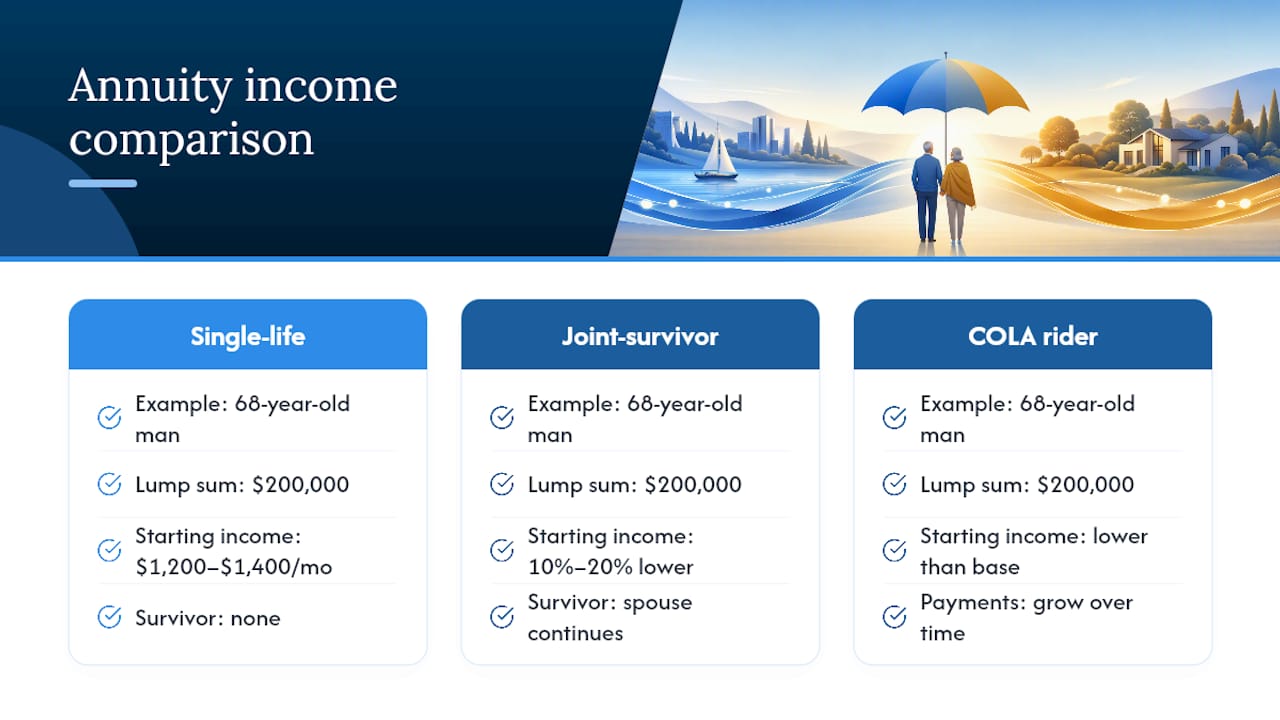
Numbers make this concrete. Say a 68 year old man puts $200,000 into a single-life immediate annuity with no riders. Depending on current interest rates and the insurer’s pricing, that might generate roughly $1,200 to $1,400 in monthly income for life.
Add a joint-and-survivor option so a spouse keeps receiving payments after his death, and that monthly figure drops, often by 10% to 20%, because the insurer now expects to pay out over two lifetimes instead of one. Add a COLA rider and the starting payment drops further still, in exchange for payments that grow over time.
These figures are illustrative only. Actual payouts hinge on prevailing interest rates, the specific insurer’s actuarial assumptions, and your exact age and health profile at purchase, so treat any number here as a ballpark, not a quote.
How Coreforseniors Fits Annuities Into a Complete Retirement Plan
At Coreforseniors, we pair annuity guidance with Medicare and broader senior planning, because retirement income and healthcare costs are two sides of the same coin. Our licensed agents run annual policy audits and have helped over 2,000 families build coverage that fits their specific health and financial picture.
Get Help Comparing Retirement Income Annuities in Lakeland, FL
Comparing insurer quotes, rider costs, and QLAC rules on your own is tedious, and one wrong assumption can lock you into a contract for decades. Coreforseniors gives Lakeland-area retirees a local, unbiased second set of eyes, someone who compares carriers side by side instead of pushing whatever product pays the best commission.

A conversation with our team typically covers three things: where your income gap actually sits between Social Security and your essential expenses, whether a QLAC makes sense given your IRA balance and RMD timeline, and how the insurers you’re considering stack up on credit rating and financial strength. We also look at how any annuity decision interacts with your Medicare premiums and out-of-pocket healthcare costs, since those two budgets are rarely separate in practice.
If you’re weighing whether to annuitize part of your nest egg, start with our free Medicare 101 webinar or reach out directly to schedule a consultation focused on your specific accounts and timeline.
Sources
- How income annuities work | Fidelity
- Social Security retirement benefits and private annuities: A comparative analysis | SSA
- Guaranteed lifetime annuity explained: Benefits and payment options | Investopedia
- Annuity


