

10 SEP Events That Trigger U.S. Medicare Enrollment: Deadlines, Forms
If you lost employer coverage, you generally get 2 months to join a Medicare Advantage or Part D plan, and 8 months to enroll in Part B if you’re working past 65. That’s a Special Enrollment Period, or SEP, and it lets you enroll or switch coverage outside the standard sign-up windows. Check the date your qualifying event happened, then call 1-800-MEDICARE or Social Security before your window closes.
TL;DR:
- The 8-month SEP for losing employer coverage after age 65 only applies if the coverage was creditable, excluding COBRA and retiree plans.
- Moving out of your plan’s area or returning from abroad triggers a 2-month SEP to switch or enroll in Medicare Advantage or Part D plans.
- Missing your SEP deadline can result in permanent penalties, such as a 10% increase in Part B premiums for each year delayed enrollment, and ongoing Part D surcharges.
- For complex situations like changing due to Medicaid loss or entering a long-term care facility, having proper documentation and early action is critical to avoid coverage gaps or penalties.
- Confirm your specific SEP rules through official sources and prepare documentation in advance to prevent costly mistakes caused by misjudging deadlines.
Core Insurance SolutionsGet Personal Medicare Enrollment GuidanceCore Insurance Solutions helps Lakeland seniors compare Medicare options, assess health needs, and navigate enrollment decisions with tailored guidance.Explore Medicare guidance
Table of Contents
- What Is a Special Enrollment Period for Medicare, and How Does It Differ by Part?
- What Life Events Qualify You for a Medicare SEP?
- How Do You Calculate Your SEP Deadline and Coverage Start Date?
- How Do You Actually Apply for a Medicare SEP?
- What Happens If You Miss Your Medicare SEP Window?
- What Special-Case SEPs Should You Know About?
- How Core Insurance Solutions Helps With SEP Enrollment
- Where Can You Verify SEP Rules Directly?
- Why Exact Dates Matter More Than General Advice
- Get Local Help With Your Medicare Special Enrollment Period
- Sources
What Is a Special Enrollment Period for Medicare, and How Does It Differ by Part?
A Special Enrollment Period is a window CMS opens for you outside the Initial Enrollment Period, the General Enrollment Period, or the Annual Enrollment Period, triggered by a specific life event rather than the calendar. Move to a new state, lose your job’s health plan, or leave incarceration, and an SEP opens the door to enroll in or change your coverage without waiting months for the next scheduled cycle.
The rules aren’t identical across the four parts of Medicare, and that’s where people get tripped up.
- Part A and Part B (Original Medicare) use event-specific SEPs, and the biggest one, working past 65 with employer coverage, runs a generous 8 months after employment or coverage ends.
- Part C (Medicare Advantage) SEPs are typically shorter, usually 2 months from the triggering event, though special categories like moving or losing Medicaid follow their own timelines.
- Part D (prescription drug plans) mirrors Part C in most cases: a 2-month window tied to the loss of creditable drug coverage, and missing it can mean a permanent penalty.
Here’s the distinction that matters most: the Initial Enrollment Period is a window around your 65th birthday, the General Enrollment Period is the annual catch-up window (January through March) for people who missed enrolling in Part B, and the Medicare Advantage Open Enrollment Period (January 1 through March 31) only lets you switch between Medicare Advantage plans or drop back to Original Medicare. An SEP is the only one of these that’s triggered by something happening in your life, not by the calendar.
What Life Events Qualify You for a Medicare SEP?
Medicare recognizes more than 10 distinct triggering events for a Special Enrollment Period, and each one comes with its own rules about what you can change and how long you have to do it.
- Moving out of your plan’s service area. If you relocate somewhere your Medicare Advantage or Part D plan doesn’t cover, you get a 2-month SEP starting the month you move, or your plan may include the month before if you notify them in advance.
- Moving back to the U.S. after living abroad. Returning from overseas triggers the same 2-month plan-change window, and it also opens a path to enroll in Part B if you never signed up while abroad.
- Losing employer or union coverage. This is the one with two different clocks running at once. You get 8 months to enroll in Part B counted from whichever comes first, the month employment ends or the month the group health coverage ends. But if you also want a Medicare Advantage or Part D plan, that part of the decision only gives you 2 months from the loss of coverage.
- Working past 65 with creditable employer coverage. Same 8-month rule as above, and it’s arguably the most valuable SEP on the books because it lets people delay Part B entirely without a penalty while they’re still covered at work. COBRA and retiree coverage do not count as active employment here, a mistake that trips up a surprising number of people who assume any continuation of coverage buys them the same 8 months.
- Losing Medicaid or Extra Help (Low-Income Subsidy). If your state Medicaid coverage ends, you typically get a window to reassess your Medicare Advantage or Part D plan, since your subsidy status directly affects what you’ll pay out of pocket.
- Your plan’s contract with Medicare ends or gets sanctioned. When CMS terminates or doesn’t renew a plan’s contract, everyone enrolled gets an SEP to find new coverage before losing benefits entirely.
- Entering or leaving a long-term care facility. Moving into or out of a nursing home or skilled facility opens an SEP that runs the month you move plus 2 additional months, giving you room to adjust Part C or D coverage around your care setting.
- Release from incarceration. Coverage decisions made while incarcerated often don’t reflect current needs, so release opens a fresh SEP to enroll or switch plans.
- Becoming eligible for a 5-star plan. If a 5-star Medicare Advantage or Part D plan is available in your area, you can switch into it once per calendar year, a narrower use case than most SEPs but a real one.
- Dual eligibility for Medicare and Medicaid. Being dual-eligible or receiving Extra Help gives you the ability to make plan changes on a monthly basis, far more flexibility than the average enrollee gets.
Each of these has its own paperwork trail, and confusing one event’s rules with another’s is the single most common way people accidentally miss a deadline.
How Do You Calculate Your SEP Deadline and Coverage Start Date?
Coverage generally starts the first day of the month after your plan or Social Security receives your enrollment request, though a few SEP categories have exceptions worth knowing about upfront.
The counting itself trips up more people than the rules do. Here are two real examples:
- Moving on May 10: Your SEP for switching Medicare Advantage or Part D plans runs through July 31, covering the month of the move plus 2 full months after.
- Employer coverage ending April 30: Your 8-month Part B SEP begins May 1 and runs through December 31, while any related Part D decision needs to happen within that same first 2 months, by June 30, to avoid a coverage gap.
Statistic to remember: the CMS enrollment and disenrollment guidance sets out over 10 separate SEP categories, each with its own effective-date rule, which is exactly why so many people misjudge their own deadline. There isn’t one universal countdown clock; there are several, and the one that applies depends entirely on which event you’re dealing with.
Notify your plan before you move, and the SEP can start the month before the move rather than the month of, effectively buying you extra runway. That’s a detail most people never think to ask about until it’s too late to use it.
How Do You Actually Apply for a Medicare SEP?
Working through a Special Enrollment Period is mostly a documentation exercise, and getting the paperwork lined up before you call makes the whole process move faster.
- Pin down your triggering event and its exact date. Write down the day employment ended, the day you moved, or the day coverage terminated. Every deadline that follows counts from that single date.
- Gather your proof. For job-based coverage loss, you’ll need the CMS-L564 form, which your employer’s HR department completes to verify your coverage dates. For a move, keep your lease, closing documents, or a change-of-address confirmation. For Medicaid loss, hold onto the termination notice.
- Loop in HR early. Ask your employer to complete the CMS-L564 a month or two before your coverage ends rather than after, since a slow HR turnaround is one of the more common ways people watch their window shrink without realizing it.
- Call the right office. Contact Social Security directly for Part A/B enrollment questions and to submit your CMS-L564. Call 1-800-MEDICARE for questions about switching Medicare Advantage or Part D plans, and contact the plan itself once you’ve chosen one.
- Submit and confirm receipt. Whether you file online, by mail, or in person, get a confirmation number or dated receipt, and follow up within a couple of weeks if you haven’t heard back.
Pro Tip: Keep a simple folder, physical or digital, with your event date, every document you gathered, and the date you submitted each form. If a plan later disputes your SEP eligibility, that paper trail is what gets the decision reversed.
If your enrollment request gets denied or you’re told you don’t qualify for the SEP you believe applies, you can appeal. Start by requesting a written explanation from the plan or Social Security, then file a formal appeal through Social Security’s reconsideration process for Part A/B disputes, or through your plan’s grievance process for Part C/D denials. Keep copies of everything you submit, since appeals move faster when the documentation is already organized.
What Happens If You Miss Your Medicare SEP Window?
Missing a deadline here isn’t a minor inconvenience. It can mean a permanent increase in what you pay for coverage.
The Part B late-enrollment penalty adds roughly 10% to your premium for every 12-month period you were eligible but didn’t enroll, and that penalty typically lasts for as long as you have Part B. The 8-month SEP for people working past 65 exists specifically to prevent this, but only if the coverage that delayed your enrollment was genuinely employer-based and creditable, not COBRA or a retiree plan mistaken for active coverage.
Part D penalties work differently and can be even less forgiving: they accrue for every month you went without creditable drug coverage and generally follow you for as long as you’re enrolled in Part D. Because the SEP window for switching drug coverage is often just 2 months, not 8, it’s easy to assume you have more runway than you actually do.
- Get written proof, ideally a letter that explicitly uses the word “creditable,” for any employer drug coverage.
- Contact Social Security as soon as you know your coverage is ending, not after.
- Run the numbers through a Part D penalty calculator before assuming you’re in the clear.
What Special-Case SEPs Should You Know About?
A handful of less common SEPs cover situations that don’t fit the standard moving or job-loss categories, but they carry real financial weight for the people who qualify.
- Dual eligible and Extra Help SEP: if you qualify for both Medicare and Medicaid or receive the Low-Income Subsidy, you can change Medicare Advantage or Part D plans once per month, far more flexibility than most enrollees get.
- 5-star SEP: available once per year if a 5-star rated plan operates in your area, though it’s a one-way switch into that plan, not a general-purpose enrollment tool.
- Exceptional circumstances SEP: disasters, plan sanctions, or misleading information from a plan representative can all justify a special enrollment window. Document names, dates, and any written communication if you believe you were misled, since CMS weighs these cases individually.
- Institutionalized and incarceration-related SEPs: entering or leaving a long-term care facility, or being released from incarceration, opens its own dedicated window separate from the general moving SEP.
How Core Insurance Solutions Helps With SEP Enrollment
Sorting out which SEP applies, and proving it, is where most people lose time. Core Insurance Solutions reviews your specific qualifying event, builds a documentation checklist for your situation, and coordinates directly with your employer’s HR department to get the CMS-L564 completed correctly and on time.
Core Insurance Solutions has helped numerous families navigate Medicare enrollment decisions, including SEP-driven ones. Beyond the initial enrollment, the firm offers annual policy audits to review plan changes and assistance with managing prescription costs. Tools like the Medicare enrollment timeline walk you through exactly where your event falls on the calendar.
The firm does not process Part A or B enrollments directly, which are handled through Social Security. It assists with plan comparison, paperwork preparation, and follow-up after coverage begins. Bring your Medicare card, any coverage termination letters, and a rough date for your qualifying event to a consult for assistance with the process.
Where Can You Verify SEP Rules Directly?
Confirm your own situation against these official sources before you submit anything:
Call 1-800-MEDICARE or Social Security directly to confirm your own enrollment action.
Why Exact Dates Matter More Than General Advice
Most Medicare guidance treats SEPs as a single concept with one deadline, and that oversimplification is where people get hurt financially. The truth is messier: an 8-month window for Part B can sit right next to a 2-month window for Part D, tied to the exact same life event, and missing the shorter one while thinking you’re covered by the longer one is a genuinely common and costly mistake.
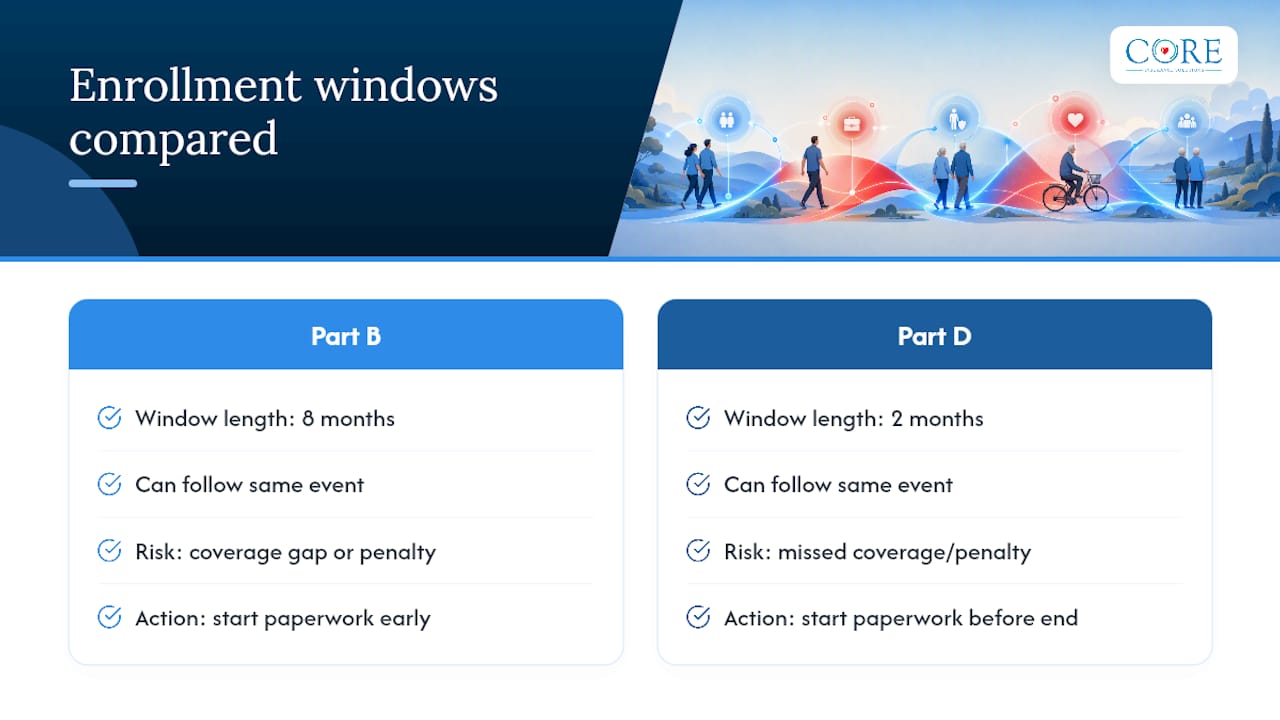
The conventional advice to “act quickly” isn’t wrong, but it’s incomplete. What actually protects you is knowing which specific window applies to which specific part of your coverage, and getting your employer’s paperwork moving before your coverage even ends, not after. Readers who treat CMS-L564 coordination as a last-minute task are the ones who end up with an accidental coverage gap or a penalty that follows them for years.
If there’s one priority to take from all of this, it’s date discipline over general urgency. Know your event date, know which window it opens, and get documentation moving early enough that a slow HR department or a lost form doesn’t cost you money for the rest of your Medicare coverage.
— Core Insurance Solutions
Get Local Help With Your Medicare Special Enrollment Period
Figuring out which SEP applies to your situation, and proving it with the right paperwork, is the kind of work this firm handles for families in various communities across Central Florida. Unlike national call centers, a local advisor reviews your coverage history and event date, then compares plans across major carriers impartially.

That local, unbiased comparison matters most when your SEP window is short and you can’t afford a wrong plan pick to cost you a permanent Part D penalty. If you’re not sure where to start, the free Medicare 101 webinar walks through enrollment basics at your own pace, or you can go straight to a review of Medicare plans and services available in your area. Either way, reach out before your window closes, not after.
This article is general information, not a substitute for advice from a qualified financial advisor. Consult a qualified financial professional about your own circumstances before acting on anything here.
Sources
- Special Enrollment Periods | Medicare
- Working past 65 | Medicare
- CMS CY 2026 Enrollment and Disenrollment Guidance (PDF)
- What are the Medicare Special Enrollment Periods? | NCOA


