

Avoid a 10% Per Year Penalty: Medicare Part B Enrollment for U.S. 65+
If you’re turning 65 and don’t have employer group health coverage, sign up for Medicare Part B during your Initial Enrollment Period. If you’re still working under a qualifying employer plan, you can usually delay without penalty until that coverage ends. Miss your window without a valid Special Enrollment Period, and you’ll pay a permanent late penalty. Apply now at SSA.gov or call 1-800-772-1213.
TL;DR:
- Enrollment during the initial period is crucial; signing up early ensures coverage begins on your 65th birthday month and avoids penalties.
- Special Enrollment Periods apply only if you have current employer coverage; waiting to end that coverage allows enrollment without penalties within eight months.
- Missing these windows means waiting for the General Enrollment Period with delayed coverage and a 10% penalty for each year of delay on your premium.
- Automatic enrollment occurs if you collect Social Security benefits, but active opt-out is necessary if you have qualifying employer coverage.
- Income-based adjustments and programs like Medicare Savings can help cover Part B costs for eligible low-income individuals.
Core Insurance SolutionsGet Clear on Your Medicare TimelineCore Insurance Solutions provides personalized Medicare guidance, helping seniors compare options based on their health needs and medical history.Explore Medicare guidance
Table of Contents
- Medicare Part B Enrollment Windows: IEP, SEP, and GEP Explained
- Who’s Eligible for Part B, and What Are the Exceptions?
- How to Sign Up for Part B: Forms, Steps, and What to Bring
- When Does Medicare Part B Coverage Actually Start?
- Part B Costs, IRMAA, and Programs That Can Cover Your Premium
- Missed the Deadline? Your Options Under the General Enrollment Period
- Forms and Contacts to Keep on Hand
- How Core Insurance Solutions Helps With Part B Enrollment
- An Agent’s Checklist: Three Mistakes That Cost Real Money
- Get Help With Your Part B Enrollment Timeline
- Sources
- FAQ
Medicare Part B Enrollment Windows: IEP, SEP, and GEP Explained
Three separate windows govern Medicare Part B enrollment, and picking the wrong one is the single most common enrollment mistake. Your Initial Enrollment Period (IEP) runs seven months: three months before your birthday month, your birthday month itself, and three months after. When you sign up inside that window changes when coverage actually starts.
The Special Enrollment Period (SEP) applies if you’re still working past 65 and covered by a current employer’s group health plan. You get eight months to enroll after that coverage or the employment ends, whichever comes first, without a late penalty.
Miss both, and you’re stuck waiting for the General Enrollment Period (GEP), which runs January 1 through March 31 every year.
- IEP: applies to almost everyone turning 65; enroll early in the window for coverage that starts right on time.
- SEP: applies only if you have current employer coverage, not retiree or COBRA plans.
- GEP: the fallback window, but it usually means months without coverage and a penalty on top.
Who’s Eligible for Part B, and What Are the Exceptions?
Most people qualify at 65 if they’re a U.S. citizen or a permanent legal resident who’s lived in the country continuously for at least five years. If you already collect Social Security or Railroad Retirement Board benefits, the Social Security Administration enrolls you in Part B automatically, and you’ll get a Medicare card in the mail roughly three months before you turn 65.
You can decline that automatic enrollment if you have qualifying employer coverage, but you have to actively opt out using the instructions on the card.
- People under 65 with certain disabilities qualify after 24 months of Social Security Disability Insurance payments.
- ALS and end stage renal disease cases follow different, faster timing rules.
- Puerto Rico residents are not automatically enrolled even if they receive Social Security, so they must actively sign up.
A retiree in Winter Haven who turned 65 last spring and already drew Social Security got her card automatically. A Bartow resident still working past 65 under his employer’s plan had to decline it on purpose to avoid double coverage he didn’t need yet.
How to Sign Up for Part B: Forms, Steps, and What to Bring
You have three ways to apply: online through the Social Security Administration’s website, by phone at 1-800-772-1213, or by mailing or faxing paper forms to your local Social Security office. Which form you need depends on your situation. Use CMS-40B (Application for Enrollment in Medicare Part B) if you already have Part A and just need to add Part B. If you’re applying through a Special Enrollment Period because employer coverage ended, submit CMS-L564 (Request for Employment Information) alongside it, with your employer completing the section verifying your coverage dates.
Here’s the checklist by situation:
- Turning 65, not yet collecting Social Security: Apply online at SSA.gov 3 months before your birthday month, or call to schedule an appointment.
- Still working with employer coverage: Wait until coverage ends, then file CMS-40B and CMS-L564 together within your 8-month SEP window.
- Already lost coverage and past the deadline: You’ll need the General Enrollment Period; gather documentation now while you wait.
Have proof of age, your Social Security number, and, if applicable, your employer’s exact coverage end date ready before you start.
When Does Medicare Part B Coverage Actually Start?
Coverage start dates hinge entirely on when inside your window you enroll. If you sign up any time during the three months before your birthday month, coverage begins the month you turn 65. Enroll during your birthday month or in the three months after, and coverage starts the following month instead.
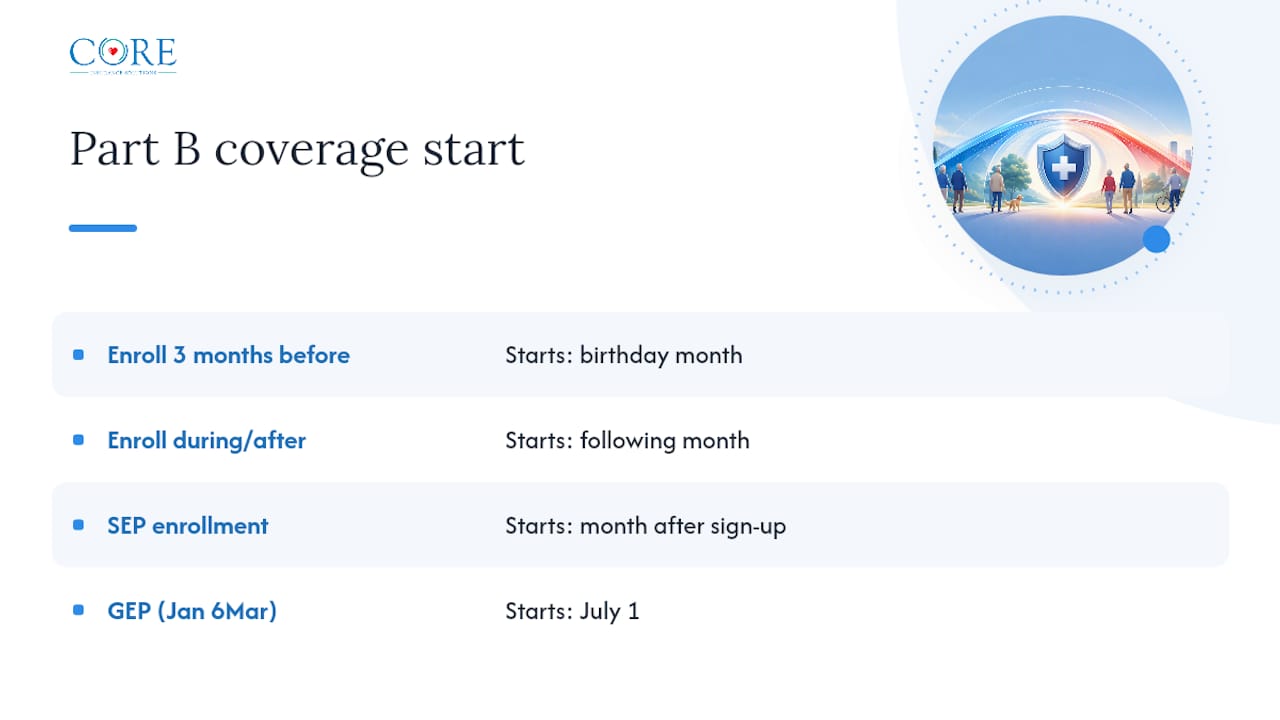
SEP enrollments generally start the month after you sign up. GEP enrollments, by contrast, typically don’t start until July 1, months after you applied in the January to March window. A Lakeland retiree who applied in February during her birthday month got coverage in March. Someone who waited until the GEP the following spring didn’t get covered until summer.
Part B Costs, IRMAA, and Programs That Can Cover Your Premium
The standard monthly Part B premium is $202.90 for most beneficiaries in 2026. That figure isn’t universal, though. Higher earners pay more through the Income-Related Monthly Adjustment Amount, or IRMAA, which scales the premium up based on your reported income from two years prior. If your income dropped since then due to a life-changing event like retirement or divorce, you can request an IRMAA adjustment directly through Social Security rather than overpaying while you wait for the next tax cycle to catch up.
If the premium itself is a strain, Medicare Savings Programs (QMB, SLMB, and QI) can cover it entirely for people who meet income and resource limits set by their state. Applications go through your state’s Medicaid office, not Social Security.
- QMB covers the widest range of costs, including premiums, deductibles, and coinsurance.
- SLMB and QI cover Part B premiums only, with slightly higher income limits.
- Even if your income looks slightly too high on paper, apply anyway. States calculate resources differently, and the only way to know for certain is to submit the application.
Core Insurance Solutions’ Part B penalty calculator can help you estimate what you’d owe if you’re weighing enrollment timing against a possible penalty.
Missed the Deadline? Your Options Under the General Enrollment Period
If you missed your IEP and don’t qualify for an SEP, you’re waiting for the GEP (January 1 to March 31), with coverage typically starting July 1. The penalty adds up during that gap: your premium rises 10% for every full 12 month period you were eligible but didn’t enroll, and it’s permanent for as long as you carry Part B.
Valid SEPs require proof, usually an employer letter stating your last coverage date and CMS-L564. Retiree plans and COBRA don’t count as current employment coverage, a mix-up that trips up a lot of people who assume any coverage protects their enrollment rights.
- Collect your employer’s dated statement now, even if you’re not sure you’ll need it.
- Run the numbers through a penalty calculator before assuming GEP is your only path.
Pro Tip: If your SEP claim gets denied, an agent who handles this daily can often spot the documentation gap faster than a second call to Social Security.
Forms and Contacts to Keep on Hand
Save these before you need them: CMS-40B adds Part B to existing Part A coverage; CMS-L564 verifies employer coverage for SEP claims; CMS-40B PDF is available directly through CMS.gov. Keep proof of age, your employer’s coverage end letter, and marriage or citizenship records together in one folder. Call Social Security at 1-800-772-1213 or use their office locator for in-person help.
How Core Insurance Solutions Helps With Part B Enrollment
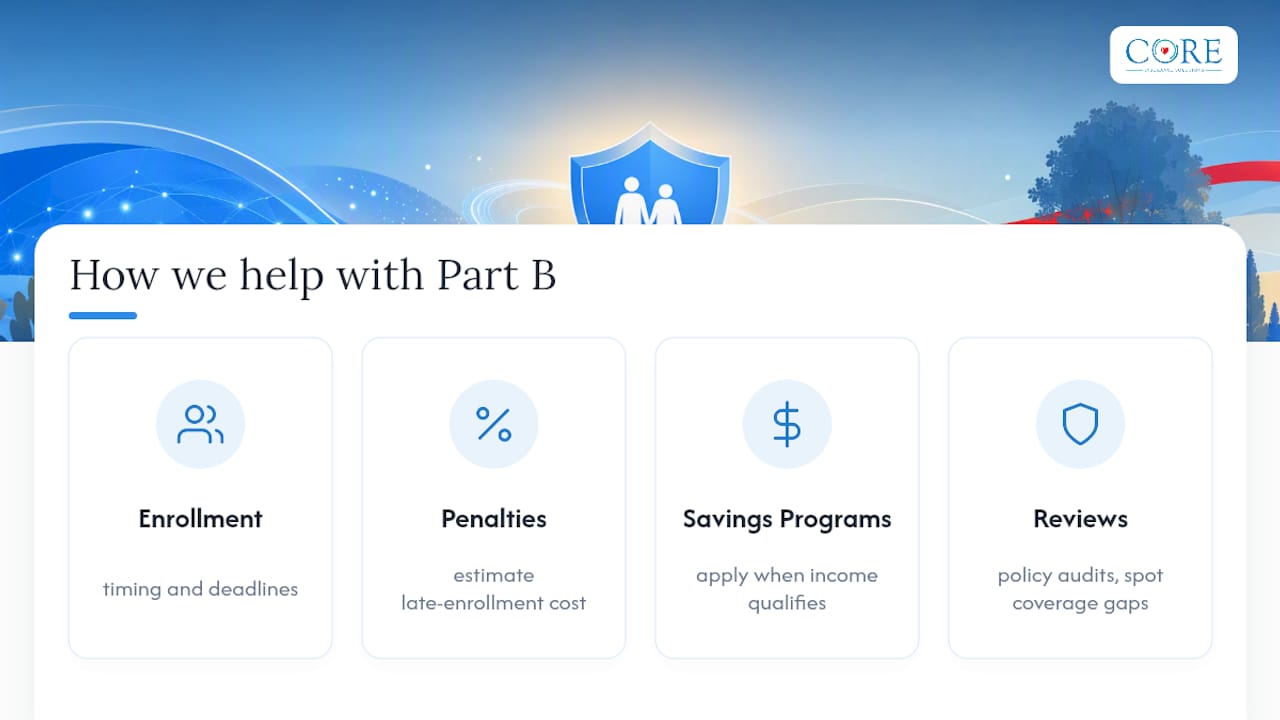
Some local agencies help seniors sort through enrollment timing, run penalty estimates, and apply for Medicare Savings Programs when income qualifies. Experienced agents may guide families through Medicare decisions, including annual policy audits that catch coverage gaps before they become expensive. If your situation involves an unusual SEP, a possible IRMAA dispute, or you want a second set of eyes before you submit paperwork, a conversation with an agent can save time and money.
An Agent’s Checklist: Three Mistakes That Cost Real Money
The mistake I see most often: someone assumes their COBRA or retiree plan counts as active employer coverage, then finds out during a claim denial that it never qualified for an SEP. Second most common: missing the 8-month SEP window by a matter of weeks. Third: never appealing IRMAA after a retirement income drop, even when they clearly qualify.
Call Social Security, pull your employer coverage letter, and run a penalty check before you assume you’re stuck.
— Core Insurance Solutions
Get Help With Your Part B Enrollment Timeline
Figuring out whether you’re in an IEP, SEP, or scrambling toward a GEP deadline is confusing enough without also weighing IRMAA brackets and Medicare Savings Program eligibility on your own. Some services provide seniors a direct line to someone who checks your specific dates, runs your penalty exposure, and tells you plainly whether you need to act this month or can wait.

If you want the fundamentals first, watch the free Medicare 101 webinar replay to see how enrollment, costs, and coverage fit together before you apply. If you already know your dates and just need help mapping them out, use the Medicare enrollment timeline tool to see exactly when your coverage would start. When your situation involves more than a straightforward IEP sign-up, contact Core Insurance Solutions and schedule a consultation before your window closes.
This article is general information, not a substitute for advice from a qualified doctor. Consult a qualified healthcare professional about your own circumstances before acting on anything here.
Sources
FAQ
Is It Mandatory to Enroll in Medicare Part B?
No. Part B is optional, but declining it without qualifying employer coverage means you risk a permanent late penalty and a gap in coverage until the next General Enrollment Period.
How Long Does It Take to Start Medicare Part B After Applying?
It depends on your window. IEP applications submitted before your birthday month typically start that same month, while SEP enrollments usually start the month after you apply.
Is There Any Way to Get Medicare Part B for Free?
Not entirely free, but Medicare Savings Programs like QMB, SLMB, and QI can cover your Part B premium if you meet your state’s income and resource limits.
Can I Choose Not to Enroll in Medicare Part B?
Yes, especially if you have qualifying current employer coverage, but if you delay without a valid Special Enrollment Period, you’ll face a lasting premium penalty once you do sign up.


