

Can You Have TRICARE and Medicare at the Same Time?
Yes. If you have Medicare Part A and Part B and you’re TRICARE-eligible, TRICARE For Life automatically wraps around Medicare with no application required. Medicare pays first for care received in the U.S. and U.S. territories, and TRICARE pays second, picking up most of what Medicare doesn’t cover.
Here’s what that means in practice:
- TRICARE For Life (TFL) starts the moment both Medicare Part A and Part B become active. No paperwork, no waiting period.
- You must keep paying your Part B premium. Drop it, and you lose TRICARE eligibility in most cases.
- For services both programs cover, out-of-pocket costs are often minimal, sometimes zero.
- Overseas, the order flips: TRICARE becomes primary since Medicare doesn’t operate outside the U.S. and its territories.
Key Takeaways
TRICARE For Life works because it pairs automatically with Medicare Part A and Part B, letting Medicare pay first and TRICARE cover most of what remains.
| Point | Details |
|---|---|
| TFL is automatic | Coverage begins the day both Medicare Part A and Part B are active, no application needed. |
| Medicare pays first domestically | TRICARE pays second in the U.S. and territories; the order flips overseas. |
| Keep Part B active | Dropping Part B typically ends TRICARE eligibility and triggers a permanent premium penalty if delayed. |
| Skip redundant coverage | TRICARE Pharmacy Program often makes Part D unnecessary; check before adding either. |
| Get a personalized review | Core Insurance Solutions offers annual audits and claims advocacy for retirees coordinating TRICARE and Medicare. |
This article is general information, not a substitute for advice from a qualified financial advisor. Consult a qualified financial professional about your own circumstances before acting on anything here.
Table of Contents
- What TRICARE For Life Covers and Who Qualifies
- How Medicare and TRICARE Coordinate Payments
- When Should You Sign Up for Medicare Part A and Part B?
- Should You Choose Medicare Advantage or Stick With Original Medicare?
- What Happens to Coverage When You Live or Travel Overseas?
- How Do You Avoid Costly TRICARE and Medicare Mistakes?
- How Do You File a TRICARE Claim and Who Do You Call?
- What Retirees Consistently Get Wrong About This Coordination
- Get a Personalized Review of Your TRICARE and Medicare Coverage
- Sources
What TRICARE For Life Covers and Who Qualifies
TFL isn’t a plan you sign up for. It’s an entitlement that switches on automatically the first day you have both Medicare Part A and Part B active, according to TRICARE’s own program description. There’s no enrollment form, no premium beyond what you already pay for Part B, and no separate ID card process to worry about.
Eligibility is individual, not household. If you’re a retiree turning 65 but your spouse is 62, your spouse doesn’t get TFL yet. They’ll stay on whatever TRICARE plan fits their situation, TRICARE Select in most cases, until they hit their own Medicare eligibility.
A few things worth knowing about how coverage plays out:
- Coverage differences can exist depending on your sponsor’s branch of service, so checking the TRICARE handbook and Medicare.gov directly is smarter than relying on secondhand advice.
- TFL travels with you. It’s active regardless of which state you retire to, including here in Florida.
- If you remarry after your first spouse’s death, eligibility rules for a new spouse can differ. That’s worth a direct conversation with a TRICARE representative.
How Medicare and TRICARE Coordinate Payments
Think of it as a two-step relay coordinating benefits through effective care coordination principles. Medicare processes the claim first. Whatever Medicare doesn’t pay, TRICARE picks up second, assuming the service is TRICARE-covered too. When both programs cover a service, you often end up with little to no bill. When only Medicare covers something TRICARE doesn’t (or vice versa), you’re responsible for whatever gap remains.
Provider type matters more than most retirees realize. Here’s the breakdown:
- Medicare-participating providers accept Medicare’s approved amount as full payment, which keeps your costs predictable and the TFL wraparound working smoothly.
- Non-participating providers can charge up to 15% more than Medicare’s approved amount (the “limiting charge”), and TRICARE may not cover the full difference.
- Opt-out providers don’t bill Medicare at all. If you see one, Medicare pays nothing, and TRICARE only pays what it would have paid had Medicare processed the claim. You could be on the hook for a private-contract rate well above either program’s usual payment.
The claims flow itself is largely hands-off. Providers submit to Medicare, Medicare adjudicates, then forwards the claim to WPS, TRICARE’s contractor for TFL, for secondary processing. In most domestic situations, you never touch a claim form.
Pro Tip: Before scheduling a procedure with a new provider, ask directly whether they’re Medicare-participating. It takes one phone call and can save you hundreds of dollars.
When Should You Sign Up for Medicare Part A and Part B?
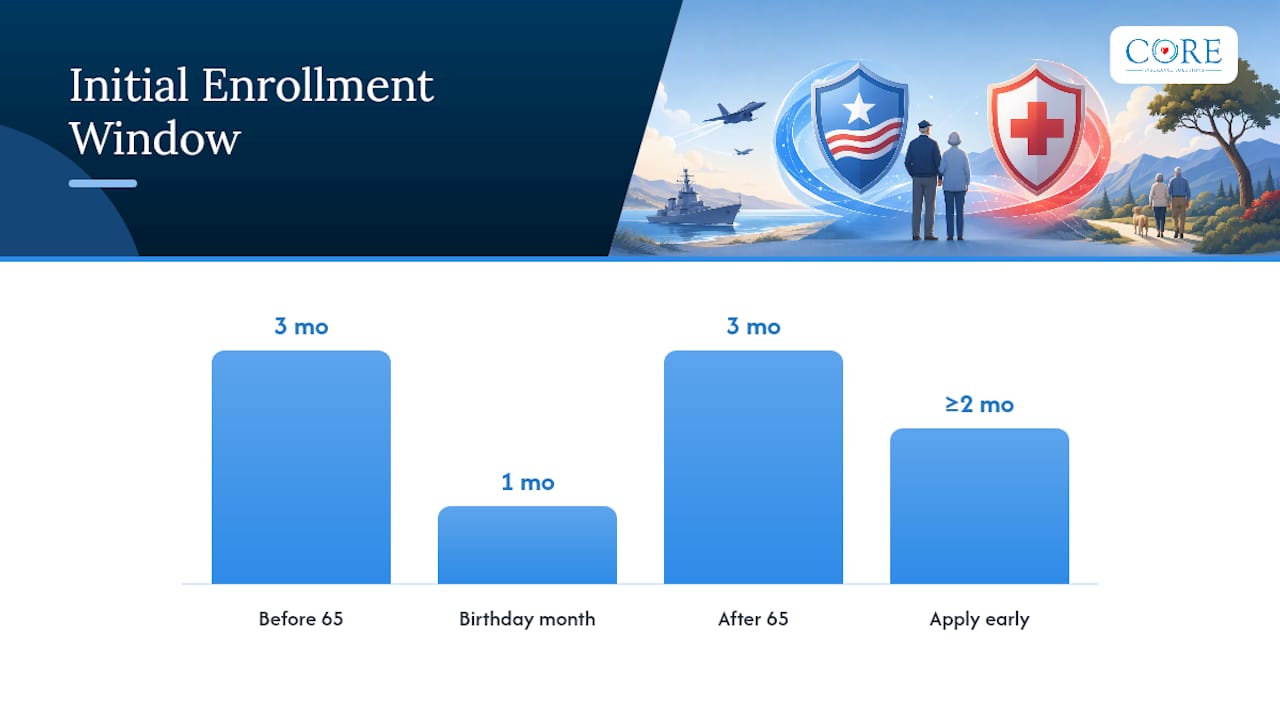
Timing here isn’t flexible if you want to avoid penalties and coverage gaps. Your Initial Enrollment Period runs three months before your 65th birthday month, through that month, and three months after, seven months total. Retirees should aim to apply at least two months before turning 65 to avoid a gap between your birthday and your effective coverage date.
Some situations shift the timeline:
- If you’re still working and covered by an employer group plan when you turn 65, you may qualify for a Special Enrollment Period once that employment or coverage ends, without facing the usual late penalty.
- Active-duty family members transitioning to retiree status have their own timing considerations tied to the sponsor’s retirement date.
- TRICARE requires Part B for most beneficiaries eligible for premium-free Part A, and delaying it means delaying TFL eligibility too.
Miss your window without a qualifying Special Enrollment Period, and Medicare can add a late enrollment penalty to your Part B premium for as long as you have Part B, on top of losing TRICARE coverage during the gap. A Medicare eligibility calculator can help you pin down your exact enrollment window before it sneaks up on you.
Should You Choose Medicare Advantage or Stick With Original Medicare?
This is where a lot of retirees run into trouble without realizing it. TFL is built to wrap around Original Medicare automatically. Enroll in a Medicare Advantage plan instead, and you’re stepping outside that automatic system.
- Medicare Advantage plans often use provider networks, which can conflict with TRICARE’s own network rules and complicate who pays what.
- Copays under Medicare Advantage sometimes require you to file a manual claim with TRICARE for reimbursement, rather than the usual behind-the-scenes coordination.
- TRICARE’s own program guidance notes that replacing Original Medicare with Advantage can disrupt the seamless secondary-payer process TFL relies on.
On the prescription side, the TRICARE Pharmacy Program, run through Express Scripts, already covers most retirees adequately. Medicare Part D is often redundant for TFL beneficiaries, though it can be worth adding if you take specialty medications not well covered under TRICARE’s formulary. Before adding either Medicare Advantage or Part D, weigh the extra premium against what you’re actually gaining, since layering supplemental coverage on top of TFL sometimes just means paying twice for the same protection.
What Happens to Coverage When You Live or Travel Overseas?
Medicare’s coverage stops at the U.S. border, aside from a few narrow exceptions. Once you’re overseas, TRICARE becomes your primary payer, but you still need to keep Part B active to remain TRICARE-eligible at all.
A few practical rules to keep in mind:
- If you carry employer-sponsored other health insurance (OHI) alongside Medicare and TRICARE, that OHI typically pays first, Medicare second, TRICARE last.
- Overseas providers usually expect payment up front. You’ll pay out of pocket, then file a claim with TRICARE for reimbursement.
- TRICARE recommends filling prescriptions before you travel since overseas pharmacies often require cash payment and a separate reimbursement claim.
- Reimbursement claims have deadlines, so keep every receipt and file promptly rather than waiting until you’re back home.
How Do You Avoid Costly TRICARE and Medicare Mistakes?
Most of the expensive mistakes retirees make with dual eligibility are avoidable with a little upkeep. Here’s a practical checklist:
- Keep your DEERS record current. An outdated address or family status entry is one of the most common reasons claims get delayed or denied.
- Enroll in Part B on time. A missed window costs you both a permanent premium penalty and a gap in TRICARE eligibility.
- Think twice before buying a Medigap policy. Since TFL already covers most of Original Medicare’s cost-sharing gaps, additional Medigap coverage is often unnecessary, though it may help if you travel extensively or want broader provider access.
- Save every Medicare Summary Notice (MSN), itemized bill, and explanation of benefits (EOB). You’ll need them if a claim gets stuck.
Pro Tip: Set a calendar reminder every January to review your prescription list against your current plan’s formulary. Drug costs shift year to year, and a quick check can catch overpayments before they add up.
Core Insurance Solutions has helped more than 2,000 families in the Lakeland, Winter Haven, and Auburndale area sort through exactly these decisions, with a holistic health needs assessment, annual policy audits, and direct claims advocacy when something goes sideways.

How Do You File a TRICARE Claim and Who Do You Call?
Most domestic claims never require your involvement. When one does, keep your itemized bill, MSN, and any OHI EOBs on hand and send them to WPS, the TFL contractor, using the address on your MSN.
Useful contacts:
- Medicare: 1-800-MEDICARE (1-800-633-4227)
- TRICARE For Life / WPS: check current claims-filing instructions at tricare.mil
- Social Security (Medicare enrollment): ssa.gov or your local SSA office
- DEERS support: 1-800-538-9552
Processing typically takes a few weeks once Medicare forwards the claim. Delays usually trace back to outdated DEERS information or a provider that isn’t Medicare-participating.
What Retirees Consistently Get Wrong About This Coordination
The biggest misconception is treating TRICARE For Life as something you have to manage actively. It isn’t. The entire design assumes you’ll keep Part B current and let the two systems talk to each other in the background.
Where retirees actually lose money is in overcorrecting: buying a Medigap policy out of habit, adding Part D without checking their existing pharmacy benefit first, or switching to Medicare Advantage because a commercial feels compelling, without realizing it trades an automatic system for a manual one. None of that is reckless. It’s just decision-making without the full picture of how TFL already works.
The fix isn’t more caution. It’s a second set of eyes that knows the coordination rules cold.
Get a Personalized Review of Your TRICARE and Medicare Coverage
Core Insurance Solutions helps retirees across Lakeland, Winter Haven, Auburndale, and Plant City sort through exactly the decisions covered above, without pushing a plan that doesn’t fit. Every review starts with a look at your actual health needs and prescriptions, not a generic sales pitch.

That means catching whether Part D is actually worth its premium given your current medications, confirming your DEERS information matches your Medicare enrollment, and stepping in as your advocate if a claim gets stuck between Medicare and the TFL contractor. Annual policy audits are built into the relationship, so a plan that fit you well at 65 doesn’t quietly become the wrong fit at 70 without anyone noticing.
If you want the full picture before your enrollment window closes, watch the free Medicare 101 webinar or check your exact dates against the Medicare enrollment timeline to see where you stand right now.
Sources
- TRICARE For Life | TRICARE
- Q&A: How Does TRICARE For Life Work With Medicare? | TRICARE Newsroom
- Medicare


