

U.S. Seniors: How to Disenroll From Medicare Advantage Without a Gap
You can disenroll from Medicare Advantage during the Annual Enrollment Period (October 15 to December 7), the Medicare Advantage Open Enrollment Period (January 1 to March 31), or a qualifying Special Enrollment Period. The safest move is to enroll in your replacement coverage first rather than simply canceling, since joining a new plan typically ends the old one automatically. Always get a confirmation number and written effective date before you stop using your current plan.
TL;DR:
- Enroll in your new Medicare coverage before canceling your current plan to automatically end the old plan and avoid coverage gaps.
- You must act within specific windows, such as the annual enrollment from October 15 to December 7 or the Medicare Advantage open enrollment from January 1 to March 31, to ensure your request takes effect on time.
- Confirm your enrollment request by obtaining a written receipt, a confirmation number, and the exact effective date, and verify these details within a week or two.
- Leaving Medicare Advantage triggers the need to enroll in a separate Part D plan and may require applying for Medigap within 63 days of coverage ending to avoid medical underwriting.
- Avoid common mistakes like neglecting to use accepted forms of disenrollment, assuming provider directories are current, or letting drug coverage lapse, which can result in penalties or coverage issues.
Core Insurance SolutionsMake Your Medicare Change With ConfidenceCore Insurance Solutions provides personalized Medicare guidance, plan comparisons, prescription cost assistance, and claims advocacy for seniors in Lakeland.Explore Medicare guidance
Table of Contents
- Quick Checklist: What to Do Now to Drop Your Medicare Advantage Plan
- When Can You Actually Disenroll? Enrollment Windows Explained
- How to Disenroll From Medicare Advantage Step by Step
- What Happens After You Disenroll: Medicare, Part D, and Medigap
- Common Pitfalls When Dropping a Medicare Advantage Plan
- Where to Get Help With Medicare Disenrollment
- What Local Advisors See During Disenrollment Season
- How Core Insurance Solutions Makes Disenrollment Safer
- Sources
- FAQ
Quick Checklist: What to Do Now to Drop Your Medicare Advantage Plan
Before you touch the phone or a form, gather your paperwork. Pull your plan ID card, your Evidence of Coverage, a full medication list with dosages, and the names of your doctors and pharmacies. You’ll need all of it to compare replacement coverage accurately.
Next, decide where you’re headed: Original Medicare plus a standalone Part D plan, a Medigap policy if you qualify, or a different Medicare Advantage plan. Each path has its own enrollment window, so confirm which one applies to your situation before submitting anything.
- Collect your plan ID, Evidence of Coverage, medication list, and provider/pharmacy details
- Choose your replacement coverage and confirm which enrollment window applies to you
- Submit the correct enrollment or disenrollment request and ask for written confirmation
- Verify your effective date before using your old plan and file every document you receive
Pro Tip: Take a photo of your plan card and Evidence of Coverage cover page before you start the process. If a dispute ever comes up about what plan you had and when, you’ll have a timestamp to back you up.
When Can You Actually Disenroll? Enrollment Windows Explained
Every disenrollment has to happen inside a defined window. Miss it, and you may be stuck until the next one opens.
Annual Enrollment Period (AEP), October 15 to December 7. This is the big one. You can drop your Medicare Advantage plan, switch to a different MA plan, move to Original Medicare, or change your Part D coverage. Any change made during this stretch takes effect January 1 of the following year, and Medicare.gov confirms that changes must reach the plan by December 7 to hit that January 1 start date.
Medicare Advantage Open Enrollment Period (MA OEP), January 1 to March 31. If you’re already enrolled in an MA plan, you get a second shot here. You can switch to another Medicare Advantage plan or return to Original Medicare, generally with coverage starting the first day of the month after the plan receives your request. This window does not let you move from Original Medicare into an MA plan, and it does not apply if you’re not already in Medicare Advantage.
Special Enrollment Periods (SEPs). Life events trigger these outside the standard calendar. Moving to a new service area, losing employer or other creditable coverage, gaining Medicaid or Extra Help, or entering or leaving an institution like a nursing facility all qualify. Timing varies by trigger. Someone leaving an institutional setting gets the SEP window plus two full months after departure, for example.
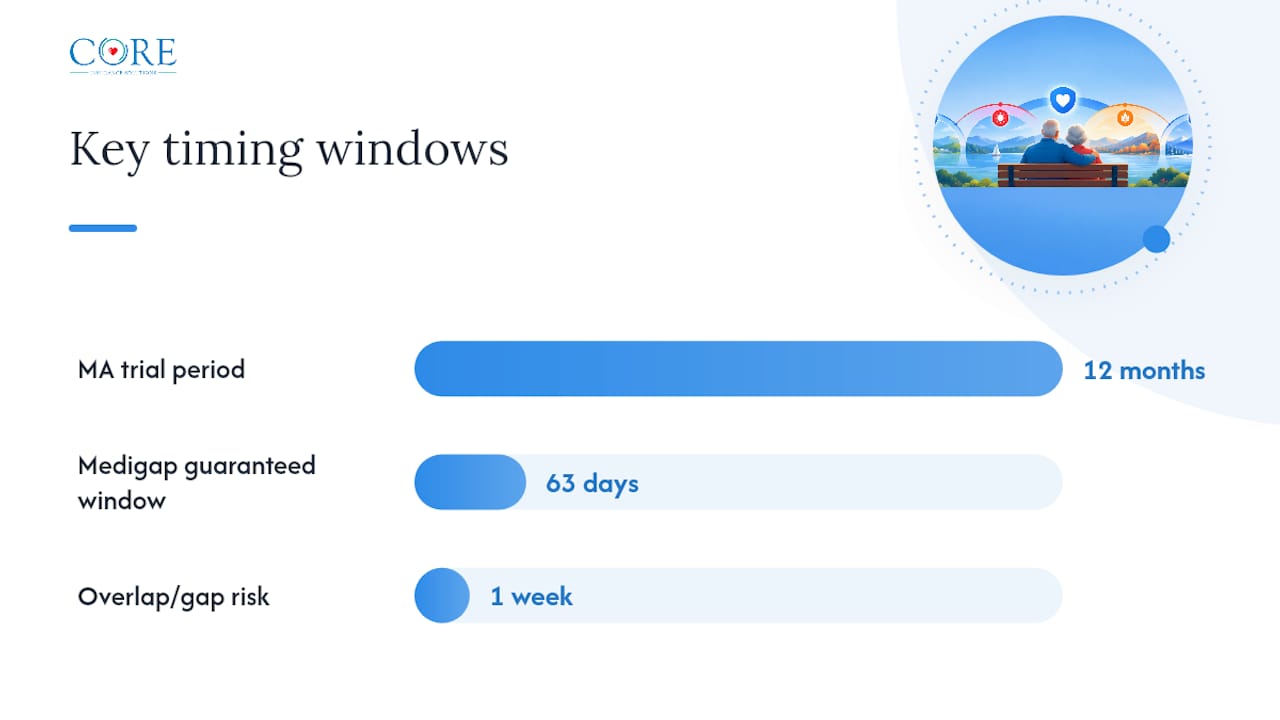
Initial Enrollment Period trial rights. If you’re new to Medicare and picked an MA plan during your Initial Enrollment Period, you get a 12-month trial right to switch back to Original Medicare with guaranteed-issue Medigap protection.
One thing worth repeating: plans and CMS determine which election period applies to your specific circumstances, and that determination can get complicated fast. Before you assume you qualify for a window, confirm eligibility directly with the plan or by calling 1-800-MEDICARE.
How to Disenroll From Medicare Advantage Step by Step
The order of operations matters more than most people realize. Enroll in your next plan before you do anything else. Joining new coverage typically ends your old Medicare Advantage plan automatically the day the new coverage begins, according to Medicare’s own guidance on switching plans. That sequence closes the gap risk almost entirely, because you’re never a day without active coverage.
Here’s the process broken into concrete steps:
- Confirm your window. Check whether you’re in AEP, MA OEP, or a documented SEP trigger before you contact anyone.
- Call 1-800-MEDICARE or your plan directly. Ask specifically for a confirmation number, the representative’s name, and the exact effective date of your change. Write all three down while you’re on the phone.
- Submit the transaction through an accepted channel. Plans generally accept a signed written notice, a faxed request, an online form through the plan’s member portal, or a plan-issued disenrollment form. A written notice can be as simple as: “I am requesting to disenroll from [Plan Name], Member ID [number], effective [date]. Please confirm receipt and effective date in writing.”
- Verify processing within a week or two. Call back or check your online account to confirm the request was logged with the effective date you expect.
- Escalate if records don’t match. If the plan or CMS shows a different effective date than what you were told, keep every receipt and confirmation number, then contact your State Health Insurance Assistance Program (SHIP) or CMS directly to sort out the discrepancy.
CMS guidance is explicit that an enrollment or disenrollment request has to be received during a valid election period, and it’s the plan’s job to determine which period applies and confirm the resulting effective date, which is usually the first of the month after the plan gets your request.
A couple of special cases deserve a mention. If you’re leaving Medicare Advantage because you’re picking up employer-sponsored group coverage, that transaction usually routes through your employer’s benefits office as well as the plan, so loop in HR early. Involuntary disenrollments, such as a plan losing its CMS contract or leaving your service area, are processed by the plan and CMS automatically, and you’ll receive a notice with your options and deadlines rather than needing to initiate anything yourself.
One number worth knowing: gaps in creditable drug coverage lasting 63 days or more can trigger a Part D late-enrollment penalty that follows you for as long as you have Part D coverage. That’s the single biggest reason to sequence your new enrollment before finalizing the old one’s end date.
What Happens After You Disenroll: Medicare, Part D, and Medigap
Dropping Medicare Advantage doesn’t leave you uninsured. It shifts you back into Original Medicare (Part A and Part B), but Original Medicare doesn’t include drug coverage on its own. You’ll need to enroll in a standalone Part D prescription drug plan separately, and the timing matters just as much here as it did for the disenrollment itself.
Medigap is where things get genuinely tricky, and it’s the part most people misunderstand. Leaving Medicare Advantage does not automatically hand you the right to buy a Medigap policy. Guaranteed-issue rights, the protection that stops an insurer from denying you or charging more for pre-existing conditions, only apply in specific situations:
- You’re using your 12-month trial right after first joining an MA plan
- Your Medicare Advantage plan is leaving Medicare or your service area
- Your plan is being terminated by CMS
In these guaranteed-issue situations, you typically need to apply for a Medigap policy within 63 days after your old coverage ends. Miss that window, and insurers in most states can require medical underwriting, which means they can deny you coverage or charge substantially more based on your health history.
Medigap rules also vary by state. A handful of states offer broader guaranteed-issue protections than federal law requires, so it’s worth a call to your State Insurance Department or a SHIP counselor to confirm what applies where you live in Florida.
The coordination piece is simple in concept but easy to fumble in practice: line up your Medigap policy’s start date with the exact day your Medicare Advantage coverage ends. A one-week overlap or gap can mean paying two premiums or, worse, having no supplemental coverage during a medical event. If you’re weighing this move, our guide on switching from Medicare Advantage to Medigap walks through the documentation this transition typically requires.
Common Pitfalls When Dropping a Medicare Advantage Plan
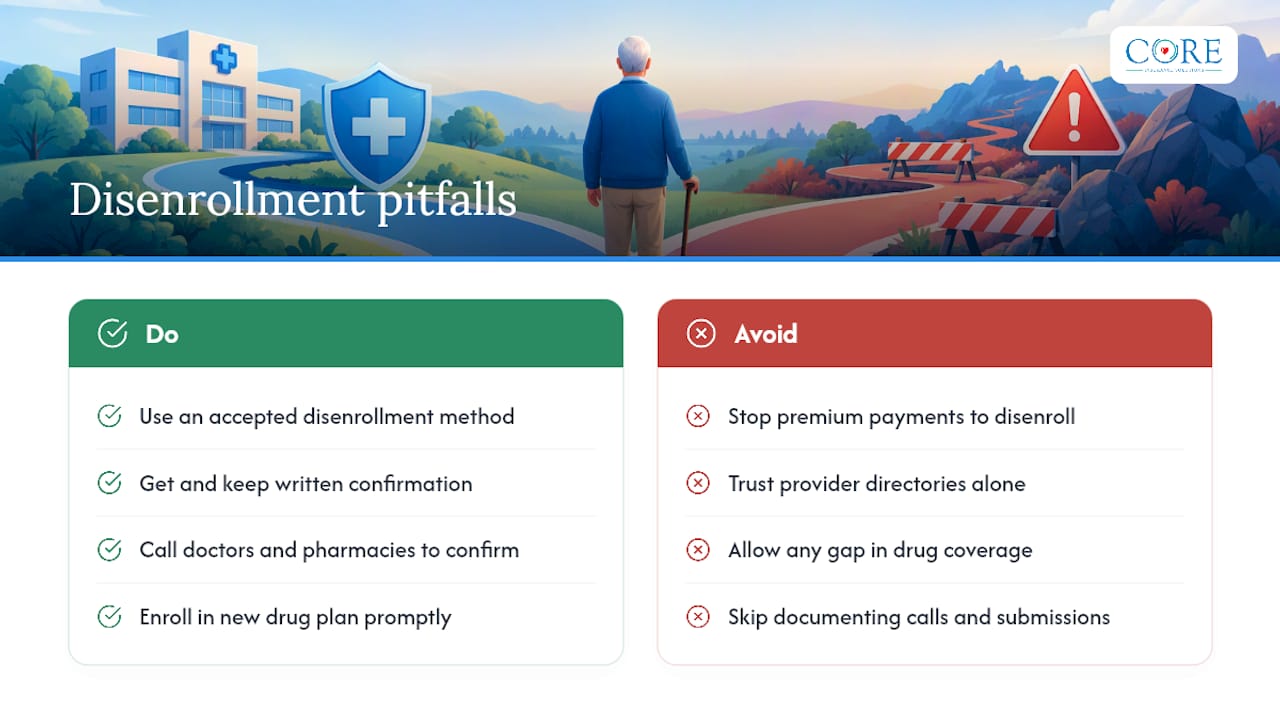
The single most common mistake is thinking that stopping premium payments counts as disenrolling. It does not. CMS guidance is clear that ignoring your bill or letting the plan lapse isn’t a valid disenrollment transaction. It just puts you at risk of collections calls and a coverage dispute down the road, since the plan’s system may still show you as an active member. Always use one of the accepted transaction methods and get it documented.
The second mistake is assuming provider directories are current. Networks shift throughout the year, and a doctor listed as in-network in January may not be by June. Call your specific doctors and pharmacies directly to confirm they’ll accept your new plan before you finalize anything, rather than trusting a directory search alone.
Third, don’t let your drug coverage lapse while you’re sorting out the rest. Even a short gap without creditable coverage adds up against the 63-day threshold that triggers a Part D penalty, so enroll in your new drug plan as soon as your window opens rather than waiting until the last minute.
Build a transition file and keep it together: your Evidence of Coverage, a medication list with exact doses, any prior authorization paperwork, and the names of every representative you spoke with. If you end up submitting more than one request because you weren’t sure the first one went through, note the date of each submission. Plans and CMS often treat the most recently received request as the one that counts, so having your own timeline can resolve a dispute in minutes instead of weeks.
Pro Tip: Keep a simple notebook or phone note with the date, time, representative name, and confirmation number for every single call. It sounds excessive until the one time you need it.
Where to Get Help With Medicare Disenrollment
You don’t have to sort this out alone, and honestly, you shouldn’t try to for anything this important. Start with 1-800-MEDICARE for official confirmation of your options, and write down the representative’s name, the call reference number, and exactly what they told you about your effective date.
Your State Health Insurance Assistance Program (SHIP) offers free, unbiased counseling and can help interpret plan-specific rules or Medigap questions particular to Florida. If you’d rather sit down with someone local, bring these items to any advisor appointment:
- Your current plan ID card and Evidence of Coverage
- A complete medication list with dosages
- Names and locations of your preferred doctors and pharmacies
- Any recent prior authorization or claims paperwork
Online plan-comparison tools work fine for a first look at what’s available, but they can’t tell you whether a specific drug is covered at your exact dose or whether a specialist you see twice a year is genuinely in-network. That’s where a live conversation earns its keep.
What Local Advisors See During Disenrollment Season
Every enrollment season, we hear versions of the same story: someone assumed their cardiologist was still in-network, only to find out mid-year that the plan had quietly narrowed its provider list. Another common pattern involves a retiree who dropped Medicare Advantage for Original Medicare without lining up a Part D plan first, then got hit with an unexpected penalty months later.
Annual policy audits catch problems like these before they become expensive. Reviewing a client’s prescriptions against a plan’s formulary every year, not just at signup, has flagged coverage changes that would otherwise surface as a pharmacy counter surprise. A basic verification checklist, confirming provider status directly with the doctor’s office and cross checking every medication against the new plan’s formulary, resolves most of the risk before a switch is even finalized.
How Core Insurance Solutions Makes Disenrollment Safer
Reading through enrollment windows, effective-date rules, and Medigap deadlines on your own is doable, but it’s also where small mistakes turn into expensive ones. A local insurance solutions provider handles this transition process daily for families in the Lakeland and surrounding Polk County area, tailoring recommendations around your specific medications and providers rather than a generic plan comparison.

A first appointment starts with a Holistic Health Needs Assessment, reviewing current medications, preferred doctors, and health priorities before considering plan options. From there, an Unbiased Carrier Comparison shows how major carriers stack up for your situation, and Prescription Cost Optimization checks whether your drug costs could drop under a different formulary. If Medigap is involved, guaranteed-issue timing is reviewed to avoid missing deadlines. And after enrollment, annual policy audits and claims advocacy support can help if issues arise with claims or rates.
Bring your plan card, Evidence of Coverage, and medication list to that first conversation. Visit our services page to see the full scope of what we handle and schedule a consultation before your enrollment window closes.
— Core Insurance Solutions
Sources
Verify every date and rule directly with Medicare.gov and CMS enrollment guidance. Save a copy showing your specific effective date.
This article is general information, not a substitute for advice from a qualified financial advisor. Consult a qualified financial professional about your own circumstances before acting on anything here.
FAQ
Is It Hard to Disenroll From Medicare Advantage?
The process itself is straightforward. Call 1-800-MEDICARE or submit a signed written request to your plan, and most transactions get confirmed within days. The hard part is timing it correctly and lining up replacement coverage, which is where most people run into trouble.
Why Would Someone Disenroll From a Medicare Advantage Plan?
Common reasons include a doctor or specialist leaving the plan’s network, rising out-of-pocket costs, a formulary change that no longer covers a needed prescription, or moving out of the plan’s service area. Some people simply want the broader provider access that comes with Original Medicare plus a Medigap policy.
How Do I Terminate a Medicare Advantage Plan?
Call your plan or 1-800-MEDICARE and request disenrollment, or submit a signed written notice, faxed request, or online form through the plan’s portal. Get a confirmation number and written effective date before you stop using your old plan, since joining new coverage is usually what ends the old plan automatically.
Can I Drop My Medicare Advantage Plan and Go Back to Original Medicare?
Yes. You can do this during AEP (October 15 to December 7), the Medicare Advantage Open Enrollment Period (January 1 to March 31), or a qualifying Special Enrollment Period. Just remember to enroll in a standalone Part D plan separately, since Original Medicare doesn’t include drug coverage on its own.
What Documents Should I Keep After Disenrolling?
Keep your confirmation number, the representative’s name, your written effective date, a copy of any disenrollment form you submitted, and your new plan’s enrollment confirmation. A transition file with these documents plus your medication list resolves most disputes quickly if a date or coverage question comes up later.


