

Does Medicare Cover Hospice Care Costs and Services?
Yes. Medicare Part A covers hospice care for eligible beneficiaries who elect the hospice benefit, and most services tied to the terminal illness come at no cost. The tradeoff: electing hospice means choosing comfort-focused care and waiving curative treatment for that specific terminal condition. Once you make that election, Medicare Part A covers hospice care for as long as a doctor certifies you remain eligible.
- Nearly all hospice-related care, including nursing visits, medical equipment, and drugs for symptom control, is covered at no cost to the beneficiary.
- Small exceptions include a nominal copay for outpatient prescriptions and a small coinsurance for inpatient respite stays.
- Your Medicare Part A and Part B premiums keep running as usual. Hospice doesn’t replace them.
Key Takeaways
Medicare Part A covers hospice care at no cost for most terminal-illness-related services once a beneficiary formally elects the benefit.
| Point | Details |
|---|---|
| Eligibility trigger | Part A entitlement plus physician certification of a six-month terminal prognosis starts the clock. |
| Four levels of care | Routine home care handles most days; continuous, inpatient, and respite care cover crises and caregiver breaks. |
| Minimal out-of-pocket costs | Expect up to a $5 drug copay and 5% coinsurance for respite stays, with Part A and B premiums continuing. |
| Election is reversible | You can revoke hospice at any time and return to standard Medicare coverage immediately. |
| Local guidance available | Core Insurance Solutions offers a free Medicare 101 webinar and local consultations for Lakeland-area families weighing hospice decisions. |
Where to Verify These Details Directly
- Medicare
- CMS: Hospice payment policy
- MedPAC: Hospice payment basics
- Medicare hospice benefits booklet (PDF)
- SSA POMS HI 00601.295
This article is general information, not a substitute for advice from a qualified doctor. Consult a qualified healthcare professional about your own circumstances before acting on anything here.
Table of Contents
- What Does Medicare Cover for Hospice Care?
- Who Qualifies for the Medicare Hospice Benefit?
- What Are Your Costs Under Medicare Hospice Coverage?
- How Do You Find a Medicare-Approved Hospice Provider?
- What Rights Do You Have Once You Elect Hospice?
- How Core Insurance Solutions Helps Families Navigate Hospice Decisions
- Sources
What Does Medicare Cover for Hospice Care?
Hospice under Medicare covers a wide range of services built around one goal: comfort, not cure. That includes physician and nursing care, home health aide and homemaker services, physical and occupational therapy, speech-language pathology, medical social services, dietary counseling, and grief support for the family that continues after the patient dies. Medicare also pays for durable medical equipment, medical supplies, and prescription drugs for pain and symptom management related to the terminal diagnosis.
What surprises a lot of families is how care intensity flexes based on need. Medicare structures hospice into four distinct levels of care:
- Routine home care. The default level, delivered wherever the patient lives, whether that’s a private home, an assisted living community, or a nursing facility.
- Continuous home care. Reserved for short-term crises, when a patient needs primarily nursing care for extended hours to manage acute symptoms at home.
- General inpatient care. Used when symptoms can’t be controlled in a home setting and require short-term management in a hospital, hospice facility, or skilled nursing facility.
- Inpatient respite care. Gives exhausted family caregivers a break, capped at five consecutive days per benefit period.
Routine home care makes up the overwhelming majority of hospice days nationally, because most patients’ symptoms stay manageable without a facility stay. The other three levels exist for the moments when they don’t, and hospice teams can move a patient between levels as clinical needs shift over the course of care. One caveat worth flagging early: Medicare distinguishes between care related to your terminal illness and care for unrelated conditions. If you break your wrist while enrolled in hospice for heart failure, Original Medicare still covers that unrelated treatment, separate from your hospice benefit.
Who Qualifies for the Medicare Hospice Benefit?
Two things have to be true. First, you need Medicare Part A. Second, a hospice medical director and your regular doctor (if you have one) must certify that you have a terminal illness with a life expectancy of six months or less, assuming the disease runs its normal course. That certification isn’t a guess. It follows specific documentation standards laid out in the Social Security Administration’s POMS guidance on hospice coverage requirements.

Electing hospice means signing a formal election statement that names your chosen hospice, your effective date, and confirms you understand you’re choosing palliative care over curative treatment for the terminal condition. The hospice provider then has to file a Notice of Election (NOE) with Medicare, and timing matters here more than most families realize.
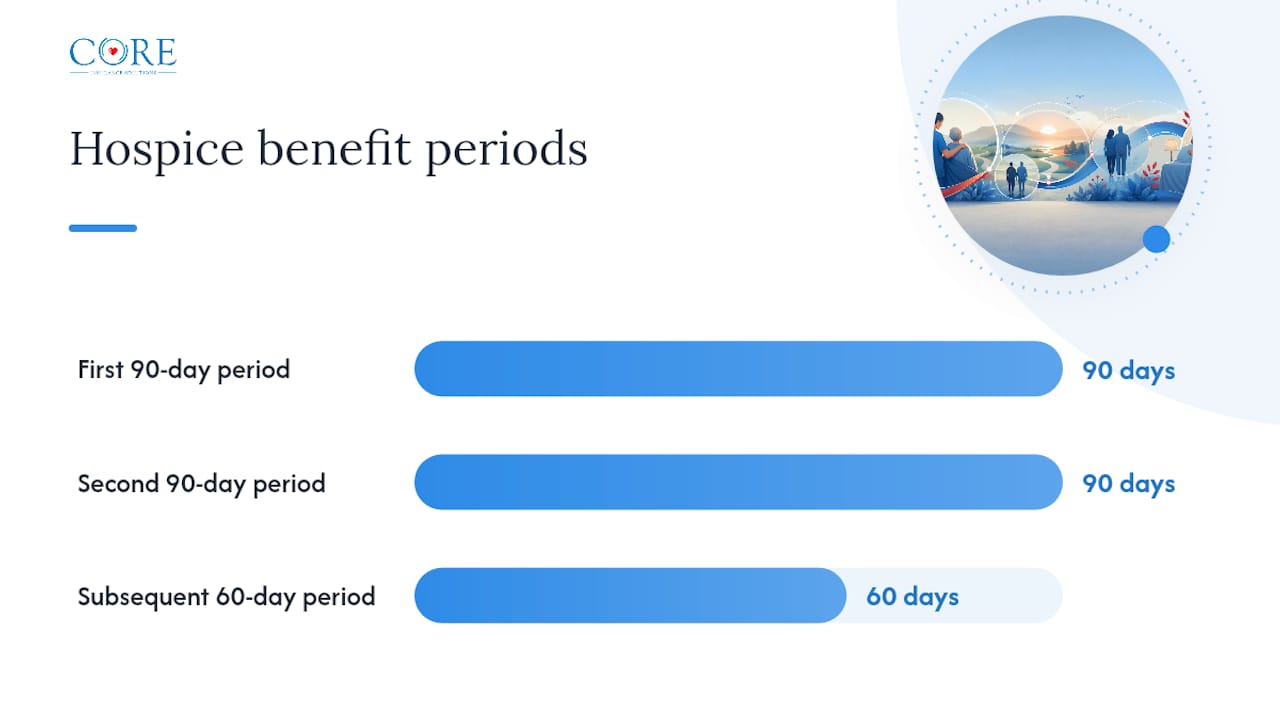
Coverage runs in benefit periods: two 90-day periods, followed by an unlimited number of 60-day periods, as long as your doctor recertifies your terminal prognosis at the start of each one. Recertification after the initial 180 days requires a face-to-face encounter between you and a hospice physician or nurse practitioner, a rule CMS added specifically to prevent long-term, indefinite enrollment without a clinical check-in.
- You can start hospice, stop it, and re-enroll later if your condition changes.
- The six-month prognosis doesn’t mean you’re discharged if you live longer. Recertification simply continues.
- Ask your hospice exactly which benefit period you’re entering and when the next recertification is due.
Pro Tip: Keep a copy of every election statement and certification date. If a dispute ever comes up about coverage timing, that paperwork trail is your fastest path to resolution.
What Are Your Costs Under Medicare Hospice Coverage?
The short version: almost nothing, if the care relates to your terminal illness and comes from a Medicare-approved hospice. That’s the entire design of the benefit. But “almost nothing” isn’t “nothing,” and knowing the exceptions saves you from an unwelcome bill.
- Prescription drugs: up to a $5 copay per outpatient prescription for pain relief and symptom control.
- Inpatient respite care: 5% coinsurance, calculated against the Medicare payment rate for that respite day.
- Room and board: if you live in a nursing facility and choose general inpatient or respite level care there, the facility may bill room and board separately, since hospice itself doesn’t cover custodial housing costs.
Behind the scenes, Medicare pays hospices a daily per-diem rate that varies by level of care, rather than billing for each individual service. That flat-rate structure is why hospices plan care across an entire episode instead of item by item, and it’s also why CMS built in a service intensity adjustment that boosts payment for skilled visits during the last seven days of life, when needs typically spike. None of this per-diem math changes what you owe. It just explains why your hospice bill (when you get one at all) looks nothing like a typical hospital statement. Your regular Part A and Part B premiums continue regardless of hospice enrollment. If you want a clearer picture of what those premiums run, a Medicare premium estimator can map out your ongoing costs alongside the hospice benefit.
How Do You Find a Medicare-Approved Hospice Provider?
Not every hospice agency meets Medicare’s certification bar, and the difference matters for your coverage. Certified hospices must meet CMS conditions of participation, which include assembling an interdisciplinary team (physician, nurse, social worker, chaplain, and aide) to build an individualized plan of care within days of admission.
- Confirm certification. Use Medicare.gov Care Compare to search Medicare-approved hospices near you and compare quality ratings.
- Call 1-800-MEDICARE if you need help interpreting a hospice’s quality scores or confirming its certification status directly.
- Ask for the election-statement addendum before you sign anything, so you know in writing what the hospice won’t cover.
The hospice, not you, is responsible for filing the Notice of Election on time. If it misses that window, the hospice (not the beneficiary) can end up liable for costs during the gap. That’s a good reason to ask directly when your NOE was filed.
What Rights Do You Have Once You Elect Hospice?
You’re not locked in, and you’re not without recourse if something feels off. Medicare gives hospice patients specific, enforceable protections, and few families know to use them.
- The election-statement addendum: a written list of items, services, and drugs the hospice has determined are unrelated to your terminal illness. Request it at election, and the hospice must provide it within five days. Ask for it later during your stay, and they have three days.
- The right to revoke: you can leave hospice at any time, for any reason, and return to standard Medicare coverage, including curative treatment, immediately.
- The right to switch hospices: once per benefit period, without losing coverage.
- The right to dispute a coverage decision: through Immediate Advocacy from your Beneficiary and Family Centered Care Quality Improvement Organization (BFCC-QIO), a resource most families never hear about until they need it.
Pro Tip: If a hospice tells you something isn’t covered and you disagree, call your State Health Insurance Assistance Program (SHIP) or 1-800-MEDICARE before you accept the charge. The BFCC-QIO exists specifically to resolve these disputes fast, often within days.
How Core Insurance Solutions Helps Families Navigate Hospice Decisions
Understanding the benefit is one thing. Applying it to your specific plan, prescriptions, and providers is another. Core Insurance Solutions works with families across Lakeland, Winter Haven, Bartow, Auburndale, and the surrounding Polk County communities to make that translation concrete.
- A free Medicare 101 webinar that walks through hospice election, enrollment timing, and how Medicare Advantage interacts with the hospice benefit.
- One-on-one help mapping your enrollment timeline so certification and election dates don’t catch you off guard.
- Prescription cost review to catch symptom-control drugs that might cost less under a different Part D plan.
- Claims advocacy if a hospice-related bill looks wrong.
This article is informational and doesn’t replace medical or legal advice from your care team.
A note from Core Insurance Solutions
We’ve spent years helping families in Polk County make sense of Medicare, including more than 2,000 households navigating exactly this kind of decision. Hospice paperwork is confusing at the worst possible time, and you shouldn’t have to decode it alone. Our Medicare 101 webinar replay covers the basics, but the medical decisions themselves belong with your doctor and hospice team.
— Core Insurance Solutions
Get Clear Answers About Your Medicare Hospice Options
Medicare’s hospice rules are consistent nationwide, but how they interact with your specific Medicare Advantage plan, your Part D drug list, or your supplemental coverage is personal to your situation. That’s where a generic FAQ page runs out of answers and a local conversation starts to matter.

Core Insurance Solutions offers a free Medicare 101 webinar replay that walks through hospice election timing, benefit periods, and how your existing coverage fits into the picture, without the sales pressure of a call center script. If you’re weighing a hospice decision now or just want to understand your options before you need them, watch the Medicare 101 webinar and then schedule a local consultation to go over your specific plan details.


