

What Is a Medicare Flex Card, and How Does It Work?
A Medicare flex card is a prepaid debit benefit offered by some Medicare Advantage plans, not by the federal Medicare program, and you should confirm eligibility and plan rules before you rely on it. Most cards load anywhere from a couple of hundred dollars to around $1,000 a year, split into monthly or quarterly deposits depending on the insurer. If someone calls you out of the blue offering a “Medicare flex card,” treat it as a red flag.
Here’s what to do right now, before you spend a dime of anything you think you’re owed:
- Do not give your Medicare number, Social Security number, or bank details to anyone who calls unsolicited.
- Check your own plan’s Evidence of Coverage or member portal to see if you actually have this benefit.
- If you’re unsure, call the number on the back of your Medicare Advantage card or dial 1-800-MEDICARE to confirm.
Key Takeaways
A Medicare flex card is a supplemental benefit from a private Medicare Advantage plan, not a federal Medicare program, and its value depends entirely on matching its categories to your actual expenses.
| Point | Details |
|---|---|
| Private plans issue flex cards | Medicare Advantage insurers offer them, not the federal Medicare program, so availability varies by plan. |
| Coverage amounts vary widely | Reported benefits range from the low hundreds of dollars up to around $1,000 annually, set by each plan. |
| Unused funds typically expire | Most cards run on quarterly or annual cycles with no rollover and no cash-out option. |
| Scams target this benefit heavily | Never share your Medicare number with an unsolicited caller claiming to issue a flex card. |
| Core Insurance Solutions verifies fit | Their carrier comparisons and policy audits confirm a flex card’s real value before you enroll. |
Table of Contents
- What a Flex Card Is and How It Differs From Original Medicare
- Who Qualifies for a Flex Card and What Limits Apply?
- What Flex Cards Cover, Typical Limits, and What They Don’t
- How to Activate, Use, and Track Your Flex Card
- How Do I Spot a Medicare Flex Card Scam?
- Is a Medicare Flex Card Worth Factoring Into Your Plan Choice?
- Does a Flex Card Affect Your Taxes or Other Benefits?
- What Merchants and Purchases Are Off Limits?
- What Happens to Unused Flex Card Funds?
- How Do You Set Up and Monitor Your Flex Card Account?
- Get Personalized Help Choosing a Plan With the Right Benefits
- Where to Verify Flex Card Details and Report Scams
- Sources
What a Flex Card Is and How It Differs From Original Medicare
The federal government does not issue flex cards. Private insurance companies that run Medicare Advantage plans create them as a way to deliver supplemental benefits that Original Medicare never covers, things like over-the-counter drugs, dental cleanings, or grocery credits. Medicare is clear on this distinction: supplemental benefits, including prepaid debit tools, come from the plan you chose, not from the government program itself.
That distinction matters because Original Medicare (Parts A and B) has no mechanism for handing out spending cards at all. Everything extra you get, dental coverage, vision exams, a flex card, comes bundled into a Medicare Advantage plan’s specific benefit package, and it varies wildly from one insurer to the next.
Insurers also don’t use one name for this benefit. You might see it marketed as:
- An “OTC allowance” limited strictly to over-the-counter health items.
- A “supplemental debit card” that covers a broader mix of dental, vision, and hearing costs.
- A “healthy food card” aimed specifically at grocery or produce purchases.
- A general “flex benefit” that combines several of the above into one card.
The name on your card doesn’t change what matters: the rules live in your plan’s paperwork, not in the marketing brochure.
Who Qualifies for a Flex Card and What Limits Apply?
Not every Medicare Advantage enrollee gets one. Eligibility depends entirely on whether your specific plan includes the benefit, and plenty of popular plans in Polk County don’t offer one at all.
A few realities worth knowing before you assume you qualify:
- You must be actively enrolled in a Medicare Advantage plan that lists the flex card as a supplemental benefit. Original Medicare and standalone Part D plans never include it.
- Food or grocery allowances are often reserved for members with specific chronic conditions under CMS’s “special supplemental benefits for the chronically ill” category, so a healthy retiree on the same plan might not get that particular perk even if a neighbor does.
- Availability shifts by state, county, and plan variant. A plan sold in Winter Haven might carry a $500 annual flex card while the same carrier’s plan in a different Florida county carries none.
- Some plans require you to opt in or complete a health screening before the card activates.
If a friend in Auburndale raves about their flex card, that says nothing about whether your plan, even from the same insurer, includes it.
What Flex Cards Cover, Typical Limits, and What They Don’t
Flex cards typically cover a defined menu of categories, and the fine print determines what actually rings up at checkout. Common covered expenses include:
- Over-the-counter medications and first-aid supplies.
- Copays for dental, vision, and hearing services.
- Assistive devices like grab bars, walkers, or hearing aid batteries.
- Transportation to and from medical appointments.
- Healthy-food or grocery allowances at approved retailers.
- Meal delivery after a hospital stay, in some plans.
Reported benefit amounts run from the low hundreds of dollars up to roughly $1,000 annually, according to Healthline’s review of plan materials, with the exact figure and distribution schedule set by each insurer.
Here’s where advertising and reality diverge. Fact-checkers at PolitiFact found that social media posts routinely overstate flex card availability and dollar amounts, making it sound like every senior on Medicare qualifies for a fat prepaid card. In practice, merchant lists are restrictive, grocery coverage often excludes alcohol, tobacco, and non-food items, and unused categories don’t convert to cash. A card meant for dental copays won’t cover your electric bill, no matter what a Facebook ad implied.

How to Activate, Use, and Track Your Flex Card
Getting value from the card comes down to following a short sequence correctly, and skipping steps is where most confusion starts.
- Confirm the rules first. Call your insurer or pull up your plan’s Evidence of Coverage to verify what the card covers, the dollar amount, and when funds load.
- Register and set a PIN. Most cards arrive inactive. You’ll typically call a number on the card or log into a member portal to activate it, set a PIN, and register for online balance checks.
- Use it correctly at checkout. In-store purchases usually require a swipe or tap at approved retailers; some plans also allow online ordering through a specific portal. Save every receipt.
If a purchase gets denied, it’s almost always because the item wasn’t on the approved list or the merchant isn’t in the network, not because the card is broken.
Pro Tip: Make a small test purchase, like a bottle of vitamins, right after activation. It confirms the card works and shows you exactly how the receipt and balance update, before you try to use it for something bigger like a dental copay.
How Do I Spot a Medicare Flex Card Scam?
Scammers love this benefit because it sounds official and generous. The most common pattern: an unsolicited phone call or text claiming “Medicare is sending you a flex card” and asking you to confirm your Medicare number or bank account to “activate” it.
Medicare itself never calls beneficiaries to offer a flex card, and it never asks for your Social Security number or banking details over the phone. Any call framed that way is not coming from a legitimate source, according to AARP’s fraud guidance.
If you get one of these calls, hang up. Don’t press a number to “opt out,” don’t confirm any personal details, and don’t click links in unsolicited texts or emails.
Report suspected fraud through these channels:
- Call 1-800-MEDICARE to verify or report suspicious contact.
- Contact your state’s Senior Medicare Patrol for scam-specific help.
- File a report at IdentityTheft.gov if personal information was shared.
- Notify your state insurance regulator if a licensed-sounding agent misrepresented the benefit.
Is a Medicare Flex Card Worth Factoring Into Your Plan Choice?
A flex card is a nice bonus, not a foundation to build a decision on. Weigh it against the parts of a plan that actually protect your finances and health access.
Run through this checklist before you let a flex card sway your decision:
- Premium and out-of-pocket maximum: a $500 flex card doesn’t offset a plan with a much higher annual cap.
- Part D drug coverage: check whether your specific medications are on the formulary at a reasonable tier.
- Provider network: confirm your doctors and preferred hospital, like those in Lakeland or Bartow, are in-network.
- Whether flex categories match your spending: a grocery allowance is worthless to you if your real costs are dental work and hearing aids.
To verify any of this, read the plan’s Evidence of Coverage in full, compare options through Medicare’s Plan Finder tool, and talk to a free State Health Insurance Assistance Program counselor if you want a second opinion.
Pro Tip: Before switching plans for a flex card, calculate what you’d actually spend in the covered categories over a year. If it’s less than the card’s annual value, the card is a real win. If it’s more, the “free money” probably won’t cover your real costs.
Does a Flex Card Affect Your Taxes or Other Benefits?
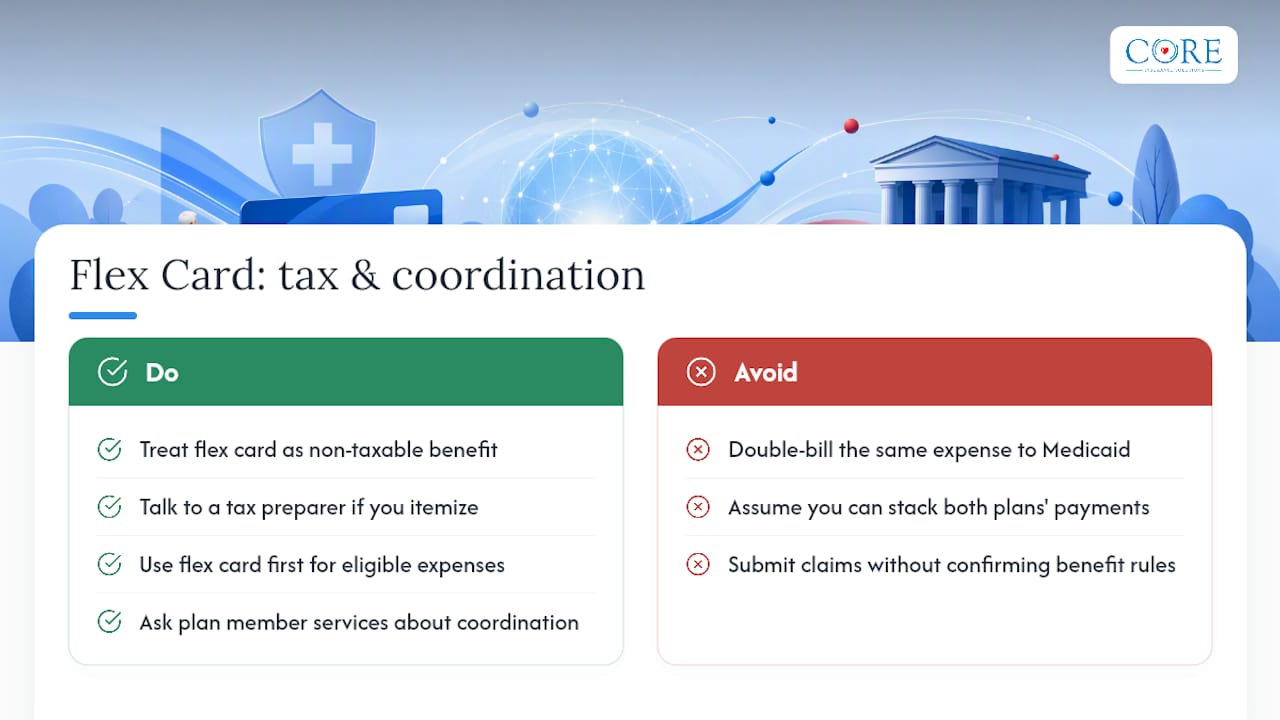
Flex card funds generally count as a reduction in cost sharing rather than taxable income, since the money never passes through your hands as cash and can only be spent on approved health related items. Most tax guidance treats employer or insurer provided health benefits this way, though your specific tax situation can vary, so it’s worth a quick conversation with a tax preparer if you itemize deductions tied to medical expenses.
Coordination with other coverage gets more nuanced. If you’re a dual-eligible beneficiary enrolled in both Medicare and Medicaid, your Medicaid coverage may already pay for some items a flex card also covers, like transportation to appointments or certain dental services. Using the flex card first for an eligible expense typically doesn’t create a conflict, but double-billing the same expense to both Medicaid and your flex card benefit isn’t allowed and could trigger a review.
If you carry a separate supplemental policy, such as a stand-alone dental or vision plan through Core Insurance Solutions, check whether your flex card and that policy could both apply to the same bill. In most cases, you’d use one or the other for a given expense, not stack both, since insurers coordinate benefits to avoid paying twice for the same service. When in doubt, ask your plan’s member services department how it coordinates with any other coverage you carry before you submit a claim through more than one source.
What Merchants and Purchases Are Off Limits?
Every flex card comes with a defined merchant network, and that list determines where the card will actually work at checkout. Most plans partner with major retail pharmacy chains and select grocery stores; smaller independent shops are often excluded entirely, even if they sell qualifying items.
Purchases typically excluded across nearly all plans include:
- Alcohol and tobacco products.
- Non-health household items like cleaning supplies or paper goods, unless specifically listed.
- Cosmetics and beauty products not classified as medical necessities.
- Cash withdrawals or gift card purchases.
- Services from out-of-network dental, vision, or hearing providers.
Some plans also cap spending per category, so you might have $300 available for OTC items but only $150 for transportation, even though both draw from the same card. The point-of-sale system typically flags ineligible items automatically, splitting a transaction so only approved products get charged to the flex balance. That’s a normal safeguard, not a card malfunction. If your entire purchase gets declined rather than partially approved, call the number on the back of the card before assuming something is broken.
What Happens to Unused Flex Card Funds?
This is one of the most common points of confusion, and the answer disappoints a lot of people: unused funds almost always expire and do not roll over. Most plans operate on either a quarterly or annual cycle, meaning money loaded in January that goes unspent by December typically disappears rather than carrying into the next benefit year.
There’s no cash-out option either. You can’t withdraw the balance, transfer it to a bank account, or apply it toward your premium. The card exists strictly to pay for approved goods and services within the plan’s defined categories, and once the benefit period closes, whatever’s left simply resets to zero.
A few practical implications follow from this:
- Check your balance at least quarterly so you’re not caught off guard by an expiration date.
- If your plan distributes funds quarterly rather than annually, spend within each quarter rather than assuming you can save it for later in the year.
- Refunds for denied or reversed purchases typically credit back to the same flex card balance, not to a bank account, and follow the same expiration timeline as the rest of the funds.
If you disenroll from the plan or switch to a different Medicare Advantage plan mid-year, any remaining flex card balance generally does not transfer with you. Confirm this directly with your insurer before you make a switch, since policies differ.
How Do You Set Up and Monitor Your Flex Card Account?
Most insurers now offer an online portal or mobile app specifically for managing the flex card, separate from your general member portal. Setting this up early saves you from surprises later.
Start by registering the card using the activation instructions included in your welcome packet, this usually means calling a toll-free number or visiting a website printed on the card itself. During activation, you’ll typically set a PIN and create login credentials for online access.
Once your account is active, check it periodically for:
- Current balance by category, if your plan splits funds across OTC, dental, or grocery allowances separately.
- Transaction history, so you can catch an unauthorized charge quickly.
- Upcoming expiration dates tied to quarterly or annual distribution cycles.
- Deposit alerts, if your insurer offers text or email notifications when new funds load.
Set a recurring reminder, monthly is reasonable, to log in and review activity. Catching an unfamiliar transaction within days rather than months makes it far easier to dispute with your card administrator and protects you if the card number was ever compromised.
How Core Insurance Solutions Helps You Evaluate Flex-Card Benefits
Core Insurance Solutions builds its process around a full needs assessment, not just chasing the flashiest perk on a brochure. We run unbiased comparisons across major carriers, conduct annual policy audits, help lower prescription costs, and advocate directly if a claim gets denied.
That process catches the details a flex card ad skips: whether the Evidence of Coverage actually supports your spending habits, whether costs stay reasonable year over year, and whether your preferred merchants accept the card at all. Start with our free Medicare 101 webinar replay or explore plans with our online shopping tool.
— Core Insurance Solutions
Get Personalized Help Choosing a Plan With the Right Benefits
There are other ways to research this on your own, Medicare’s Plan Finder, a state SHIP counselor, or hours spent comparing Evidence of Coverage documents yourself. All of them work, but they take time most seniors would rather not spend cross-referencing insurer paperwork.
Core Insurance Solutions does that comparison work for you, and does it without a bias toward any single carrier. We’ve helped more than 2,000 families in Lakeland, Crystal Lake, Plant City, Winter Haven, and surrounding Central Florida communities match their actual health needs, prescriptions, and preferred doctors to a plan that fits, not just one with an appealing flex card. Our annual policy audits catch cost creep before it hits your wallet, and our claims advocacy means you’re not on your own if a dental or vision claim gets denied.
If a flex card benefit caught your attention, the smartest next step is confirming whether it comes attached to a plan that also covers your prescriptions and keeps your doctors in-network. Watch our free Medicare 101 webinar to get oriented, or go straight to our Medicare Advantage plan-shopping tool to see what’s actually available where you live.
Where to Verify Flex Card Details and Report Scams
Confirming a flex card benefit or reporting a suspicious offer takes just a few reliable stops, all free to use.
- Medicare: compare Medicare Advantage plans in your area and review Evidence of Coverage documents.
- State Health Insurance Assistance Program (SHIP): free, unbiased counseling on plan benefits and enrollment questions.
- Senior Medicare Patrol: locate your state’s scam-reporting resource for Medicare-related fraud.
- 1-800-MEDICARE: verify any unsolicited offer or report suspected fraud directly.
- IdentityTheft.gov: file a report if you shared personal information with a scammer.
This article is general information, not a substitute for advice from a qualified financial advisor. Consult a qualified financial professional about your own circumstances before acting on anything here.


