

State SMACs Decide How Dual Eligible Plans Coordinate Your Care
A Dual-Eligible Special Needs Plan (D-SNP) is a Medicare Advantage plan built specifically for people who qualify for both Medicare and Medicaid, and it coordinates those two programs so you deal with fewer gaps and less paperwork. Most D-SNPs bundle in Part D drug coverage and extra services like dental or transportation. Availability depends on your state and county, so checking a plan finder or talking with a SHIP counselor is the fastest way to know what’s actually offered where you live.
TL;DR:
- Fully integrated plans (FIDE) often offer comprehensive, one-card services with coordinated care, while coordination-only plans require managing separate Medicare and Medicaid systems.
- Most D-SNPs automatically include Part D coverage, and full dual eligibles usually pay little out-of-pocket due to Medicaid assistance, but plan type influences benefit delivery.
- Enrollment varies by county, with protections allowing duals to switch plans monthly or into more integrated options once available, to better match changing needs.
- State Medicaid policies significantly affect how benefits are delivered, with some plans providing long-term supports directly and others leaving Medicaid as a separate system.
- Comparing plans requires verifying provider networks, understanding integration levels, and reading the Evidence of Coverage, as plan details can differ widely even within the same state.
Table of Contents
- What Is a Dual Eligible Special Needs Plan?
- What Do FIDE, HIDE, and Coordination-Only Actually Mean?
- What Benefits and Services Come With a D-SNP?
- Who Can Enroll, and When Can You Switch Plans?
- How Does Care Coordination Actually Work Inside a D-SNP?
- How Do You Choose the Right D-SNP for Your Situation?
- Does Enrolling in a D-SNP Affect Your Medicaid Coverage?
- Where Can You Find and Compare D-SNPs in Your Area?
- Our Take: What We’ve Learned Helping Dual-Eligible Clients Locally
- Get Local Help Choosing Between Dual Eligible Plans
- Sources
What Is a Dual Eligible Special Needs Plan?
Congress created D-SNPs as a category of Medicare Advantage plan under federal law, specifically to serve people who carry both Medicare and Medicaid coverage at the same time. That dual status can happen two ways. “Full duals” get comprehensive Medicaid benefits alongside Medicare. “Partial duals” only receive help with premiums and cost sharing through programs like the Qualified Medicare Beneficiary category, without full Medicaid benefits.
Every D-SNP is required to coordinate Medicare and Medicaid benefits to some level, though how much coordination actually happens varies quite a bit, which is a point worth sitting with before you assume all D-SNPs work the same way.
If you’re not sure which category you fall into, your state Medicaid office or a Medicare Eligibility Calculator can clear that up in a few minutes. Most D-SNPs include Part D prescription coverage automatically, and because Medicaid often covers part of the premium, many dual eligibles pay little to nothing out of pocket for their Medicare Advantage plan itself.
What Do FIDE, HIDE, and Coordination-Only Actually Mean?
Not all D-SNPs integrate Medicare and Medicaid the same way, and the difference shows up the moment you try to use your benefits. Fully Integrated Dual Eligible (FIDE) plans combine nearly all your Medicare and Medicaid services, including long-term care, under one organization and often one member card. Highly Integrated Dual Eligible (HIDE) plans go further than the baseline but stop short of full integration, often covering behavioral health or long-term services through a closely linked but separate arrangement. Coordination-only (CO) plans meet the federal minimum: they share some data and processes but leave Medicare and Medicaid largely as two separate systems you have to navigate on your own.
States drive much of this through the State Medicaid Agency Contract (SMAC), which spells out exactly what a plan operating in that state must do. Some states push for tight alignment with Managed Long-Term Services and Supports (MLTSS); others leave coordination minimal. That’s why the exact same plan brand can behave differently depending on which state you’re enrolled in.
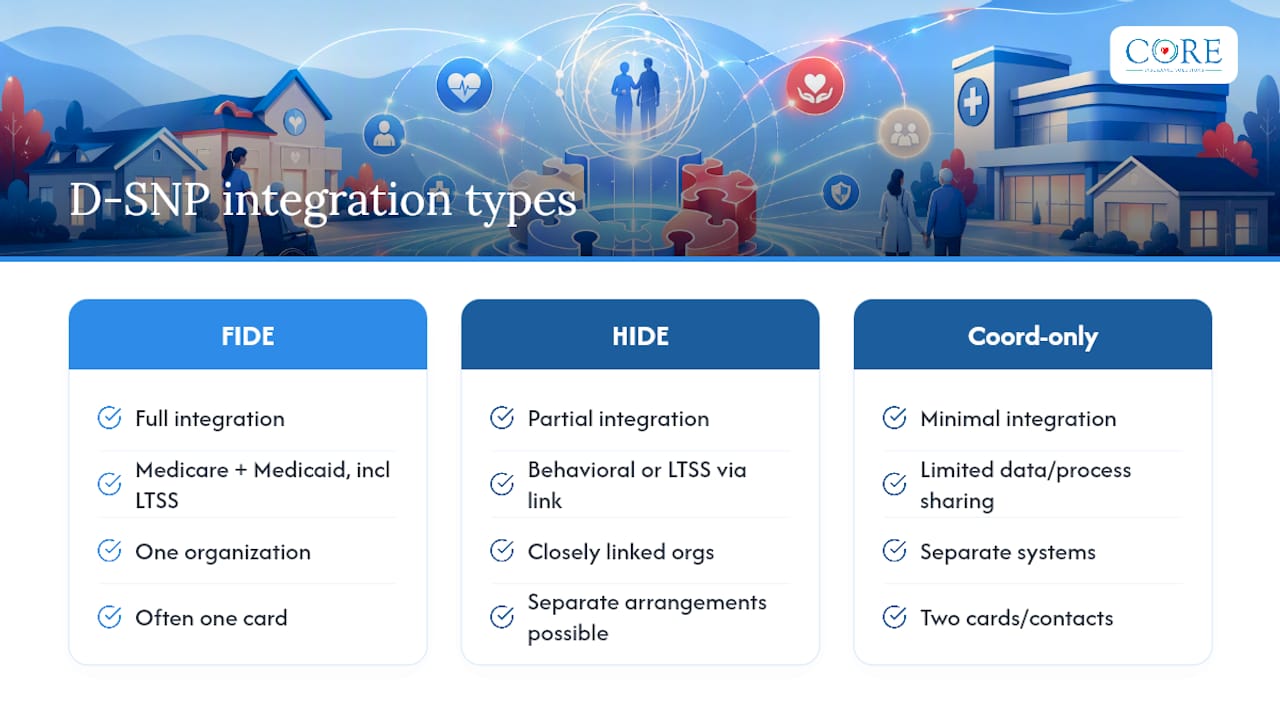
For you, the practical difference is stark: a FIDE plan might mean one appeals process and one care team handling everything, while a coordination-only plan can mean two separate systems, two sets of paperwork, and two phone numbers when something goes wrong.
What Benefits and Services Come With a D-SNP?
Every D-SNP has to cover what Original Medicare covers, which is Part A hospital care and Part B medical services, and nearly all of them fold in Part D drug coverage as well. Medicaid, when you’re a full dual, typically picks up costs Medicare doesn’t touch: long-term care, personal care assistance, and cost-sharing amounts like deductibles and copays.
Where D-SNPs tend to stand out is supplemental benefits. KFF’s analysis found that D-SNPs offer certain extras more often than standard Medicare Advantage plans, including:
- Dental, vision, and hearing coverage beyond Original Medicare’s limits
- Non-emergency medical transportation to appointments
- Meal delivery after a hospital stay or ongoing for eligible members
- Over-the-counter allowance cards for items like pain relievers and vitamins
- In-home support services, such as help with bathing or light housekeeping
Which benefits come from Medicaid versus the plan’s own supplemental package depends on your state and your dual status. A full dual in an MLTSS-aligned state might get long-term supports through Medicaid directly, while a partial dual relies more heavily on whatever the D-SNP itself layers on top of Medicare.
Who Can Enroll, and When Can You Switch Plans?
Eligibility for a D-SNP starts with proving you’re enrolled in both Medicare and Medicaid, but availability is where things get local. Plans are approved county by county, so a D-SNP available in one part of your state may not exist thirty miles away. Checking your specific service area before assuming a plan is an option matters more with D-SNPs than with standard Medicare Advantage.
A few enrollment mechanics are unique to dual eligibles:
- Default enrollment protections can automatically place newly eligible duals into a D-SNP aligned with their existing Medicaid managed care plan, though you always retain the right to opt out or choose differently.
- The Monthly Special Enrollment Period (SEP) lets most dual eligibles change Medicare Advantage or Part D plans once per month, a flexibility most Medicare beneficiaries don’t have.
- The Integrated Care SEP, in effect as of January 1, 2025, gives duals an additional window specifically to move into an integrated D-SNP (FIDE or HIDE) when one becomes available in their area.
These SEPs exist because federal policy recognizes that dual eligibles’ needs shift more often, and locking someone into a poor-fit plan for a full year creates real harm.
How Does Care Coordination Actually Work Inside a D-SNP?
Three pieces do the heavy lifting behind the scenes, and all three should show up in the plan’s own paperwork if the coordination is real rather than marketing language.
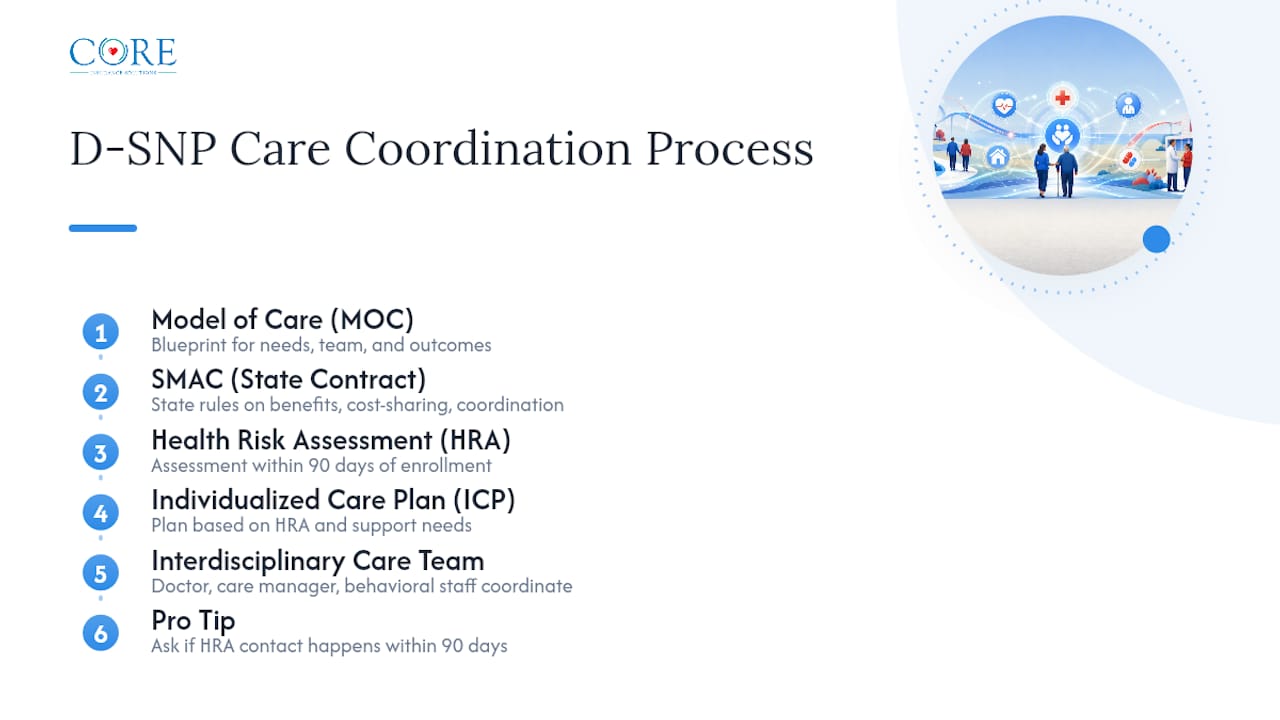
The Model of Care (MOC) is the blueprint every D-SNP must follow, laying out how the plan identifies member needs, assembles a care team, and tracks outcomes over time. The State Medicaid Agency Contract (SMAC) sets the state-specific rules: which Medicaid benefits the plan is responsible for, how cost-sharing protections apply, and what provider coordination looks like in that particular state. Justice in Aging notes that SMACs detail eligibility categories, covered Medicaid benefits, and verification processes that vary from state to state.
From there, the Health Risk Assessment (HRA) kicks off the process, usually within 90 days of enrollment, feeding into an Individualized Care Plan (ICP) built around your specific conditions and support needs. An interdisciplinary care team, which can include your doctor, a care manager, and behavioral health staff, is supposed to use that plan to actually coordinate your care rather than leave it sitting in a file.
Pro Tip: Ask the plan directly whether you’ll be contacted for your HRA within the first 90 days. If nobody reaches out and you have to chase them down, that’s an early signal about how seriously the plan treats its own Model of Care.
How Do You Choose the Right D-SNP for Your Situation?
Picking a D-SNP means looking past the premium and marketing brochure into the details that determine whether you can actually see your doctors and afford your medications. Work through this before you enroll:
- Network access: Confirm your current doctors and specialists are in-network, not just “accepting new patients.”
- Integration level: Ask directly whether the plan is FIDE, HIDE, or coordination-only, since KFF found that most D-SNP enrollees, 57%, are in coordination-only plans, with only about 8% in fully integrated plans.
- Formulary and Part D coverage: Get the prior authorization and step therapy rules for your current prescriptions in writing before you switch.
- Evidence of Coverage (EOC): Read the section on Medicaid-covered services versus plan supplemental benefits.
- Appeals process: Ask whether Medicare and Medicaid appeals run through one combined process or two separate ones.
- Cost-sharing protections: Confirm the plan honors your Medicaid cost-sharing protections rather than billing you directly.
Red flags include a plan representative who can’t clearly explain the difference between FIDE and coordination-only, or an EOC that’s vague about which entity handles long-term care requests.
Does Enrolling in a D-SNP Affect Your Medicaid Coverage?
No. Enrolling in a D-SNP does not replace or reduce your Medicaid benefits, it layers Medicare Advantage coordination on top of coverage you already have. Full duals keep their comprehensive Medicaid benefits regardless of which D-SNP integration level they choose. Partial duals continue receiving whatever premium and cost-sharing assistance their category provides.
The real distinction is how those Medicaid benefits get delivered. In a FIDE or HIDE plan, the D-SNP itself may directly deliver certain Medicaid services like long-term supports. In a coordination-only plan, Medicaid stays a separate system you access through your state’s Medicaid managed care plan or fee-for-service program, even while your Medicare Advantage runs through the D-SNP.
If you ever lose Medicaid eligibility, most D-SNPs offer a “deeming period,” typically a few months, during which you keep D-SNP coverage while you work to restore your Medicaid status. Contact your state Medicaid agency immediately if that happens.
Where Can You Find and Compare D-SNPs in Your Area?
Start with Medicare’s Plan Finder tool, which shows every D-SNP available in your specific county along with star ratings, drug coverage, and supplemental benefits. It’s free, unbiased, and updated annually ahead of open enrollment.
From there:
- Call your State Health Insurance Assistance Program (SHIP) for free, one-on-one counseling that isn’t tied to any carrier
- Contact your state Medicaid agency directly if you need SMAC details or Evidence of Coverage documents a plan hasn’t provided
- Run a quick check with a Medicare Eligibility Calculator to confirm your dual status before you start comparing plans
- Review our complete guide to Medicare Advantage plans if you want the broader mechanics before narrowing to D-SNPs specifically
When the comparison gets complicated, especially sorting FIDE from coordination-only options, a licensed local agent can walk through the SMAC and EOC with you line by line.
Our Take: What We’ve Learned Helping Dual-Eligible Clients Locally
Working with more than 2,000 families across Central Florida has taught Core Insurance Solutions that the integration level matters more than the plan’s name on the card. We use eligibility calculators, Part D penalty checks, and full health risk assessments to match each client’s real medical history, not a generic checklist. If you want that same level of attention, a free consultation or our Medicare 101 webinar is the place to start.
— Core Insurance Solutions
Get Local Help Choosing Between Dual Eligible Plans
Comparing FIDE, HIDE, and coordination-only plans on your own means reading dense Evidence of Coverage documents and calling multiple carriers just to figure out which one actually talks to your Medicaid benefits. Core Insurance Solutions handles that legwork for you, in person, with agents who already know which D-SNPs operate in Lakeland, Winter Haven, Bartow, and the surrounding Polk County area.
We run a full health needs assessment before recommending anything, check your prescriptions against each plan’s formulary for hidden prior authorization barriers, and follow up every year with a policy audit to make sure your plan still fits. If you’d rather learn the basics first, watch our free Medicare 101 webinar replay at your own pace, then reach out for a one-on-one consultation to compare your specific dual-eligible options.
This article is general information, not a substitute for advice from a qualified financial advisor. Consult a qualified financial professional about your own circumstances before acting on anything here.
Sources
- Dual Eligible Special Needs Plans (D-SNPs) | CMS
- 10 things to know about Medicare Advantage D-SNPs | KFF
- Dual-Eligible Special Needs Plans: Frequently Asked Questions | Justice in Aging
- Medicare Advantage dual eligible special needs plans - MACPAC


