

Medicare Seniors: Fix Coordination of Benefits to Avoid Surprise Bills
Coordination of benefits is the system Medicare uses to decide which insurer pays a medical bill first when you have more than one type of coverage. The primary payer pays up to its coverage limits; the secondary payer picks up eligible costs the primary left behind. For most people 65 and older, Medicare pays first, but employer coverage, COBRA, disability, and kidney disease can flip that order. If your coverage recently changed, tell your provider now and call the Benefits Coordination & Recovery Center before claims pile up.
TL;DR:
- The order of payment depends on specific coverage scenarios, with employer size, COBRA status, and ESRD affecting whether Medicare pays first or second.
- Confirming coverage updates with the Benefits Coordination & Recovery Center and responding promptly to claim questionnaires prevents processing delays and claim denials.
- When primary payers delay, Medicare issues conditional payments, but recovering those funds can take months, leaving temporary out-of-pocket costs for beneficiaries.
- Accurate, up-to-date records are essential, requiring beneficiaries to notify Medicare of coverage changes immediately and retain documentation to support claims.
- Coordination issues often stem from paperwork or timing gaps, not complicated rules, so proactive reporting and regular policy audits can prevent most claim disputes.
Core Insurance SolutionsGet Clearer Medicare Coverage GuidanceCore Insurance Solutions compares Medicare options, reviews your health needs, and supports you through claims concerns and policy audits.Explore Medicare guidance
Table of Contents
- How Does Medicare Coordination of Benefits Work?
- Common COB Scenarios That Change Who Pays
- What Does the Benefits Coordination & Recovery Center Do?
- What Happens When a Primary Payer Delays Your Claim?
- How to Keep Your Medicare COB Record Accurate
- Practical Tips and Common Pitfalls
- How Long Does Medicare Coordination of Benefits Take?
- What If a Coordination of Benefits Claim Gets Denied?
- Common Misconceptions About Coordination of Benefits
- How Coordination of Benefits Affects Your Out-of-Pocket Costs
- What Our Clients Get Wrong Most Often About Coordination of Benefits
- Get Help Sorting Out Your Medicare Coordination
- Sources
How Does Medicare Coordination of Benefits Work?
Medicare’s payment order isn’t a judgment call your doctor’s office makes on the spot. It follows a fixed set of federal rules, and the answer depends on why you have Medicare and what other coverage sits alongside it.
For most beneficiaries who qualify by turning 65, Medicare pays first, and any retiree plan, Medigap policy, or other supplemental coverage pays second. That’s the default. But several situations reverse it:
- Active employer group health plan (large employer, 20+ employees): the employer plan usually pays first if you’re still working and covered through your job or a spouse’s job.
- Small employer (under 20 employees): Medicare typically pays first instead.
- COBRA coverage: Medicare generally pays first once you’re Medicare-eligible, even while on COBRA.
- End-Stage Renal Disease (ESRD): a 30-month coordination period applies, during which an employer group plan usually pays first before Medicare takes over.
- Disability-based Medicare with employer coverage: the employer plan often pays first if the employer has 100 or more employees.
- Medicaid: Medicaid almost always pays last, after Medicare and any other insurance, for services Medicare covers.
These aren’t guidelines with wiggle room. They’re the rules CMS applies when it processes your claim, and getting the order wrong is one of the most common reasons a bill gets denied and bounced back to you.
Common COB Scenarios That Change Who Pays
Real situations rarely match the textbook case, so here’s how the rules play out when they actually collide with your life.
- Working past 65 with employer coverage. If your employer has 20 or more employees, that group plan pays first and Medicare pays second. Confirm your employer is reporting you correctly, since a missing report to the Benefits Coordination & Recovery Center is a frequent cause of rejected claims.
- Retiree coverage after you stop working. Once you retire, the employer plan almost always becomes secondary, and Medicare becomes primary. Many retirees don’t realize this switch happens automatically the day employment ends, not the day the retiree plan technically starts.
- COBRA after leaving a job. If you’re already Medicare-eligible when your COBRA coverage begins, Medicare pays first. COBRA administrators sometimes assume they’re primary, which causes claims to process incorrectly until someone corrects the record.
- ESRD plus employer coverage. During the 30-month coordination window, the employer plan pays first. After that period ends, Medicare takes over as primary, even if you keep the employer plan as a secondary payer.
- Multiple coverage sources at once, such as TRICARE alongside Medicare, or a retiree plan plus a spouse’s active employer plan. These stacked situations need each payer’s coordination status confirmed individually, because one wrong link in the chain delays every claim behind it.
What Does the Benefits Coordination & Recovery Center Do?
The Benefits Coordination & Recovery Center is the CMS contractor that tracks every case where a beneficiary has coverage besides Medicare. It’s the office that actually updates your file when your insurance situation changes.
The BCRC’s core functions include:
- Collecting and storing information about your other insurance coverage.
- Creating what CMS calls Medicare Secondary Payer occurrence records, which flag your file so claims route to the right payer first.
- Opening investigations when a claim or a self-report suggests someone else should be paying before Medicare.
- Managing data exchange agreements with private insurers so paid-claim information can transmit automatically.
Not every insurer has a cross-over agreement with Medicare. When one exists, CMS explains that claim information transmits automatically to your secondary payer once Medicare processes it, so you rarely have to submit anything twice. When no agreement exists, you or your provider may need to send the claim to the secondary payer manually, which is where most coordination delays actually start.
You can reach the BCRC by phone, mail, or fax, and the office maintains set business hours for beneficiary calls about coverage updates or case status.
What Happens When a Primary Payer Delays Your Claim?
Sometimes the payer that’s supposed to go first doesn’t act fast enough, and Medicare steps in temporarily so you’re not stuck holding the bill.
A conditional payment is exactly what it sounds like: Medicare pays a claim on the condition that it gets reimbursed later if another payer turns out to be responsible. Medicare.gov notes providers may bill Medicare when a primary payer has not paid promptly, which keeps your care from stalling while a liability, workers’ compensation, or no-fault claim gets sorted out.
Once the BCRC identifies the actual primary payer, Medicare pursues recovery of that conditional payment directly from whoever was responsible, not from you in most cases. Still, a few practical risks matter here:
- If both payers dispute their share, you can end up temporarily responsible for the balance while the dispute gets resolved.
- Providers may bill you directly if they haven’t been told about the correct payment order.
- Recovery cases can take months, so keep every letter and payment record until the case closes.
How to Keep Your Medicare COB Record Accurate
Most coordination problems trace back to outdated records, not complicated rules. Fixing that is mostly a matter of paperwork discipline.
- Call the BCRC directly to report new coverage, dropped coverage, or a change in employment status. Have your Medicare number, the other insurer’s name and policy number, and your coverage start date ready before you call.
- Respond immediately to any Medicare Secondary Claim Development Questionnaire you receive. CMS uses these letters when a claim or a self-report suggests another payer might be primary, and a late reply is one of the top causes of stalled claims.
- Tell every provider’s office about coverage changes the same week they happen, not just Medicare. Front-desk staff bill based on what’s in their system, which may lag behind what CMS knows.
- Save your Explanation of Benefits statements and insurer letters. They’re your proof if a claim gets misrouted months later.
Pro Tip: Treat the Medicare Secondary Claim Development Questionnaire like a bill with a due date. CMS uses your answers to lock in who’s responsible for payment, and a missing reply often triggers a manual review that can push claims back by months.
Practical Tips and Common Pitfalls
Many coordination problems come down to timing and paperwork, not confusing rules. A client switches jobs, forgets to tell Medicare, and three months later a claim bounces back unpaid.
A short checklist prevents most of it:
- Inform every provider’s office in writing when your coverage changes, not just verbally at checkout.
- Confirm your employer’s benefits office actually reported your Medicare eligibility, since HR departments sometimes miss this step.
- Keep every Explanation of Benefits statement for at least a year.
- Note your exact Part A and Part B enrollment dates, since those dates determine payment order in several scenarios.
- Follow up within 30 to 120 days if a claim seems stuck, before it becomes a recovery case.
There are services that assist clients through annual policy audits that catch these gaps early, along with claims advocacy when a bill gets stuck between two payers. If a claim has already been denied and you can’t identify why, call the BCRC first. If the issue is about which plan fits your situation going forward, that’s when talking to your agent makes more sense.
How Long Does Medicare Coordination of Benefits Take?
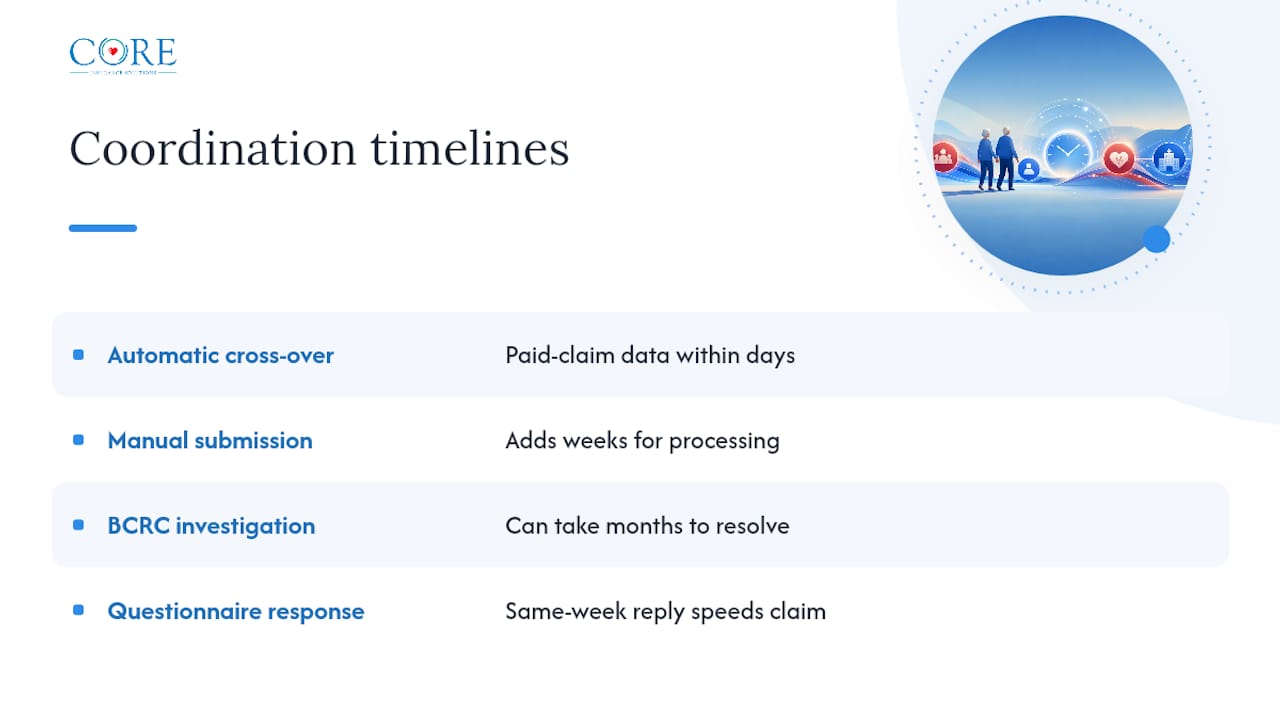
Timing varies depending on whether an automatic cross-over agreement exists between Medicare and your other insurer. When it does, your secondary payer typically receives paid-claim data within days of Medicare processing the claim, and you rarely have to do anything.
Without a cross-over agreement, the timeline stretches. You or your provider has to submit the claim to the secondary payer separately, and that manual step can add weeks. If the BCRC needs to investigate whether another payer is primary, such as after an accident or a workers’ compensation claim, that investigation can take considerably longer, sometimes months, especially if records from an employer or another insurer are slow to arrive.
The Medicare Secondary Claim Development Questionnaire adds its own clock. Once CMS mails one, it’s waiting on your response to finalize how a specific claim should be paid. Answer within the window given in the letter, and the claim usually moves forward quickly. Miss it, and CMS may proceed with limited information, which sometimes means the claim processes incorrectly and has to be corrected later.
None of these timelines are fixed by law in the way a 30-day appeal deadline is. They’re operational, driven by how fast agreements transmit data and how fast people respond to requests. That’s precisely why the beneficiary’s own responsiveness matters so much here. A questionnaire answered the same week it arrives can mean the difference between a claim paid on the first pass and one still under review two months later.
What If a Coordination of Benefits Claim Gets Denied?
A denial tied to coordination of benefits usually means Medicare’s records show a different payer should have gone first, or a secondary payer never received the claim at all. The fix starts with figuring out which one happened, not with filing a formal appeal right away.
Start by requesting your Medicare Summary Notice, which shows exactly how the claim was processed and why it was denied. If the notice shows Medicare paid as secondary when it should have paid as primary, or vice versa, contact the BCRC to correct the underlying coordination record. Once that record is fixed, the claim can often be reprocessed without a formal appeal.
If the coordination information is already correct and the denial still seems wrong, you have the standard Medicare appeal rights available for any denied claim. That process starts with a request for redetermination, filed within 120 days of the date on your Medicare Summary Notice. From there, if you disagree with the outcome, you can escalate to reconsideration by a Qualified Independent Contractor, and further still to an Administrative Law Judge hearing for claims that meet the dollar threshold.
For coordination-specific disputes, involving your provider’s billing office matters more than in a typical appeal. Providers often have information about payer sequencing that didn’t make it into your file, and a corrected claim resubmission from their end can resolve the issue faster than a formal appeal track. Keep copies of every notice and letter, since coordination disputes frequently require referencing dates and coverage periods that are easy to lose track of otherwise.
Common Misconceptions About Coordination of Benefits
A lot of billing confusion traces back to a handful of persistent myths about how coordination actually works.
“Medicare always pays first.” It doesn’t. Active employer coverage at a large employer, COBRA in specific timing situations, and the ESRD coordination period all change the order. Assuming Medicare is always primary is one of the fastest ways to end up with a denied claim.
“Medicaid fills every remaining gap.” Medicaid typically pays last, after Medicare and any other insurance, and only for services Medicare covers under its own rules. It’s not a blanket backstop for costs Medicare denies outright.
“Once I report my coverage, I never have to update it again.” Coordination records need updating every time your coverage changes, including retirement, a new job, losing a spouse’s plan, or COBRA ending. The BCRC doesn’t automatically know your situation changed unless someone tells them.
“The secondary payer will just catch whatever the primary misses.” Secondary payers only cover costs that fall within their own plan’s rules. A service the primary payer denied because it wasn’t covered at all usually isn’t picked up by the secondary payer either.
“My provider’s office handles all of this automatically.” Providers bill based on what’s in their system, which may not reflect a coverage change you haven’t reported yet. The reporting responsibility sits with you, not your doctor’s office.
How Coordination of Benefits Affects Your Out-of-Pocket Costs
Getting the payment order right isn’t just an administrative detail. It directly determines how much you pay out of pocket for a given service.
When coordination works correctly, your secondary payer covers costs your primary payer’s deductible, copay, or coinsurance left behind, often bringing your out-of-pocket cost close to zero for covered services. That’s the entire point of carrying supplemental coverage alongside Medicare. But when the payment order is wrong in Medicare’s records, claims can process as if you have no secondary coverage at all, leaving you billed for the full deductible and coinsurance amount until someone fixes the record.
The financial exposure compounds when a claim sits in dispute. If the primary payer hasn’t paid within the general 120-day window Medicare recognizes, and Medicare hasn’t yet stepped in with a conditional payment, providers may bill you directly while the two payers sort out responsibility. You typically get that money back once the correct payer is identified, but you’re temporarily out of pocket in the meantime, which matters if you’re on a fixed income.
Prescription drug coverage adds another layer. Coordination between Medicare Part D and other drug coverage affects your true out-of-pocket costs, which in turn affects when you move through your plan’s coverage phases. A Part D plan that isn’t coordinating correctly with another drug plan can miscalculate what you’ve already paid, delaying when you reach more favorable coverage.
What Our Clients Get Wrong Most Often About Coordination of Benefits
Most of the coordination questions we hear from clients follow a pattern: someone changed jobs, retired, or lost a spouse’s coverage, and nobody told Medicare. By the time a claim gets denied, the client assumes something is wrong with their plan, when really it’s a records problem sitting between their employer, their insurer, and CMS.
Our approach starts with a policy audit that checks whether your coverage is actually reporting correctly, not just whether your plan looks good on paper. From there, we verify employer reporting when it applies, and step in as an advocate if a claim gets stuck between two payers arguing over who’s primary. Coordination issues are almost always fixable. They just take someone willing to track down the right record and push it through.
— Core Insurance Solutions
Get Help Sorting Out Your Medicare Coordination
Untangling who pays first shouldn’t fall entirely on you while you’re also managing a medical issue. Some local Medicare brokers work with seniors in the Lakeland area and surrounding communities to sort out exactly which plan should be paying, verify enrollment dates, and advocate directly with insurers when a claim gets stuck in coordination limbo.

Annual policy audits can catch reporting gaps before they turn into denied claims, and claims advocacy services can help manage the phone calls and paperwork. If you’re not sure whether your current coverage is coordinating correctly, or you’re approaching 65 and want to understand your enrollment timing before problems start, watch our Medicare 101 webinar replay or visit our Medicare plans and services page to schedule a review with a local agent.
Sources
- Who pays first? | Medicare
- Coordination of Benefits | CMS
- How Medicare works with other insurance | Medicare
- Coordination of Benefits contacts | CMS


