

Avoid a Lifetime Part B Penalty: COBRA and Medicare for U.S. 65+ Enrollees
Yes, you can hold COBRA and Medicare together, but Medicare almost always becomes your primary payer once you’re entitled to it, with COBRA sliding into a secondary role. The one exception is end stage renal disease, where COBRA can stay primary during a coordination period that can last up to 30 months for certain conditions like ESRD. Miss your Part B enrollment window because you assumed COBRA covered you, and a lifetime penalty follows.
TL;DR:
- COBRA typically becomes secondary to Medicare once enrolled, except during a 30-month coordination period for end-stage renal disease.
- Missing the Part B initial enrollment window without active employer coverage can lead to lifelong penalties, with COBRA not qualifying for special enrollment periods.
- Active employment with 20+ employees allows delaying Part B without penalty, but losing that coverage triggers the SEP clock, whether or not COBRA is elected.
- COBRA premiums often exceed Medicare plus Medigap costs, but it may be worthwhile short-term if employer contributions or dependent coverage are needed.
- Always verify if COBRA drug coverage is creditable, as losing it within 63 days can result in lifelong Part D penalties.
Core Insurance SolutionsGet Medicare Choices Matched to Your NeedsCore Insurance Solutions provides personalized Medicare guidance, compares major carriers, and helps seniors navigate complex coverage decisions.Explore Medicare guidance
Table of Contents
- How Coordination of Benefits Works: Who Pays First and Why It Matters
- Enrollment Timing: IEPs, SEPs, Part B Deadlines, and Penalties
- Three Common Scenarios and What to Do in Each
- Prescription Drugs and Part D: Creditable Drug Coverage Rules with COBRA
- Cost Trade-Offs: When Keeping COBRA Makes Sense (and When It Usually Doesn’t)
- Action Checklist: Immediate Steps, Who to Call, and Paperwork to Gather
- Core Insurance Solutions: How We Help People Avoid Penalties and Gaps
- How to Get Personalized Help from Core Insurance Solutions
- Sources
How Coordination of Benefits Works: Who Pays First and Why It Matters
Coordination of benefits is just the rulebook insurers use to decide who pays a claim first and who covers what’s left. The “primary” payer processes the claim first and pays up to its coverage limits. The “secondary” payer, if there is one, may pick up some or all of the remaining balance, depending on the plan’s terms.
For most people who qualify for Medicare by age or disability, For most people who qualify for Medicare by age or disability, Medicare generally becomes the primary payer once you’re enrolled, and COBRA pays second, if it pays anything at all. That last part trips people up constantly.
- COBRA is not required to cover costs Medicare doesn’t pay. Some plans do, many don’t.
- The ESRD exception flips this order: COBRA can act as the primary payer for a coordination period of up to 30 months before Medicare takes over.
- Providers need to know about both coverages immediately, or claims can get billed to the wrong payer and delayed for weeks.
Pro Tip: Call your COBRA plan administrator and ask, in writing, exactly how they coordinate with Medicare. Don’t assume. Plan language on this varies more than most people expect.
Enrollment Timing: IEPs, SEPs, Part B Deadlines, and Penalties
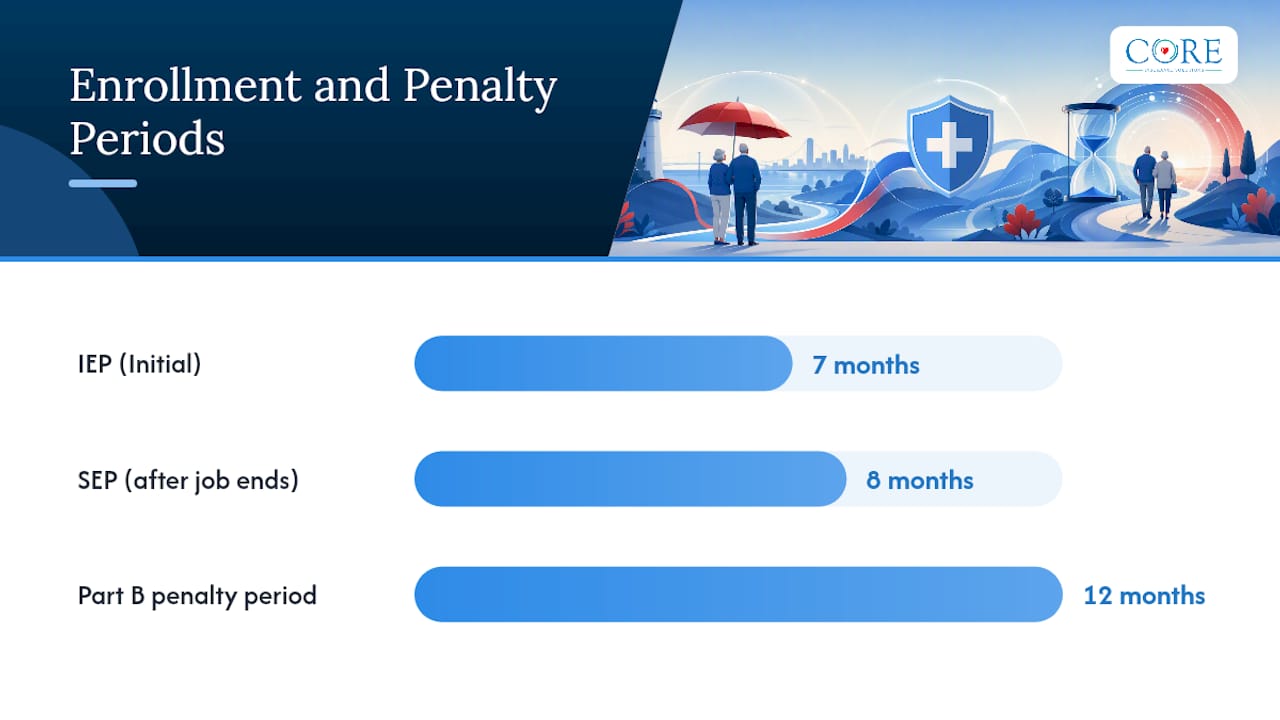
Your Initial Enrollment Period (IEP) runs seven months: three months before your 65th birthday month, your birthday month itself, and three months after. Miss this window without qualifying employer coverage, and you’re looking at a penalty that follows you for life.
Here’s where COBRA causes real damage. COBRA does not count as active employment coverage, which means it does not qualify you for a Special Enrollment Period (SEP) later. People assume COBRA works like employer insurance and delay Part B, thinking they can enroll later without consequence. They can’t.
- If you’re still actively working with employer group coverage at 65, you get an SEP: eight months to enroll in Part B after that job or the coverage ends, whichever comes first.
- If you leave your job and elect COBRA instead of enrolling in Medicare, that eight month SEP clock is already running. COBRA doesn’t pause it or restart it.
- Miss the SEP or your IEP entirely, and you’ll face a Part B penalty of 10% added to your premium for every full 12 month period you were eligible but didn’t enroll, for as long as you have Part B.
- Part D carries its own penalty, roughly 1% of the national base premium for every month you go without creditable drug coverage after your IEP ends.
Pro Tip: Mark your calendar the day you lose active employer coverage, not the day your COBRA election paperwork arrives. The SEP clock starts at job loss, and waiting for COBRA paperwork has cost people months they didn’t realize they’d lost. Core Insurance Solutions’ enrollment timeline tool lays out these windows month by month.
Three Common Scenarios and What to Do in Each
Most readers fall into one of three situations. Here’s the direct move for each one.
- You elected COBRA first, and Medicare eligibility is now approaching. Enroll in Medicare during your IEP regardless of your COBRA status. Once you’re Medicare-entitled, COBRA will likely terminate automatically, though dependents on your plan may retain coverage separately, sometimes for up to 36 months, per your plan’s terms.
- You’re already on Medicare, and COBRA becomes available afterward (say, after a layoff). You can still elect COBRA, but Medicare stays primary. Run the numbers before paying for it. In most cases, COBRA’s added cost buys you very little beyond what a Medigap or Advantage plan already covers.
- You’re working past 65 with active employer coverage, and COBRA is not yet in play. Active employer coverage from a company with 20 or more employees is typically creditable, meaning you can delay Part B penalty-free. The moment that job ends and COBRA starts, your SEP clock begins ticking, whether or not you actually elect COBRA.
Prescription Drugs and Part D: Creditable Drug Coverage Rules with COBRA
“Creditable coverage” means a drug plan pays, on average, at least as much as Medicare’s standard Part D plan. Your COBRA plan administrator determines this status and must tell you in writing, usually in an annual notice.
- Ask your plan administrator directly whether your COBRA drug coverage is creditable. Don’t guess.
- Once creditable coverage ends, you have 63 days to enroll in Part D without triggering the late penalty.
- Losing COBRA coverage entirely, even for a day past that 63-day window, can mean paying the Part D penalty for the rest of your life.
Pro Tip: Keep the creditable coverage notice from your COBRA plan in the same folder as your enrollment paperwork. If a penalty dispute ever comes up, that notice is your proof.
Cost Trade-Offs: When Keeping COBRA Makes Sense (and When It Usually Doesn’t)
COBRA premiums often run higher than what you’d pay for Medicare Part B plus a Medigap or Medicare Advantage plan, largely because you’re now covering the full premium your employer used to subsidize, plus up to a 2% administrative fee. Comparing the total cost of both paths, side by side, before committing to either one matters more than most people realize.
- Add up your COBRA monthly premium plus realistic out-of-pocket costs for the year.
- Compare that total against your Part B premium plus a Medigap or Advantage plan’s premium and expected copays. Core Insurance Solutions’ guide to Medigap versus Advantage breaks down how those two paths differ in cost and flexibility.
- COBRA can still make sense short term if your employer is still contributing toward premiums, if you need a short bridge while sorting out a Medigap application, or if dependents need continued coverage COBRA provides but Medicare doesn’t.
Before deciding either way, request your Summary Plan Description from your COBRA administrator and run the actual numbers, or ask a SHIP counselor to run them with you.
— Core Insurance Solutions
Action Checklist: Immediate Steps, Who to Call, and Paperwork to Gather
If you’re inside your IEP or SEP window, don’t wait. Roughly 10% of Medicare beneficiaries pay a Part B late penalty, most of them because they assumed other coverage, often COBRA, bought them more time than it actually did.
- Confirm your enrollment deadline today. Enroll in Part A and B immediately if you’re inside your IEP or SEP.
- Request your COBRA Summary Plan Description and ask the administrator directly about coordination rules and Part D creditable status.
- Call your local SHIP counselor for free, state-specific guidance, or reach the Benefits Coordination & Recovery Center at 1-855-798-2627 for unresolved payer-order questions.
- Call 1-800-MEDICARE for anything involving enrollment deadlines or penalty disputes.
Core Insurance Solutions: How We Help People Avoid Penalties and Gaps
We built our process around one recurring problem: people relying on COBRA who miss their Part B window and get stuck with a penalty they’ll carry for life. Our holistic needs assessment looks at your medical history, current prescriptions, and COBRA status together, then compares carriers without bias toward any single one. We’ve helped clients catch a looming Part B penalty in time and switch to a lower-cost Medigap plan that better matched their actual prescriptions. Our Medicare 101 webinar replay walks through these same timing rules in more detail.
How to Get Personalized Help from Core Insurance Solutions
You can get assistance from a local advisor who looks at your specific COBRA situation and tells you exactly what to do next, not a generic script.

We help residents compare Medicare Advantage, Medigap, and Part D plans against whatever COBRA coverage they’re currently paying for, line by line. That includes checking whether your current drug coverage is creditable, running a real cost comparison between COBRA and a Medicare Supplement plan, and encouraging regular policy reviews to keep coverage up to date. If claims get routed to the wrong payer, advocacy may be needed to resolve the issue.
Start with our Medicare enrollment timeline to see exactly where your deadlines fall, or watch our free Medicare 101 webinar replay for a plain-language walkthrough. Ready to talk specifics? Reach out through our Medicare plans and services page to schedule a conversation with a local advisor before your enrollment window closes.
Sources
- CMS — End-Stage Renal Disease (ESRD) coordination guidance
- U.S. Department of Labor — COBRA FAQs
- Medicare — How Medicare works with other insurance (PDF)
- Medicare Interactive — COBRA and Medicare coordination
This article is general information, not a substitute for advice from a qualified financial advisor. Consult a qualified financial professional about your own circumstances before acting on anything here.


