

Urgent Care Medicare Coverage: What You’ll Actually Pay
Yes, Medicare covers medically necessary urgent care visits, but what you pay depends on whether you have Original Medicare or a Medicare Advantage plan. Under Original Medicare, Part B kicks in after you meet your annual deductible, and you’re on the hook for 20% of the Medicare-approved amount after that.
- Part B deductible for 2026 applies
- Your share after the deductible: 20% coinsurance on the approved amount
- Medicare Advantage plans usually charge a flat copay instead
Pro Tip: Call the clinic before you walk in. Ask if they accept Medicare and if they accept assignment. That one question can save you a surprise bill.
Key Takeaways
Medicare covers medically necessary urgent care, but your actual cost depends on whether you carry Original Medicare, a Medigap policy, or Medicare Advantage.
| Point | Details |
|---|---|
| Part B deductible applies first | You pay the $283 Part B deductible before Medicare’s 20% coinsurance kicks in. |
| Advantage plans use flat copays | Medicare Advantage typically charges a set copay instead of deductible plus coinsurance. |
| Call ahead every time | Confirm the clinic accepts Medicare and assignment before you’re seen. |
| International coverage is limited | Original Medicare generally doesn’t cover care outside the U.S.; check Medigap travel benefits. |
| Coreforseniors reviews your actual costs | Coreforseniors audits your plan’s urgent care copay and network fit during a local consultation. |
Table of Contents
- Does Medicare Cover Urgent Care Under Part B or Medicare Advantage?
- How Billing Typically Works and What You’ll Likely Pay
- How to Find an Urgent Care That Accepts Medicare
- Traveling? Where Medicare Urgent Care Coverage Stops
- Urgent Care or Emergency Room? A Quick Way to Decide
- What Medicare Won’t Pay for at Urgent Care
- Medigap and Part D: How They Change Your Urgent Care Bill
- Steps to Take Before and After an Urgent Care Visit
- Let Core Insurance Solutions Take the Guesswork Out of Your Plan
- Frequently Asked Questions
- Sources
Does Medicare Cover Urgent Care Under Part B or Medicare Advantage?
Original Medicare Part B pays for what CMS calls “urgently needed care.” That’s medical language for a sudden illness or injury that isn’t life-threatening but can’t wait for a regular doctor’s appointment. Think a sprained ankle, a sinus infection that’s gotten worse over a weekend, or a cut that needs stitches. None of these require an ambulance or a trip to the ER, but all of them need attention now, not next Tuesday.
If you’re on Medicare Advantage (Part C), your plan is legally required to cover the same urgently needed care as Original Medicare. The catch is that Medicare Advantage plans set their own copays and often restrict non-emergency care to in-network providers. You could pay $0 or $75 for the same sprained wrist, depending entirely on your plan’s Summary of Benefits. Reviewing how Medicare Part B coverage works alongside your plan documents helps you understand what’s actually different.
Urgently needed care sits in a gap between “see your regular doctor” and “call 911.” It’s covered, but the coverage rules shift depending on which type of Medicare you carry.
Quick cost snapshot for 2026: Part B deductible is $283, and once you’ve met it, you owe 20% coinsurance on the approved amount for the visit. If the clinic operates as a hospital outpatient department, expect an additional copay on top of that.
How Billing Typically Works and What You’ll Likely Pay
Under Original Medicare, the order of operations is simple. You pay toward your Part B deductible first, if you haven’t already met it for the year. After that, you owe 20% of whatever Medicare has approved for the visit, and Medicare picks up the other 80%.
Medicare Advantage works differently. Most plans charge a flat urgent care copay, often somewhere in the $30 to $75 range, though this varies widely by plan and region. Always check your plan’s Summary of Benefits rather than assuming a number.

One wrinkle that trips people up: some urgent care centers are technically part of a hospital’s outpatient department. When that’s the case, you may owe a separate hospital outpatient copay in addition to your 20% coinsurance.
Before you’re seen, ask three things:
- Does this clinic accept Medicare assignment?
- Does it bill as a hospital outpatient department?
- Does it participate in my specific Medicare Advantage network?
Pro Tip: Bring your Medicare card, your plan name, and your member ID to every visit. Keep the itemized bill afterward. If a charge looks wrong later, that paperwork is what makes an appeal possible.
How to Find an Urgent Care That Accepts Medicare
A little homework before you’re sick saves a lot of frustration once you are. Here’s the sequence that works:
- Search Medicare Care Compare to confirm a facility participates in Medicare and check its quality ratings.
- Call the clinic directly and ask if they accept Medicare and accept assignment.
- If you’re on Medicare Advantage, log into your plan’s provider directory to verify the clinic is in-network.
- Have your Medicare number and plan name ready before you call, so the front desk can check you against their system immediately.
Ask this exact set of questions when you call: Do you accept Medicare? Do you accept assignment? Do you bill as hospital outpatient? Do you accept my specific Medicare Advantage plan?
- If the clinic is out-of-network or doesn’t accept assignment, expect to pay more, possibly the full amount up front.
- Keep every receipt. You may need to file a claim for partial reimbursement afterward.
Traveling? Where Medicare Urgent Care Coverage Stops
Original Medicare generally covers urgently needed care anywhere in the United States, which is one advantage it holds over some Medicare Advantage plans. Advantage plans often restrict full coverage to their own network, and going out-of-area, even within the U.S., can mean higher costs or plan-specific rules.
The bigger gap shows up overseas. Original Medicare generally does not pay for care outside the U.S., with only rare exceptions tied to specific border situations. If you travel internationally, that’s a real exposure to think about.
- Check your specific plan’s out-of-area rules before any trip.
- Carry your Medicare card at all times.
- Consider supplemental travel coverage with international medical benefits if you travel abroad often
Pro Tip: A Medigap policy with foreign travel emergency coverage can close part of this gap. Ask about that benefit specifically when comparing plans.
Urgent Care or Emergency Room? A Quick Way to Decide
The line between urgent care and the ER comes down to whether waiting is dangerous. Urgent care exists for problems that need same-day attention but won’t kill you if you wait an hour. The ER exists for problems that could.
- Ask yourself: is this life-threatening right now?
- If yes, go to the ER or call 911. Chest pain, severe bleeding, trouble breathing, and sudden confusion all belong there.
- If no, urgent care is almost always faster and cheaper. Sprains, minor cuts, ear infections, and fevers without other red flags fit here.
Coverage differs by setting too. An ER visit that leads to a hospital admission can shift some costs to Part A instead of Part B, changing your cost-sharing entirely. Experts consistently draw this line: urgent care and the ER are not interchangeable, and choosing the wrong one for a genuine emergency can cost you more than money. If you’re ever unsure, treat it as an emergency and let the ER sort it out.
What Medicare Won’t Pay for at Urgent Care
Medicare doesn’t cover everything a walk-in clinic offers. Cosmetic procedures are excluded outright. So is anything a doctor determines wasn’t medically necessary, even if you wanted it done. Certain medications given on-site may not be covered if they’re not on your Part D plan’s formulary, which can mean an unexpected charge at checkout.
There’s another risk worth knowing about: some clinics choose not to participate in Medicare at all, or they don’t accept assignment even though they see Medicare patients. When that happens, you may need to pay the full amount up front and file for reimbursement yourself.
Never assume a clinic bills the way you expect. Ask about their Medicare participation and billing practice before you accept any non-emergency service, not after you get the bill.
Medigap and Part D: How They Change Your Urgent Care Bill
A Medigap policy can pick up your 20% coinsurance under Original Medicare, depending on which plan letter you have. That’s one reason so many beneficiaries pair Part B with a Medigap policy rather than relying on Original Medicare alone. One catch: Medigap doesn’t work alongside Medicare Advantage, so you’re choosing one path or the other.
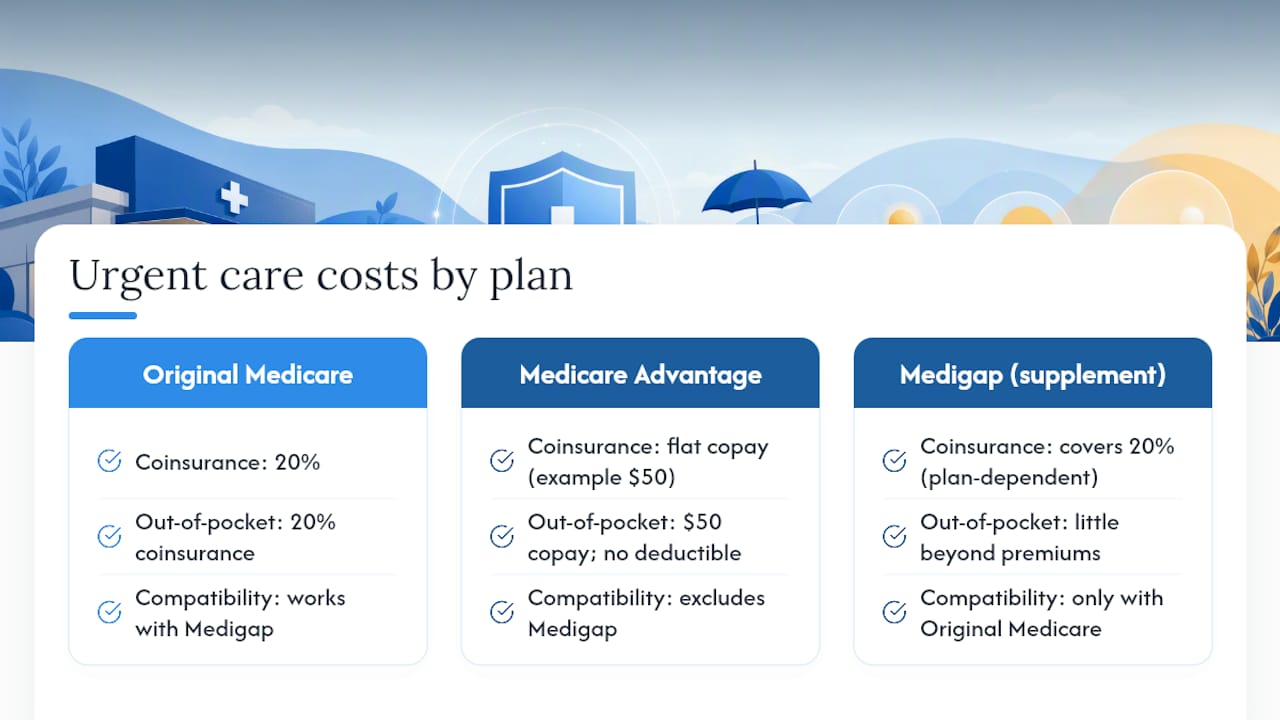
Part D matters too. If the clinic prescribes something on the spot, your out-of-pocket cost depends entirely on your specific formulary and tier structure.
Picture two visits for the same ankle sprain. With Original Medicare and a solid Medigap plan, you might pay close to nothing beyond your premiums. With Medicare Advantage, you might pay a flat $50 copay instead, no deductible involved.
Steps to Take Before and After an Urgent Care Visit
Reduce your risk of a surprise bill with a short routine:
- Verify the clinic accepts Medicare and confirm whether they accept assignment.
- Ask directly whether they bill as hospital outpatient, since that changes your cost.
- Check whether you’ve already met your Part B deductible this year.
- Bring your Medicare card and, if applicable, your Advantage plan ID.
- Request an itemized bill before you leave, not weeks later.
- If something looks wrong, follow Medicare’s claims and appeals process and submit your documentation promptly.
Pro Tip: If you get billed incorrectly, write down every date, name, and dollar amount as soon as you notice it. A licensed agent can also review your plan and help you contest a charge that shouldn’t have landed on your desk.
Advisor perspective: what most people get wrong
Most costly surprises come from skipping one step: confirming acceptance before the visit, not during checkout. Beneficiaries assume all urgent care clinics treat Medicare the same way. They don’t. In plan audits and claims work, the pattern repeats: a five-minute phone call upfront would have prevented the dispute entirely.
Let Core Insurance Solutions Take the Guesswork Out of Your Plan
Coreforseniors gives you something a generic insurance comparison site can’t: a real, local review of whether your specific plan actually handles urgent care the way you think it does. We compare Medicare Advantage and Medigap options side by side, run annual policy audits to catch cost creep before it hits your wallet, and step in on claims advocacy if a bill comes back wrong.
If you’re near Lakeland, Crystal Lake, Plant City, or anywhere else we serve across Central Florida, our team can walk through your current plan’s urgent care copay, check your Part D formulary for common prescriptions, and flag network gaps before you ever need to use them. Watch our free Medicare 101 webinar for a plain-English rundown, or go straight to scheduling a plan review with our Lakeland team to see exactly what you’d pay at the urgent care clinics near you.
Frequently Asked Questions
Is urgent care covered by Medicare? Yes. Medicare Part B covers medically necessary urgent care visits, and Medicare Advantage plans must offer the same coverage, though costs and network rules vary by plan.
What is the urgent care copay under Medicare? Under Original Medicare, there’s no fixed copay. You pay 20% coinsurance after meeting the $283 Part B deductible. Medicare Advantage plans usually charge a flat copay instead, which you can find in your plan’s Summary of Benefits.
Does Medicare cover urgent care out of state? Generally, yes, for Original Medicare. Medicare Advantage plans may limit full coverage to in-network providers, so check your plan before traveling out of your service area.
Will Medicare pay for urgent care I get outside the U.S.? No, in almost all cases. Original Medicare doesn’t cover care received abroad. A Medigap plan with foreign travel emergency benefits can help close that gap.
What should I ask an urgent care clinic before my visit? Ask if they accept Medicare, if they accept assignment, if they bill as hospital outpatient, and if they’re in-network for your specific Medicare Advantage plan.
This article is general information, not a substitute for advice from a qualified doctor. Consult a qualified healthcare professional about your own circumstances before acting on anything here.


