

Medicare Telehealth Coverage: What’s Covered Through 2027
Medicare covers telehealth now, and the flexibilities that expanded virtual care during the pandemic are extended through December 31, 2027, under the Consolidated Appropriations Act, 2026. You’ll generally pay the same cost-sharing as an in-person Part B visit, which is typically 20% after your deductible. A handful of rules are scheduled to tighten again on January 1, 2028, so it’s worth knowing what to verify now.
TL;DR:
- Medicare covers telehealth visits at the same cost-sharing rate as in-person visits, typically 20% after meeting the Part B deductible, with no added surcharge when connecting from home.
- The list of covered services includes primary care, mental health, diabetes training, and certain rehab visits, with behavioral health telehealth being the most permanently secure.
- Telehealth flexibility extensions last through December 2027, but restrictions related to location, provider types, and service scope could return or tighten in 2028.
- Confirm with your provider whether your virtual visit will be billed as Medicare telehealth, and be aware that originating site fees apply only if not connecting from home.
- Medicare Advantage plans often offer more generous or broader telehealth coverage than Original Medicare, making plan-specific reviews essential before scheduling virtual visits.
Table of Contents
- What Counts as Telehealth Medicare Coverage?
- Which Services Does Medicare Cover Over Telehealth?
- How Much Does Telehealth Cost Under Medicare?
- What’s Changing With Medicare Telehealth in 2026 and 2027?
- How Do You Prepare for a Medicare Telehealth Visit?
- Does Medicare Advantage Cover Telehealth Differently?
- Why Trust This Medicare Telehealth Guidance?
- Who Qualifies for Medicare Telehealth Coverage?
- How Do You Find a Medicare-Certified Telehealth Provider?
- How Does Telehealth Affect Prescriptions and Medication Management?
- How Does Medigap Interact With Telehealth Coverage?
- What Isn’t Covered by Medicare Telehealth?
- What This Extension Really Means for You
- Let Core Insurance Solutions Check Your Telehealth Benefits
- Where to Verify Medicare Telehealth Rules Yourself
- Sources
What Counts as Telehealth Medicare Coverage?
Medicare telehealth coverage refers to a defined set of services delivered by live video (and, for many services, audio-only) that Medicare treats as equivalent to an in-person visit for billing purposes. That’s a distinct category from virtual check-ins and e-visits, two terms beneficiaries often confuse with telehealth.
- Telehealth visits use specific billing codes and place-of-service designations, and they’re paid at the same rate as the comparable office visit.
- Virtual check-ins are brief, patient-initiated check-ins (phone or video) to decide if an office visit is needed, usually with a smaller copay.
- E-visits happen through an online patient portal, initiated by an established patient, and billed under separate codes.
CMS maintains a formal Medicare telehealth services list and updates it through the annual physician fee schedule rulemaking process, with most additions or removals taking effect January 1. Several services added during the COVID-19 public health emergency, from mental health counseling to certain chronic care management visits, are now either permanent or extended through 2027 rather than temporary add-ons. That distinction matters if you’re trying to figure out whether a service you relied on in 2023 is still covered today.
Which Services Does Medicare Cover Over Telehealth?
The Medicare telehealth services list covers a wide range of outpatient care, though not every specialty visit qualifies. Common examples include:
- Office and outpatient evaluation visits with your primary care doctor or a specialist
- Psychotherapy and behavioral health counseling sessions
- Diabetes self-management training
- Certain cardiac and pulmonary rehabilitation follow-ups
- Nutrition therapy and some preventive counseling visits
Behavioral health telehealth has the strongest long-term footing of any category. CMS guidance confirms that audio-only visits and expanded geographic access for behavioral and mental health services are treated as more permanent than most other telehealth flexibilities, which are tied to the 2027 extension deadline. If you rely on regular therapy sessions by phone, that access is on more solid ground than, say, a routine specialist follow-up delivered the same way. Some non-behavioral therapy services could face new restrictions once the broader extension lapses in 2028, so it’s worth asking your provider now whether your specific visit type falls into the permanent or the temporary bucket.
How Much Does Telehealth Cost Under Medicare?
For most telehealth visits under Original Medicare, you pay 20% of the Medicare-approved amount after you’ve met your Part B deductible, the same cost-sharing structure as an in-person visit. There’s no separate “telehealth surcharge” built into Original Medicare’s standard cost-sharing.
Where extra fees can show up: if you receive telehealth from a clinic or facility acting as your originating site rather than from home, that facility may bill a separate originating site fee under code Q3014, priced around $31.85 for CY 2026. That fee doesn’t apply if you’re connecting from your own home, which remains an allowed originating site through 2027.
Before your appointment, it helps to confirm a few billing details with the front desk:
- Whether they’ll bill place-of-service code 02 (telehealth not at home) or 10 (telehealth at home)
- Whether a GQ modifier (asynchronous store-and-forward telehealth) applies to your visit
- Whether the practice bills Original Medicare directly or through your Medicare Advantage plan, since the paperwork and network rules differ
What’s Changing With Medicare Telehealth in 2026 and 2027?
The CAA, 2026 extended the major COVID-era telehealth flexibilities through December 31, 2027, and it also directs HHS and CMS to establish new reporting requirements and telehealth modifiers for virtual visits going forward. That reporting piece isn’t just bureaucratic housekeeping. Policy analysts note the data collected under these new modifiers during the extension window will likely shape whatever permanent telehealth policy comes after 2027.
Here’s what stays in place through the end of 2027, according to CMS’s updated Telehealth FAQ:
- Your home counts as an eligible originating site, so you don’t need to travel to a clinic to receive covered telehealth.
- Audio-only visits remain covered for many services, not just behavioral health.
- The list of practitioner types allowed to bill Medicare for telehealth stays expanded, including physical therapists and speech-language pathologists.
- Federally Qualified Health Centers and Rural Health Clinics keep their expanded telehealth billing rules.
On January 1, 2028, absent further legislative action, several of these flexibilities revert: geographic and originating site restrictions could return for many non-behavioral services, and the expanded practitioner list could shrink back toward pre-pandemic rules.
Pro Tip: Mark your calendar for late 2027. CMS typically releases the following year’s physician fee schedule final rule in the fall, so watching for that announcement will tell you months in advance exactly which telehealth rules survive into 2028.
How Do You Prepare for a Medicare Telehealth Visit?
A little prep prevents most of the billing surprises beneficiaries run into with virtual visits.
- Call the practice ahead of time and confirm they participate in Medicare and will bill your visit as telehealth, not an uncovered virtual check-in.
- Ask directly what your estimated cost will be, including whether an originating site fee applies.
- Test your camera, microphone, and internet connection (or confirm your phone line works, if it’s audio-only) a day before the appointment.
- If you need an interpreter or accessibility accommodation, request it when you schedule, not the day of.
- Save the visit summary, any after-visit notes, and your Medicare Summary Notice once it arrives, so you have a paper trail if something is billed incorrectly.
If a telehealth claim gets denied or a charge looks wrong, start with the billing office that submitted the claim. If that doesn’t resolve it, Medicare’s appeals process and your State Health Insurance Assistance Program can both help sort out disputed charges.
Pro Tip: Audio-only visits still generate a Medicare Summary Notice just like video visits. Check yours against what you were told at scheduling. A mismatch is often the first sign of a coding error, not a coverage denial.
Does Medicare Advantage Cover Telehealth Differently?
Medicare Advantage plans frequently go beyond what Original Medicare covers for virtual care, sometimes lowering your copay for a virtual primary care visit to a few dollars or offering telehealth for specialties Original Medicare doesn’t cover at all.
- Check your plan’s Evidence of Coverage document for a telehealth or “virtual visits” benefit section.
- Call your plan’s member services line directly. Plan-specific benefits vary enough that a general answer about “Medicare telehealth” won’t tell you what your plan actually pays.
- If you’re comparing Medicare Advantage plans for the first time or reviewing whether your current plan still fits, that’s exactly the kind of side-by-side comparison Core Insurance Solutions helps Lakeland-area families work through every enrollment season.
Why Trust This Medicare Telehealth Guidance?
Core Insurance Solutions has helped more than 2,000 families across Lakeland, Winter Haven, and Bartow sort through Medicare decisions, including plan-specific telehealth benefits. Beyond this guide, resources include a Medicare 101 webinar, a plan eligibility calculator, and annual policy audits that catch coverage gaps before they become expensive surprises.
Who Qualifies for Medicare Telehealth Coverage?
If you’re enrolled in Medicare Part B, whether through Original Medicare or a Medicare Advantage plan, you’re generally eligible for covered telehealth services. There’s no separate telehealth enrollment or application process required beyond your existing Medicare enrollment.
That said, eligibility for a specific telehealth visit depends on a few factors beyond just having Part B:
The service itself has to be on Medicare’s telehealth list. Not every type of medical visit qualifies for virtual delivery, even during the extension period. Your provider’s office should be able to tell you whether a given appointment type is eligible before you schedule it.
Your provider has to be enrolled in Medicare and willing to bill telehealth appropriately. Some practices, particularly smaller specialty offices, still don’t offer virtual visits even when the service itself is covered, simply because they haven’t built out the billing workflow or technology.
Original Medicare beneficiaries currently qualify regardless of location, a change from pre-pandemic rules that restricted telehealth to rural areas. That geographic flexibility is part of what’s extended through December 31, 2027, and part of what could tighten again in 2028.
Medicare Advantage enrollees follow their plan’s specific rules, which are often more generous than Original Medicare but vary by carrier. If you’re newly turning 65 or switching plans, confirming telehealth eligibility should be part of your enrollment conversation, not an afterthought you discover the first time you try to book a virtual visit.
How Do You Find a Medicare-Certified Telehealth Provider?
Start with a provider you already see. Most primary care practices, mental health counselors, and specialists who accept Medicare now offer at least some virtual visit options, and asking your existing doctor’s office is faster than searching for a new one.
If you’re looking for a new telehealth provider, a few verification steps protect you from surprise bills:
- Ask directly, “Do you accept Medicare, and do you bill telehealth visits as Medicare-covered services?” A “yes” to accepting Medicare doesn’t always mean “yes” to billing this particular visit as telehealth.
- Use Medicare’s official provider search tool on Medicare.gov to confirm a provider is enrolled in Medicare before your first virtual appointment.
- If you’re on a Medicare Advantage plan, check your plan’s provider directory or call member services, since your plan’s network for telehealth may differ from its network for in-person care.
- Be cautious of telehealth-only platforms advertising services without ever confirming Medicare billing. Some direct-to-consumer telehealth apps operate outside Medicare entirely and charge cash rates, which is fine if you know that going in, but a problem if you assumed Medicare would cover it.
Federally Qualified Health Centers and Rural Health Clinics have their own expanded telehealth billing rules that remain in place through 2027, so if you get care through one of these centers, ask specifically how their telehealth billing works, since it can differ from a standard physician’s office.
How Does Telehealth Affect Prescriptions and Medication Management?
A telehealth visit carries the same prescribing authority as an in-person one. If your doctor determines during a virtual visit that you need a new prescription or a dosage adjustment, they can send that prescription to your pharmacy exactly as they would after an office visit.

Medication management has actually become one of the more practical use cases for virtual care among older adults. Routine follow-ups to check how a blood pressure medication or diabetes treatment is working often don’t require a physical exam, which makes them well suited to a video or even audio-only check-in. That’s part of why diabetes self-management training and similar chronic care visits appear on Medicare’s telehealth services list.
A few things worth knowing about how this intersects with your drug coverage:
- Telehealth doesn’t change your Part D plan’s formulary or what tier a drug falls under. Coverage and copay rules for the medication itself stay the same whether it was prescribed in person or virtually.
- Controlled substance prescribing over telehealth has specific federal requirements that go beyond Medicare’s own rules, so if you’re managing a controlled medication, ask your provider directly whether a video visit will satisfy those requirements or whether an in-person visit is still needed periodically.
- If a virtual visit results in a new prescription, ask your provider’s office to send it electronically to your pharmacy rather than relying on a phone-in order, which reduces errors and speeds up pickup.
If you’re trying to lower what you pay out of pocket for prescriptions overall, that’s a separate conversation from telehealth access, and one Core Insurance Solutions works through with clients as part of routine Part D plan reviews.
How Does Medigap Interact With Telehealth Coverage?
If you have Original Medicare plus a Medigap (Medicare Supplement) policy, your telehealth cost-sharing works the same way it does for any other covered Part B service. Medicare pays its share, and depending on which Medigap plan letter you hold, your policy picks up some or all of the remaining 20% coinsurance.
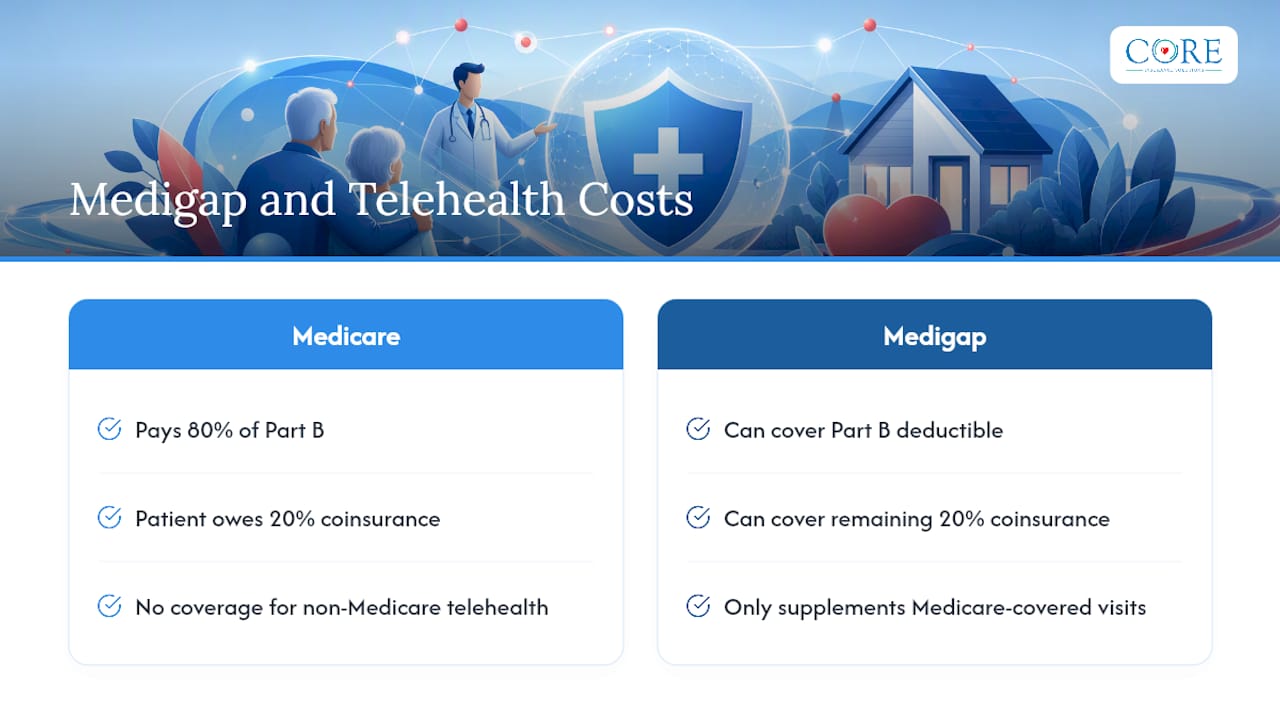
This is one of the more overlooked advantages of pairing Medigap with telehealth access. If your Medigap plan covers the Part B deductible and coinsurance, a telehealth visit can end up costing you the same as it would with no telehealth involved at all, which is to say, close to nothing.
One caveat: Medigap policies don’t cover services Original Medicare doesn’t cover in the first place. If a virtual visit doesn’t qualify as Medicare telehealth (an e-visit through a portal, for instance, or a cash-pay telehealth app), your Medigap policy has nothing to supplement, since there’s no Medicare payment for it to fill in behind. That’s another reason confirming a visit is billed as genuine Medicare telehealth, not a look-alike service, matters before you assume your Medigap plan has you covered.
What Isn’t Covered by Medicare Telehealth?
Medicare telehealth coverage has real boundaries, and running into one unexpectedly is how most billing surprises happen.
Certain specialty care still generally requires an in-person visit. Procedures requiring hands-on examination, imaging that requires equipment in the room, and many surgical consultations aren’t candidates for virtual delivery regardless of how flexible the rules get. Dental, vision, and hearing services aren’t part of Medicare telehealth coverage at all, since routine care in those categories typically isn’t covered by Original Medicare in any format; if you want that coverage, it comes through a separate benefit or a Medicare Advantage plan with dental, vision, and hearing add-ons.
New patient visits face more restrictions than established patient visits in some circumstances, since certain telehealth codes require an existing patient relationship. If you’re trying to establish care with a brand-new doctor for the first time, ask upfront whether that first visit can happen virtually or whether it needs to be in person.
Emergency care, obviously, isn’t a telehealth substitute. And services that fall outside CMS’s telehealth list entirely, even if delivered over video, simply won’t be paid at Medicare’s telehealth rate; they may be billed as an uncovered virtual check-in or e-visit with different, sometimes higher, out-of-pocket costs. The safest habit is asking your provider’s office one direct question before any virtual appointment: “Will this be billed as Medicare telehealth?” If the answer is anything other than a clear yes, ask what it will be billed as instead.
What This Extension Really Means for You
The 2027 extension buys real time, not a permanent guarantee. For most Lakeland-area seniors we work with, that means continuing to use telehealth exactly as they have been, while treating late 2027 as a checkpoint rather than an afterthought. Behavioral health access looks the most durable of anything on the telehealth list. Everything else deserves a fresh look before the calendar turns.
The smartest move right now isn’t worrying about 2028. It’s confirming what your specific plan covers today, since that’s where most of the confusion actually lives. Watching our Medicare 101 webinar replay or running your situation through our eligibility calculator takes fifteen minutes and usually answers more questions than a week of searching online.
— Core Insurance Solutions
Let Core Insurance Solutions Check Your Telehealth Benefits
Figuring out whether your specific plan covers telehealth the way you think it does isn’t something a generic Medicare.gov search can answer, since Medicare Advantage benefits vary by carrier and by county. Core Insurance Solutions reviews your actual plan documents, compares telehealth benefits and cost-sharing across major carriers, and flags gaps before they turn into a bill you didn’t expect.

Our team handles unbiased plan comparisons, enrollment paperwork, annual policy audits, and help lowering prescription costs, all without steering you toward one carrier for our own convenience. If you’re not sure whether your current plan’s telehealth benefits still make sense heading into 2027, watch our Medicare 101 webinar replay or visit our Medicare plans and services page to schedule a free consultation with a local agent who can walk through your options line by line.
Where to Verify Medicare Telehealth Rules Yourself
For primary source reading, Medicare.gov’s telehealth coverage page covers costs and eligible services. CMS’s Telehealth FAQ answers billing and geographic questions. HHS Telehealth tracks policy changes, and the CAA, 2026 summary explains the legislative extension itself.
Sources
- Medicare
- Telehealth policy updates (HHS Telehealth)
- Consolidated Appropriations Act, 2026: section-by-section (U.S. Senate Finance Committee)


