

Prescription Assistance Programs: Where to Start and How to Apply
Yes, real help exists, and you should start with one program before any other: Medicare’s Extra Help, also called the Low-Income Subsidy (LIS). If you’re on Medicare and struggling with drug costs, Extra Help typically covers a slice of your premiums, deductibles, and coinsurance, and it often opens the door to other savings automatically. Beyond that, three more layers can stack on top: State Pharmaceutical Assistance Programs (SPAPs), manufacturer patient assistance programs (PAPs), and nonprofit foundation grants.
- Extra Help (federal): apply through the Social Security Administration online or by phone.
- SPAPs (state): wraparound coverage that varies by where you live.
- Manufacturer PAPs and nonprofit funds: helpful for gaps Extra Help and SPAPs don’t close.
Pro Tip: Run a free BenefitsCheckUp screening today. It takes about 10 minutes and flags every program you might qualify for, not just Extra Help.
Key Takeaways
Extra Help should be the first program every Medicare beneficiary checks, because it’s federal, predictable, and often unlocks additional savings automatically.
| Point | Details |
|---|---|
| Apply for Extra Help first | Federal LIS coverage lowers premiums and coinsurance; apply through SSA online or by phone. |
| Layer state and nonprofit help | Check SPAPs, NeedyMeds, and RxAssist after Extra Help to close remaining gaps. |
| Gather documents early | Bank statements, benefit letters, and ID speed up any application you file. |
| Recheck eligibility yearly | 2026 resource limits and your own finances both change, so reapply if you were denied before. |
| Get a professional plan review | Core Insurance Solutions offers annual Part D audits and claims advocacy to complement assistance programs. |
This article is general information, not a substitute for advice from a qualified doctor. Consult a qualified healthcare professional about your own circumstances before acting on anything here.
Table of Contents
- What Types of Prescription Assistance Programs Exist?
- Who Qualifies for Extra Help, and What Should You Gather First?
- How Do You Actually Find and Apply for Help?
- When Should You Bring in a Licensed Medicare Advisor?
- Which Resources Should You Trust First?
- Why Extra Help Deserves First Priority, Not an Afterthought
- How Core Insurance Solutions Fits Into Your Prescription Cost Plan
- Sources
What Types of Prescription Assistance Programs Exist?
Four distinct systems handle prescription assistance in the United States, and confusing them wastes time you don’t have.
Extra Help (LIS) is federal and works only alongside Medicare Part D. It reduces or eliminates your monthly premium, cuts your deductible, and caps what you pay per prescription. People with full Medicaid, a Medicare Savings Program, or Supplemental Security Income get enrolled automatically. Everyone else has to apply. Extra Help exists in all 50 states with the same federal rules everywhere, which makes it the most predictable place to start.
State Pharmaceutical Assistance Programs work differently. They “wrap around” your existing Part D plan rather than replacing it, paying costs after your Part D plan processes the claim first. Some states run SPAPs, and the programs vary widely among those states. New Jersey’s PAAD and Pennsylvania’s PACE and PACENET programs are among the longest-running examples, according to the National Council on Aging. Some states cap enrollment or restrict eligibility by diagnosis, so confirm current rules with your state’s aging office before assuming you qualify.
Manufacturer PAPs and nonprofit foundations fill a different gap entirely. Drug companies designed most PAPs to help uninsured or commercially insured patients, not people on Medicare, so Medicare beneficiaries often hit a wall here. Nonprofits like the PAN Foundation and Patient Advocate Foundation run disease-specific grant funds that can help regardless of insurance status, though funds open and close depending on donations and demand.
Here’s where people get confused: Medicaid and CHIP are insurance programs that cover prescriptions directly. SPAPs and PAPs are not insurance. They’re assistance layered on top of whatever coverage you already have.
Who Qualifies for Extra Help, and What Should You Gather First?
Eligibility hinges on income, resources, and a few automatic triggers. Here’s the checklist:
- Check for automatic qualification. If you have full Medicaid, a Medicare Savings Program, or SSI, Extra Help usually applies without you filing anything.
- Confirm your income and resource levels. CMS set the 2026 resource limits at $16,590 for a single applicant and $33,100 for a married couple, with income generally assessed against federal poverty guidelines.
- Gather your paperwork. You’ll need recent bank and retirement account statements, Social Security award letters, and proof of any other benefits.
- Mark your calendar to reapply. Resource limits and your own finances both shift year to year, so a denial in 2025 doesn’t mean a denial in 2026.
If your savings dropped or your income changed since your last check, it’s worth reapplying even if you were turned down before.
How Do You Actually Find and Apply for Help?
Work through these in order. Each step either gets you assistance directly or points you toward it.
- Apply for Extra Help first. Use the SSA’s online application or call the agency directly. SSA will ask for the income and resource documentation you gathered above, and most applications get a decision within a few weeks.
- Run a BenefitsCheckUp screening. NCOA’s free tool cross-references dozens of programs at once, catching state and nonprofit options you’d never find searching one by one.
- Search NeedyMeds and RxAssist for manufacturer programs. NeedyMeds maintains a searchable database of PAPs, discount cards, and free clinics, and RxAssist organizes assistance listings by drug name and manufacturer.
- Call your local SHIP counselor. State Health Insurance Assistance Programs offer free, one-on-one help and know your state’s SPAP rules better than any national website.
If those routes come up short, apply directly to a manufacturer PAP or a foundation fund. You’ll typically need your prescriber’s signature, proof of income, and your diagnosis documented for disease-specific grants.
- Extra Help: apply through SSA
- State help: contact your SHIP or state aging department
- Manufacturer or nonprofit gaps: search NeedyMeds and RxAssist
Pro Tip: Sign up for PAN Foundation’s fund alerts before you need them. Disease-specific grant funds open and close fast, and an email alert can be the difference between getting in and missing the window.
When Should You Bring in a Licensed Medicare Advisor?
Part D formularies change every year, sometimes dramatically. A plan that covered your medications cheaply in 2025 might reclassify one of them to a higher tier in 2026, and you won’t know unless you check.
A licensed advisor earns its keep in a few specific situations:
- You take specialty or brand-name medications with no generic equivalent.
- You have both Medicare and Medicaid and aren’t sure how the two interact with Extra Help.
- Your plan denied a claim or you’re stuck in an appeals process.
- You haven’t compared plans during Open Enrollment in more than a year.
Pro Tip: Even if you already have Extra Help, an annual Part D formulary review can catch a cheaper plan that covers your exact drug list better than your current one.
Which Resources Should You Trust First?
Stick to these sources before anything you find through a general search engine.
- SSA Extra Help application: the official starting point for applying, with phone support if you’d rather not use the online form.
- Medicare: covers Extra Help details, LI NET temporary coverage, and links to SPAP information by state.
- NCOA’s BenefitsCheckUp: a single screening tool that checks you against dozens of federal, state, and nonprofit programs at once.
- NeedyMeds and RxAssist: searchable databases for manufacturer PAPs and other drug cost discounts.
- Your state SHIP office: free, local, and the fastest way to confirm SPAP details for where you live.
Why Extra Help Deserves First Priority, Not an Afterthought
Most advice on this topic treats every program as equally worth checking, which sounds thorough but wastes a reader’s limited time and energy. It isn’t. Extra Help is federal, predictable, and often does the heaviest lifting on its own, which is exactly why it belongs first in line.
The conventional advice undersells state programs badly. Extra Help gets all the publicity, so people assume it’s the whole answer and stop looking. It usually isn’t. A retiree in a state with a real SPAP can end up paying less out of pocket than a retiree in a state without one, even with identical Medicare coverage. That’s not a small detail. It’s the difference between a workable drug budget and a monthly scramble.
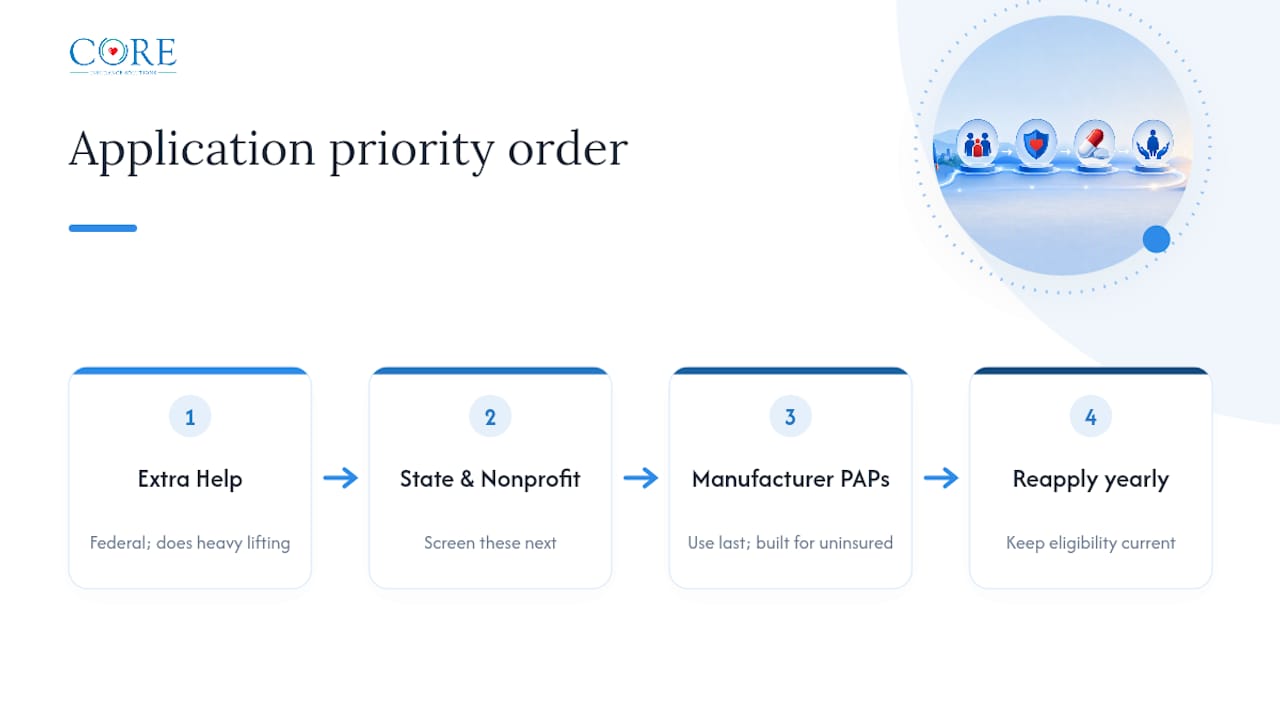
The other place conventional wisdom fails: treating manufacturer PAPs as a first stop instead of a last resort. Those programs were built mainly for the uninsured. Medicare beneficiaries chasing them first often burn weeks before circling back to Extra Help and SPAPs, which were the better fit from the start.
Apply for Extra Help. Screen for state and nonprofit help. Reapply every year. That sequence, in that order, is what actually moves the needle.
— Core Insurance Solutions
How Core Insurance Solutions Fits Into Your Prescription Cost Plan
Assistance programs solve part of the puzzle, but picking the right Part D plan in the first place solves a bigger chunk of it. Core Insurance Solutions works with Medicare beneficiaries across Lakeland, Crystal Lake, Plant City, Winter Haven, and the surrounding Polk County area to make sure your drug coverage actually matches your medication list, not just a generic plan someone signed you up for years ago.
Our team runs annual policy audits that catch formulary changes before they hit your wallet, walks clients through the Extra Help application when it makes sense, and steps in as an advocate if a claim gets denied unfairly. We compare plans across major carriers without steering you toward one for our own benefit, and prescription cost optimization is built into every review we do. If you want a straightforward second opinion on your current Part D plan or help figuring out which assistance programs actually apply to you, start with our free Medicare 101 webinar replay or reach out for a no-cost consultation on your prescription drug plan options in Lakeland.
Sources
- Apply for Medicare Part D Extra Help program — SSA
- Help with drug costs — Medicare
- Prescription Help from States and Drug Manufacturers — NCOA
- Resource limits for the Medicare Part D Low-Income Subsidy: Annual adjustment for CY 2026 — CMS
- NeedyMeds


