

20% Coinsurance: What Medicare Mental Health Covers for U.S. Seniors
Original Medicare covers mental health care in two distinct lanes: Part A pays for inpatient psychiatric hospital stays, and Part B pays for outpatient care like therapy, psychiatric evaluations, and telehealth visits. Part D covers psychiatric medications. The cost rule that catches most people off guard: once you meet your Part B deductible, you typically pay 20% coinsurance for outpatient visits, but only if your provider accepts assignment.
TL;DR:
- Medicare’s outpatient mental health care costs are largely dependent on provider acceptance of assignment, which affects coinsurance and potential excess charges.
- Psychiatric medications are covered under Part D, but drug costs vary based on plan formulary tiers, and low-income beneficiaries may qualify for assistance programs.
- The lifetime limit of 190 days applies only to freestanding psychiatric hospitals, while in-hospital units within general hospitals do not count toward this cap.
- Telehealth mental health services are now a permanent feature of Medicare, with temporary flexibilities in place for audio-only visits, requiring an in-person visit within six months before initial therapy.
- Many providers, especially in private practice, opt out of Medicare due to lower reimbursement rates and administrative burdens, making prior verification essential before appointments.
Core Insurance SolutionsReview Your Medicare CoverageGet personalized guidance comparing Medicare options, prescription costs, and coverage details for your healthcare needs.Explore Medicare guidance
Table of Contents
- What Medicare Covers for Mental Health: Parts A, B, D, and Advantage
- Who Can Bill Medicare for Outpatient Therapy?
- How Inpatient Psychiatric Stays Affect Your Costs
- Telehealth and Digital Mental Health Tools: What’s Covered Now
- What You’ll Actually Pay: Assignment, Excess Charges, and Facility Fees
- Coverage for Addiction Treatment, PHP, IOP, and Preventive Screenings
- How to Find a Medicare Mental Health Provider Near You
- How Core Insurance Solutions Helps Beneficiaries Navigate Mental Health Coverage
- Get Personalized Help Reviewing Your Medicare Mental Health Coverage
- Where to Verify Mental Health Coverage Rules
- Sources
- FAQ
What Medicare Covers for Mental Health: Parts A, B, D, and Advantage
Mental health coverage under Medicare isn’t one benefit. It’s four separate systems working together, and knowing which one applies to your situation changes what you pay and where you can get care.
Part A handles inpatient psychiatric hospital care: your room, meals, nursing care, and any drugs administered during the stay. If you’re admitted to a freestanding psychiatric hospital rather than a general hospital, Part A caps your coverage at 190 days over your lifetime. That’s a hard ceiling, not a per-year limit, and it applies only to freestanding facilities.
Part B is where most mental health treatment actually happens. It covers individual and group psychotherapy, psychiatric diagnostic evaluations, family counseling when it’s part of your treatment plan, and partial hospitalization or intensive outpatient program services delivered in qualifying settings. Medicare.gov’s outpatient mental health coverage page also lists depression and alcohol misuse screenings, which can be free if your provider accepts assignment.
Part D covers the medications tied to mental health treatment. Most Part D plans are required to cover substantially all drugs in six protected classes, including antidepressants, antipsychotics, and anticonvulsants. Formularies still vary by plan, so the specific drug you take might sit on a different cost tier depending on the carrier.
Medicare Advantage plans must cover everything Original Medicare covers, but many add supplemental behavioral health benefits, such as expanded telehealth counseling or lower copays for therapy visits. The tradeoff is usually a narrower provider network.
Who Can Bill Medicare for Outpatient Therapy?
Not every mental health professional can bill Medicare directly, and that distinction affects whether you get charged at all.
Providers who can bill Part B directly for outpatient mental health services include psychiatrists, clinical psychologists, clinical social workers, nurse practitioners, physician assistants, and clinical nurse specialists. Marriage and family therapists and licensed mental health counselors gained direct Medicare billing rights in recent years, expanding access in areas where psychiatrists are scarce. Other professionals, like certain counselors without independent billing status, may provide care “incident to” a physician’s supervision, meaning the physician’s practice bills for the service instead.
You’ll typically find these services delivered in a psychiatrist’s office, a hospital outpatient department, a community mental health center (CMHC), or a federally qualified health center (FQHC) or rural health clinic (RHC). Each setting can carry different facility fees on top of the provider’s charge.
Before your first visit, run through this quick checklist:
- Ask directly: “Do you accept Medicare, and do you accept assignment?”
- If the answer to assignment is no, ask what the excess charge percentage looks like.
- Confirm whether the facility bills separately from the provider (common at hospital outpatient departments).
- Ask if telehealth visits are billed the same as in-person visits.
Assignment matters because a provider who accepts it agrees to charge only the Medicare-approved amount, leaving you responsible for the deductible and 20% coinsurance. Skip this question and you could end up owing considerably more.
How Inpatient Psychiatric Stays Affect Your Costs
Inpatient psychiatric care runs on “benefit periods,” and understanding this mechanic can save you real money.
A benefit period starts the day you’re admitted to the hospital and doesn’t end until you’ve gone 60 consecutive days without inpatient care. If you’re readmitted within that 60-day window, you’re still in the same benefit period and don’t face a new deductible. But if you’re readmitted after that window closes, a new benefit period begins, which means a new Part A deductible.
Freestanding psychiatric hospitals carry a 190-day lifetime limit, a rule unique to mental health care. Distinct-part psychiatric units inside general acute-care hospitals don’t count against that limit, which is why some patients needing longer-term treatment get routed there instead.
Within a benefit period, you pay the Part A deductible for days 1 through 60, a daily coinsurance for days 61 through 90, and can draw on 60 lifetime reserve days after that if needed. Even during an inpatient stay, Part B still covers physician visits and psychiatric evaluations performed by your doctor.
Telehealth and Digital Mental Health Tools: What’s Covered Now
Telehealth for mental health care is now a permanent part of Medicare, not a temporary pandemic accommodation. Part B covers behavioral health telehealth visits, including audio-only appointments when video isn’t accessible or when a patient prefers a phone call.
There’s one timing rule worth knowing: current HHS telehealth policy generally requires an in-person visit within six months before your first mental health telehealth appointment, with periodic in-person visits after that. Flexibilities around this requirement have been extended through at least December 31, 2027, so ask your provider how the current rule applies to your case.
Pro Tip: Call your provider’s office before scheduling a telehealth appointment and ask directly whether an in-person visit is required first under their current billing setup. Rules shift, and offices don’t always advertise the change.
Quick facts on telehealth coverage:
- Psychiatrists, psychologists, clinical social workers, and nurse practitioners can all bill for telehealth mental health visits.
- You pay the standard 20% Part B coinsurance after your deductible, same as an in-office visit.
- FDA-cleared digital mental health treatment (DMHT) devices are billed by your treating practitioner under specific G-codes, not purchased directly by you.
What You’ll Actually Pay: Assignment, Excess Charges, and Facility Fees
The gap between what you expect to pay and what actually lands on your bill almost always traces back to three things: assignment, facility fees, and whether you have supplemental coverage.
If your provider accepts assignment, that’s the whole story. If they don’t, they can add an excess charge of up to 15% above the approved amount, and you’re on the hook for that difference.
Hospital outpatient departments add another layer: a separate facility fee alongside the provider’s charge, meaning two line items instead of one.
A few ways to protect your budget:
- Confirm assignment status before your first appointment, not after the bill arrives.
- Ask hospital-affiliated clinics whether they bill a separate facility fee.
- Check whether a Medigap policy covers your Part B coinsurance and any excess charges.
- If Part D drug costs for psychiatric medications are tight, ask about Extra Help, the federal program that lowers premiums and copays for qualifying low-income beneficiaries.
A Medicare Advantage plan can restructure these costs entirely, sometimes with flat copays instead of coinsurance, but usually within a narrower network.
Coverage for Addiction Treatment, PHP, IOP, and Preventive Screenings
Medicare’s mental health coverage extends well beyond talk therapy into substance use treatment and preventive care, and the settings matter as much as the services themselves.
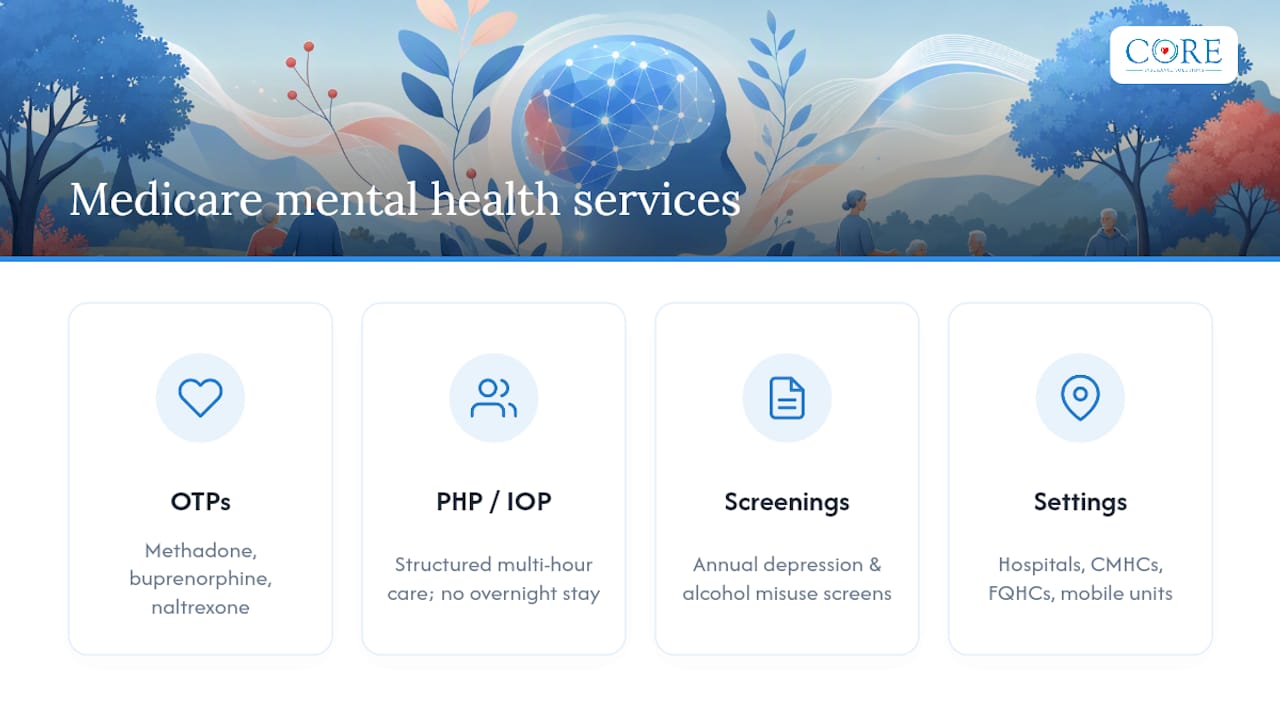
Opioid use disorder treatment is covered through opioid treatment programs (OTPs), including medications like methadone, buprenorphine, and naltrexone, along with counseling and toxicology testing. Some services are even delivered through mobile units, extending access to rural areas.
Partial hospitalization programs (PHP) and intensive outpatient programs (IOP) offer structured, multi-hour treatment without an overnight stay. These are typically delivered through hospital outpatient departments, CMHCs, or FQHCs, and require a physician-certified treatment plan showing medical necessity.
On the preventive side, Medicare covers an annual depression screening and alcohol misuse screening, plus brief counseling sessions tied to a positive alcohol screening, at no cost when your provider accepts assignment. Documentation of medical necessity, meaning your provider records why the treatment fits your diagnosis and history, is what keeps claims from getting denied. The MLN1986542 booklet from CMS breaks down these program-specific rules in more depth.
How to Find a Medicare Mental Health Provider Near You
Finding a provider who actually takes Medicare, and takes assignment, takes a few extra minutes upfront but saves real frustration later.
- Start with Medicare.gov’s Care Compare tool or call 1-800-MEDICARE to search for enrolled mental health providers in your area.
- Contact your State Health Insurance Assistance Program (SHIP) for free, unbiased counseling on coverage questions specific to your situation.
- Before booking, ask every provider: Do you accept Medicare? Do you accept assignment? Does your facility bill separately? Do you offer telehealth?
- Verify the provider’s Medicare enrollment and National Provider Identifier (NPI) directly through Care Compare rather than taking a receptionist’s word for it.
- For plan-level questions, like whether your Medicare Advantage plan requires prior authorization for PHP or IOP, reviewing your specific plan benefits or speaking with SHIP or a licensed agent can clarify what’s required before you start treatment.
How Core Insurance Solutions Helps Beneficiaries Navigate Mental Health Coverage
Mental health coverage questions rarely show up in isolation. They usually surface alongside a bigger question: is this plan actually built for what I need? That’s the piece Core Insurance Solutions focuses on with seniors across Lakeland, Winter Haven, Auburndale, and the surrounding Polk County communities.
Our approach starts with comparing Medicare Advantage, Medigap, and Part D options side by side against a client’s actual medical history, not a generic checklist. That includes reviewing Part D formularies for psychiatric medications, since drug tiers shift year to year and can quietly raise your costs if nobody catches it. Annual policy audits can catch these changes before they hit your wallet, and claims advocacy may assist when a bill looks wrong.
None of this replaces your doctor. If you have an urgent clinical need, talk to your provider or SHIP first. Coverage guidance works best once your treatment plan is already in place.
— Core Insurance Solutions
Get Personalized Help Reviewing Your Medicare Mental Health Coverage
Here’s the honest version of a next step: check what your current plan actually covers, gather your medication list and provider names, then decide if you need a second set of eyes on the details. Core Insurance Solutions is the alternative to guessing your way through open enrollment. Unlike a generic insurance hotline, we run a full comparison across major carriers serving Lakeland, FL and the surrounding Polk County area, then match it against your actual health needs, not a one-size-fits-all script.
If you’re not ready for a full consult yet, start with two free tools: the Medicare 101 webinar replay walks through how mental health benefits fit into the bigger Medicare picture, and the Medicare Premium Estimator gives you a real number for what Part B and Part D might cost before you commit to anything.
A consultation with our team covers a full policy review, a side-by-side of plan options available in your area, a check of your Part D formulary against the medications you actually take, and support if a claim gets denied or a bill looks off. Schedule a review of your current plan and find out whether your mental health benefits are actually working as hard as they should be.
Where to Verify Mental Health Coverage Rules
- Medicare’s inpatient and outpatient mental health pages for official coverage rules and cost details.
- The Medicare & Your Mental Health Benefits booklet for a plain-language overview straight from CMS.
- HHS telehealth policy updates for the latest audio-only and in-person visit rules.
- Your State Health Insurance Assistance Program (SHIP) for free, one-on-one coverage counseling.
- SAMHSA’s National Helpline and NIMH for treatment locators and crisis support resources.
This article is general information, not a substitute for advice from a qualified doctor. Consult a qualified healthcare professional about your own circumstances before acting on anything here.
Sources
- Mental health care (outpatient) | Medicare
- Mental health care (inpatient) | Medicare
- MLN1986542 – Medicare & Mental Health Coverage (CMS)
- Telehealth
FAQ
Will Medicare pay for mental health care?
Yes. Part A covers inpatient psychiatric hospital stays, Part B covers outpatient therapy, evaluations, and telehealth, and Part D covers psychiatric medications, with standard deductible and coinsurance rules applying.
Why do some therapists not accept Medicare?
Medicare’s reimbursement rates are often lower than private insurance pays, and the billing and documentation requirements can be more time consuming, which leads some therapists, particularly those in solo private practice, to opt out of the program entirely.
What does Medicare not cover for mental health?
Medicare generally doesn’t cover long-term custodial care, marriage counseling that isn’t tied to a diagnosed condition, or services from providers who aren’t enrolled in Medicare, and coverage gaps also show up when a freestanding psychiatric hospital stay exceeds the 190-day lifetime limit.
Does Medicare cover telehealth therapy?
Yes, permanently, under Part B, including audio-only sessions in certain situations, though an in-person visit is generally required within six months before your first telehealth mental health appointment under current HHS policy.


