

Medigap in Florida: Buy Within Your 6 Month Window, New Enrollees
For most Florida residents turning 65, Plan G or Plan N covers the bulk of Medicare’s cost gaps at a manageable premium, and the choice between them mostly comes down to how much you value flat, predictable bills versus lower monthly cost. Your window to buy either one without health questions is short: a one-time Medigap Open Enrollment Period lasting half a year tied to Part B enrollment. Miss it, and insurers can medically underwrite you. Note that Medigap never includes drug coverage. You’ll still need a separate Part D plan.
TL;DR:
- Once the six-month Medigap open enrollment starts at age 65 and enrollment in Part B, insurers cannot deny coverage or charge more based on health.
- Florida’s issue-age rating locks premiums to your age at purchase, but rate increase history and regional factors like zip code influence long-term costs.
- Outside the open enrollment, guaranteed issue rights are limited to specific triggers, such as switching from Medicare Advantage or losing coverage, with narrow 63-day windows.
- Medigap plans in Florida do not include drug coverage and require a separate Part D plan, nor do they cover dental, vision, or overseas emergency care.
- Comparing carriers should focus on financial strength and rate increase history, as benefits are standardized by plan letter and coverage is identical across providers.
Table of Contents
- What Does Medigap Cover in Florida?
- When Is Florida’s Medigap Open Enrollment Period?
- How Does Medigap Pricing Work in Florida?
- How Do You Buy a Medigap Policy in Florida?
- Medigap or Medicare Advantage: Which Fits You Better?
- Where Can Florida Residents Get Free Medigap Help?
- What Doesn’t Medigap Cover in Florida?
- How Do You File a Medigap Claim in Florida?
- Can Florida Insurers Cancel or Raise Your Medigap Rates?
- How Do You Compare Medigap Carriers in Florida?
- Publisher Perspective: How Core Insurance Solutions Helps Florida Seniors Choose
- Get Local Help Choosing Your Florida Medigap Plan
- Sources
What Does Medigap Cover in Florida?
Every Medigap policy sold in the United States follows a federal standardization rule: a Plan G from one carrier covers exactly the same benefits as a Plan G from another. The letter defines the benefits. The carrier only controls the price and how it treats you after you file a claim. That single fact makes shopping in Florida far simpler than most people expect, because you’re never comparing apples to oranges on coverage. You’re comparing service and premium history on identical benefits, per Medicare’s plan comparison chart Medicare’s plan comparison chart.
Three options dominate the Florida market:
- Plan G covers everything Original Medicare doesn’t except the annual Part B deductible. It’s the closest thing to “set it and forget it” coverage, and it’s why most new enrollees land here.
- Plan N trades a lower premium for small copays (typically $20 for office visits, $50 for ER visits) and no coverage for Part B excess charges. If you rarely see specialists who bill above the Medicare-approved amount, the savings usually outweigh the copays.
- High-deductible Plan G flips the math: a much lower monthly premium in exchange for a higher annual deductible you pay before the plan kicks in. It fits residents who are healthy now and want to hedge against a bad year without paying full freight every month.
Plans C and F still exist, but only if you became Medicare-eligible before January 1, 2020. If you’re newly eligible, those two letters simply aren’t on your menu, no matter what a quote comparison site shows you.
When Is Florida’s Medigap Open Enrollment Period?
Florida’s Medigap Open Enrollment Period (OEP) starts the first day of the month you’re both 65 or older and enrolled in Medicare Part B. It runs for a half-year period, and it’s the only guaranteed window most people get. During that half-year period, an insurer cannot turn you down or charge you more because of a preexisting condition, under Florida’s Medicare Supplement Insurance rules.
Outside that window, you still might qualify for guaranteed issue rights under a handful of specific triggers:
- You tried a Medicare Advantage plan within your first year and want to switch back (the “trial right”).
- You lose employer or union coverage that was paying secondary to Medicare.
- Your Medicare Advantage plan leaves your area, or you move out of its service area.
- Your Medigap insurer goes bankrupt or misleads you into dropping coverage.
Each of these opens a narrow window, usually 63 days, so acting fast matters as much as knowing your rights exist.
Miss both the OEP and every guaranteed-issue trigger, and Florida insurers can require full medical underwriting. That means health questions, possible coverage denials for certain conditions, and premiums priced against your actual risk instead of the standard rate. According to federal Medigap guidance, this is true nationally, but Florida’s issue-age rating system (explained next) makes timing even more consequential here.
How Does Medigap Pricing Work in Florida?
Florida requires insurers to price Medigap policies using issue-age rating, meaning your premium is locked in based on your age when you first buy the policy, not your current age. Buy at 65, and your base rate stays tied to that 65-year-old entry point for the life of the policy, even as you turn 70 or 80. Rates still rise with inflation and claims trends across the whole block of policyholders, but you avoid the sharper jump that comes with age-banded or attained-age pricing used in some other states, per Florida’s Medicare Supplement statute.
That said, issue-age rating doesn’t mean every carrier charges the same amount. Several factors still move your premium:
- The insurer’s own pricing philosophy and claims experience
- Your zip code, since rates often vary by region even within Florida
- Household discounts, which some carriers offer if your spouse also buys a policy with them
- Tobacco use, which triggers a surcharge with most carriers
- The carrier’s history of rate increases over time
Pro Tip: Ask every carrier you’re considering for its five year rate increase history before you buy. Two Plan G policies can look identical on paper today and diverge by hundreds of dollars a year within five years, based on nothing but each insurer’s track record of raising rates.
If you switch insurers later, some carriers may use your new age at the time of the switch rather than your original issue age, so re-shopping isn’t automatically free of consequences.
How Do You Buy a Medigap Policy in Florida?
Buying a policy is straightforward if you follow the steps in order and don’t skip the license check.
- Confirm your Part A and Part B start date. Your OEP clock starts the month Part B becomes active, not the month you apply.
- Pick a plan letter based on your actual habits. Frequent specialist visits favor Plan G. Rare doctor visits and a tolerance for small copays favor Plan N.
- Collect at least three written quotes. Since benefits are identical by letter, price and insurer stability are what you’re actually comparing.
- Verify the agent and company are licensed through Florida’s Office of Insurance Regulation before signing anything, and ask directly about that carrier’s rate increase history.
- Apply during your OEP whenever possible. This locks in guaranteed acceptance regardless of your health history.
If you apply outside the OEP without a guaranteed-issue trigger, expect a health questionnaire covering conditions like diabetes, heart disease, and recent hospitalizations. Insurers can impose waiting periods or deny coverage outright based on your answers. Have your Medicare card, current medication list, and a summary of any major diagnoses ready before you start the application. Every policy also comes with a 30-day free-look period once issued, so you can back out and receive a refund if the plan doesn’t fit once you see it in writing.
Medigap or Medicare Advantage: Which Fits You Better?
The two paths solve different problems, and mixing them up costs people money every year.
- Medigap pairs with Original Medicare, has no provider networks, and gives you predictable, often minimal, out-of-pocket costs. It does not include drug coverage, so you’ll pair it with a standalone Part D plan.
- Medicare Advantage often bundles Part D and sometimes dental or vision, usually carries a lower or $0 supplemental premium, but works through networks and prior authorizations that can create higher out-of-pocket exposure if you get seriously ill.
A rough rule of thumb: if predictable costs and free choice of any Medicare-accepting provider matter most, Medigap wins. If a lower monthly bill matters more than network flexibility, Medicare Advantage often wins. And remember that trial right from earlier. If you pick Medicare Advantage first and it doesn’t work out, you get one shot within 12 months to switch to Medigap with guaranteed issue. For a deeper side-by-side, see this comparison of Medicare Advantage and Medigap built specifically around Florida’s rules.
Where Can Florida Residents Get Free Medigap Help?
You don’t have to figure this out alone, and you shouldn’t pay for basic guidance.
- Medicare.gov’s Plan Finder lets you compare standardized benefits side by side at no cost.
- Florida SHINE (the state’s SHIP counseling program) offers free, unbiased Medicare counseling by phone or in person.
- Florida’s Office of Insurance Regulation (myfloridacfo.com) runs a company license search and a sample rate lookup tool so you can check a carrier’s standing before you buy.
Start with a Plan Finder search this week, call SHINE if you have questions about your OEP timing, and always use your 30-day free-look period if a policy doesn’t match what you expected once it arrives in writing.
What Doesn’t Medigap Cover in Florida?
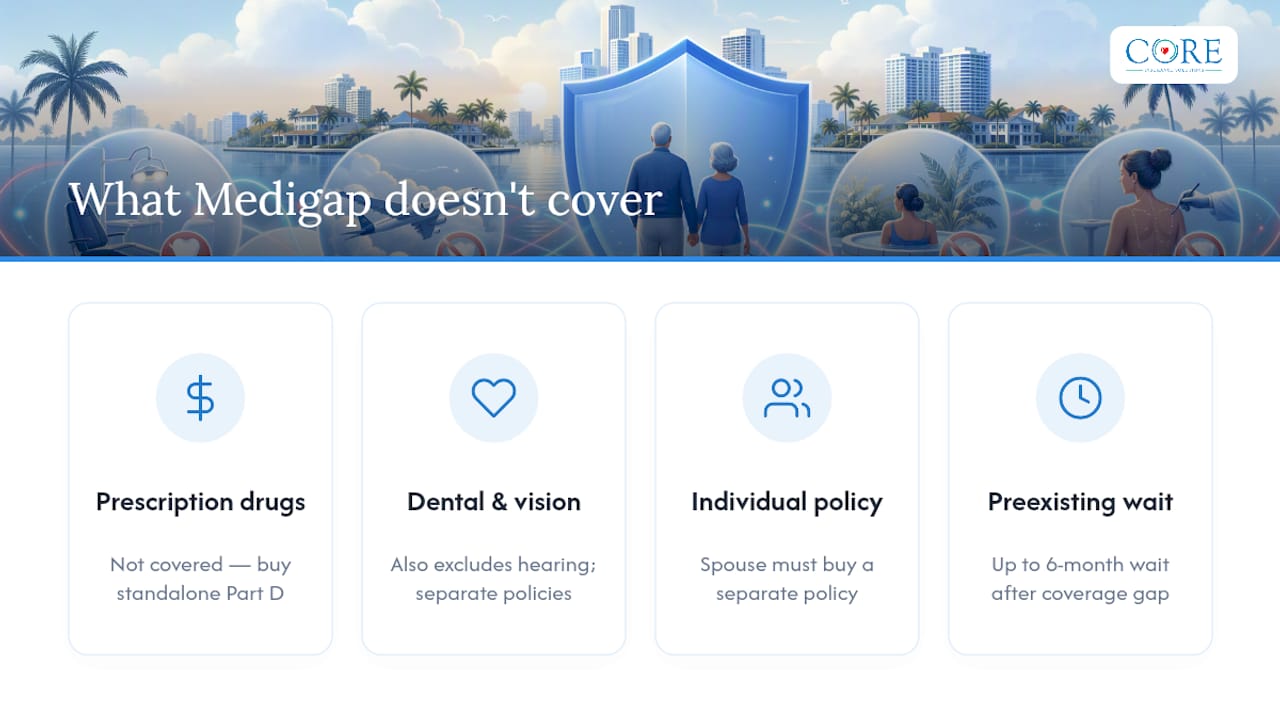
Medigap fills gaps in Original Medicare, but it isn’t blanket coverage, and the exclusions catch people off guard more often than the coverage itself does. The biggest one: no plan letter includes prescription drugs. That surprises a lot of new enrollees who assume “supplement” means “supplements everything.” You’ll need a standalone Part D plan alongside whichever Medigap letter you pick, and Medicare’s own guidance is explicit about that separation.
Dental, vision, and hearing are also outside Medigap’s scope entirely. Those require separate standalone policies, which is one reason routine cleanings and eyeglasses trip up budgets that assumed full coverage.
Medigap policies are also individual, meaning your spouse needs their own policy. There’s no family plan structure the way employer coverage often works. If you and your spouse both want Medigap, you’re buying two separate policies, though some carriers offer a household discount to soften that cost.
Preexisting condition waiting periods can still apply in narrow cases. If you had a gap in prior creditable coverage before enrolling, an insurer may impose up to a six month waiting period on care related to that specific condition, even during guaranteed issue enrollment. Prior continuous coverage typically counts against that waiting period, shortening or eliminating it.
Finally, Medigap doesn’t cover services Original Medicare itself excludes, like most long-term custodial care, routine foot care, or overseas emergency care beyond a limited lifetime benefit some plans include. If Original Medicare says no, your Medigap policy almost always says no too. The plan is a supplement to Medicare’s rules, not an override of them.
How Do You File a Medigap Claim in Florida?
The claims process is one of the most underrated advantages of Medigap, because for most covered services, you don’t file anything at all. Original Medicare processes the claim first, and your Medigap insurer automatically receives the crossover claim and pays its share directly to the provider. You typically never see a bill for a fully covered service.
Where it gets more hands on is with providers who don’t participate in electronic crossover billing, which still happens with some smaller practices or out-of-state providers. In that case, you’ll need your Medicare Summary Notice (MSN), which arrives quarterly or is available anytime through your MyMedicare.gov account. Submit a copy of that MSN directly to your Medigap insurer along with any claim form they require. Most carriers post their claim forms online or will mail one on request.
Keep a simple folder, physical or digital, of every MSN and any Explanation of Benefits your Medigap insurer sends back. Discrepancies do happen, particularly with high-deductible Plan G, where tracking how much of your deductible you’ve met matters for anticipating your next few bills. If a claim gets denied or paid incorrectly, you have the right to appeal, and the appeal process starts with the same MSN that started the claim.
Reimbursement timelines vary by carrier, but most Florida Medigap insurers process crossover claims within two to three weeks of receiving Medicare’s portion. If a claim stalls well beyond that, a call to the insurer’s customer service line with your MSN in hand usually resolves it faster than a written appeal.
Can Florida Insurers Cancel or Raise Your Medigap Rates?
Florida law requires every Medigap policy to be guaranteed renewable, meaning your insurer cannot cancel your coverage as long as you keep paying premiums, regardless of your age or how many claims you’ve filed. That’s a meaningful protection compared to some other insurance products, and it’s written directly into Florida’s Medicare Supplement statute.
What insurers can do is raise premiums, and they do it on a block basis, meaning everyone with the same plan letter and rating class sees the same percentage increase, not an increase targeted at you individually for filing claims. Rate increases go through a review process, but they’re not capped at a fixed percentage the way some other insurance lines are regulated.
The only ways a policy legitimately ends are non-payment of premium, fraud on the application, or the insurer withdrawing that specific plan from the Florida market entirely. Even in the last case, Florida gives you guaranteed issue rights to switch to a comparable plan with another carrier rather than leaving you without coverage. That protection is exactly why the issue-age rating and guaranteed renewability rules matter more in Florida than the sticker price of any single quote you get today.
How Do You Compare Medigap Carriers in Florida?
Since every insurer selling a given plan letter must offer identical benefits, comparing carriers in Florida is really about comparing everything else: price trajectory, financial strength, and how they treat you when you actually need them.
Start with the insurer’s financial strength rating from an independent agency like AM Best. A high rating suggests the carrier can pay claims reliably for decades, which matters more with Medigap than almost any other insurance product, since you may hold this policy for 20 or 30 years. Then look at that five-year rate increase history mentioned earlier. Some carriers have kept increases modest and steady; others have hit policyholders with double-digit jumps in back-to-back years. That history is public information you can request directly from the carrier or an independent agent.
Customer satisfaction matters too, though it’s harder to quantify than a rating number. Ask specifically about claims handling speed and how the carrier’s customer service performs when something goes wrong, not just when you’re signing up. A carrier that’s easy to buy from and difficult to deal with during a claim is a bad trade.
Florida’s sample rate search tool through the state’s Office of Insurance Regulation lets you pull real premium comparisons by zip code before you ever talk to an agent, which is worth doing before your first phone call so you know a fair price range going in.
Publisher Perspective: How Core Insurance Solutions Helps Florida Seniors Choose
Core Insurance Solutions builds Medigap decisions around a personalized health needs assessment, then runs unbiased comparisons across major carriers so the timing and plan letter actually fit your situation, not a one-size script. Annual policy audits catch rate creep before it costs you a full year of overpayment, and claims advocacy steps in when a crossover claim stalls. A local brokerage has helped many families across Polk County and surrounding cities, including Lakeland, Winter Haven, and Auburndale, get this right the first time.
— Core Insurance Solutions
Get Local Help Choosing Your Florida Medigap Plan
Reading about issue-age rating and guaranteed-issue triggers only gets you so far. At some point you need someone to run the actual numbers for your zip code, your health history, and your timeline. That’s the gap a local brokerage fills for seniors across Lakeland and Polk County: a local, unbiased comparison across major carriers instead of a single company’s sales pitch, backed by annual reviews so your plan doesn’t quietly get more expensive while you’re not looking.
If you want the fundamentals first, start with the free Medicare 101 webinar replay, which walks through Original Medicare, Medigap, and Part D at your own pace. When you’re ready to talk specifics, our Medicare plans and services page is the fastest way to schedule a local consultation and get real Medigap quotes compared side by side before your Open Enrollment Period closes.
This article is general information, not a substitute for advice from a qualified financial advisor. Consult a qualified financial professional about your own circumstances before acting on anything here.
Sources
- Medicare Supplement Insurance Overview | Consumer Services | Florida Department of Financial Services
- Compare Medigap plan benefits | Medicare
- Florida Statutes — Medicare supplement policies (section 627.6741)


