

Save $2,435 in 2026 With Florida Medicare Savings Programs
Florida’s Medicare Savings Programs can pay your monthly Part B premium, which is $202.90 in 2026 and, if you qualify for the top tier, wipe out Medicare deductibles and copays too. The fastest way to find out where you stand is to apply through Florida DCF MyACCESS or call SHINE for free help. Apply even if you think your income is a little too high. The math often works out better than people expect.
TL;DR:
- The QMB program covers all Medicare cost-sharing, saving about $2,435 annually on premiums, deductibles, and coinsurance, with providers legally barred from billing enrollees.
- Income limits for 2026 start at $1,350/month for single applicants and $1,824 for couples after a $20 disregard, with resource caps at $9,950 and $14,910 respectively.
- Applying through Florida DCF MyACCESS or SHINE is quick and recommends preparing financial documents in advance to prevent delays.
- Qualifying automatically grants Part D Extra Help, significantly reducing prescription costs and fee penalties without any extra application.
- Most applicants should focus on QMB, SLMB, or QI, as these cover the majority of retirees, while QDWI is limited to a smaller group of working-disabled individuals under 65.
Core Insurance SolutionsCompare Your Medicare OptionsCore Insurance Solutions helps Lakeland seniors assess health needs, compare major carriers, and find coverage suited to their medical history.Explore Medicare guidance
Table of Contents
- What Are Medicare Savings Programs in Florida?
- What Are the 2026 Income and Resource Limits in Florida?
- What Does Each Program Actually Pay For?
- Do You Qualify? A Quick Eligibility Checklist
- How to Apply for Medicare Savings Programs in Florida
- What Happens After You Submit Your Application?
- Does Qualifying for an MSP Get You Part D Extra Help Too?
- How Core Insurance Solutions Helps Florida Seniors Navigate MSPs
- Get Free Help Comparing Your Medicare Options in Florida
- Sources
- FAQ
What Are Medicare Savings Programs in Florida?
Medicare Savings Programs (MSPs) are Medicaid-administered benefits that pay some or all of your Medicare costs if your income and savings fall under certain limits. They are not full Medicaid. They are a narrower Florida Medicaid program built specifically to lighten the load of Medicare premiums, deductibles, and coinsurance for people who qualify for Medicare but live on a tight budget.
There are four MSP types, each with a different scope:
- QMB (Qualified Medicare Beneficiary): the broadest program, covering Part A and Part B premiums plus deductibles and coinsurance.
- SLMB (Specified Low-Income Medicare Beneficiary): pays the Part B premium only.
- QI (Qualifying Individual): also pays the Part B premium only, but funding is limited and awarded first-come, first-served.
- QDWI (Qualified Disabled and Working Individual): covers the Part A premium for people under 65 who returned to work after losing Social Security Disability Insurance.
Florida caseworkers most often talk about QMB, SLMB, and QI, since those three cover the vast majority of retirees applying for help. QDWI serves a much smaller specific group.
What Are the 2026 Income and Resource Limits in Florida?
Florida sets its MSP thresholds using the federal poverty level, and the 2026 limits determine which program, if any, you qualify for.
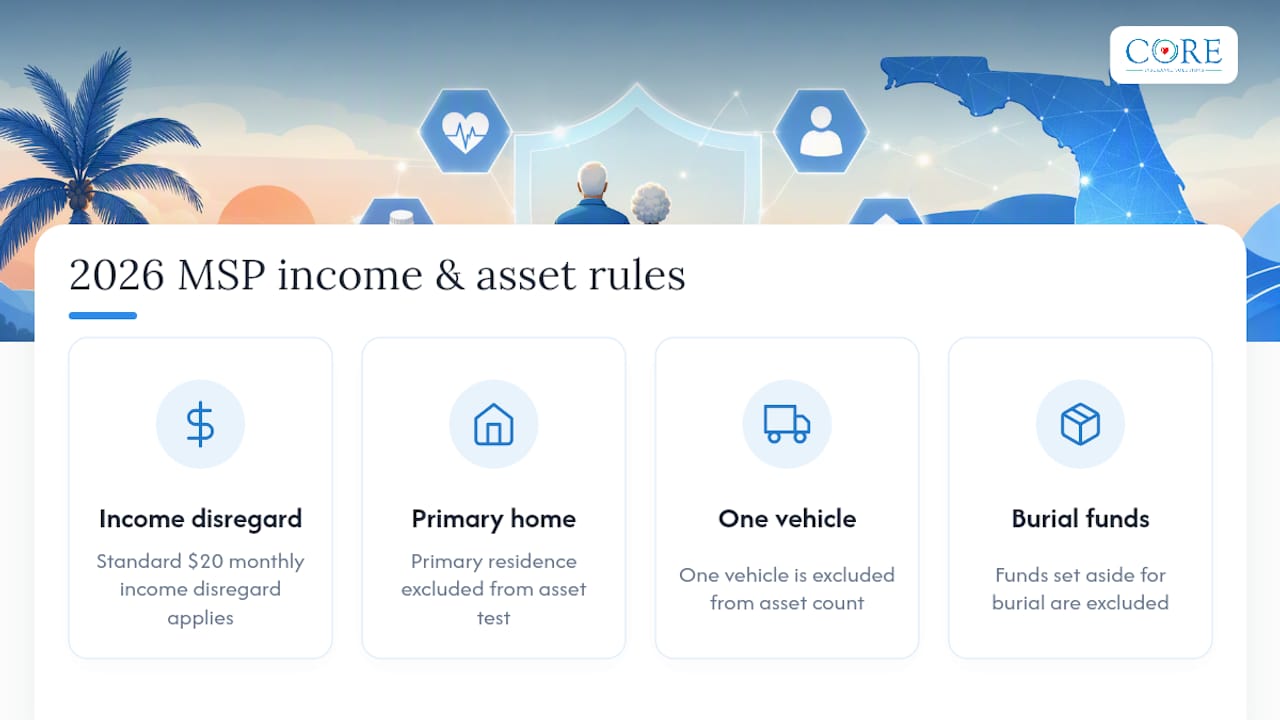
Countable income is not simply your Social Security check. Florida applies a standard $20 monthly income disregard to almost everyone, meaning the first $20 of your monthly income doesn’t count against these limits. Certain resources are excluded from the asset test entirely: your primary home, one vehicle, and funds set aside for burial expenses, according to the Social Security Administration’s guidance on how states calculate MSP eligibility. That exclusion surprises a lot of applicants who assume owning a paid-off house disqualifies them. It doesn’t.
What Does Each Program Actually Pay For?
The dollar difference between these programs is significant, and QMB carries a protection most people don’t know exists.
- QMB pays your Part A premium (if you have one), your Part B premium, and Medicare’s deductibles and coinsurance. Providers are legally barred from billing QMB enrollees for Medicare-covered cost-sharing, even if a doctor’s office tries. That’s a federal rule, not a courtesy.
- SLMB and QI both cover the Part B premium only, which is $202.90 a month in 2026.
- QDWI covers the Part A premium for working individuals who lost disability benefits due to earnings but still have a qualifying disability.
A QMB enrollee saves roughly $2,435 a year on the Part B premium alone, before counting deductibles and coinsurance eliminated on top of it. SLMB and QI enrollees save that same $202.90 a month, or about $2,435 annually, just on Part B.
Do You Qualify? A Quick Eligibility Checklist
Before you spend an afternoon on paperwork, run through these basics:
- You must be enrolled in Medicare Part A, or eligible to enroll, and live in Florida.
- Your countable monthly income must fall under the limit for the program you’re targeting, after the $20 disregard.
- Your countable resources must stay under $9,950 (individual) or $14,910 (couple).
- If you already have full Florida Medicaid, you generally don’t need QI, since Medicaid already covers Medicare cost-sharing more broadly. MSP-only help works differently than full Medicaid, and understanding that distinction avoids confusion later.
- QDWI applies only to a specific group: people under 65 who lost Social Security Disability Insurance because they went back to work.
If your income sits just above a limit, apply anyway. Caseworkers apply disregards and exclusions that often lower your countable income below what a rough calculation suggests.
Pro Tip: Gather your last two months of bank statements and your most recent Social Security award letter before you start the application. Missing financial documents cause more delays than any other single issue in Florida MSP processing.
How to Apply for Medicare Savings Programs in Florida
Florida gives you three ways in, and picking the right one saves time.
- Choose your channel. The fastest route for most people is Florida DCF MyACCESS, the state’s online benefits portal. You can also file a paper Medicaid application, visit a local DCF Family Resource Center in person, or call the DCF customer call center to start over the phone.
- Gather your documents before you begin. You’ll need your Medicare card, a photo ID, proof of Florida residency (a utility bill or lease works), your two most recent pay stubs or Social Security award letter, and your last two bank statements.
- Submit carefully. If uploading through MyACCESS, use clear scans rather than phone photos with glare or cropped edges. Name your files by document type so caseworkers can identify them fast. If English isn’t your first language or you’d rather talk to a person, SHINE counselors at 1-800-963-5337 offer free, unbiased help in multiple languages, and Core Insurance Solutions’ Medicare enrollment guide walks through the same documentation checklist in more detail.
What Happens After You Submit Your Application?
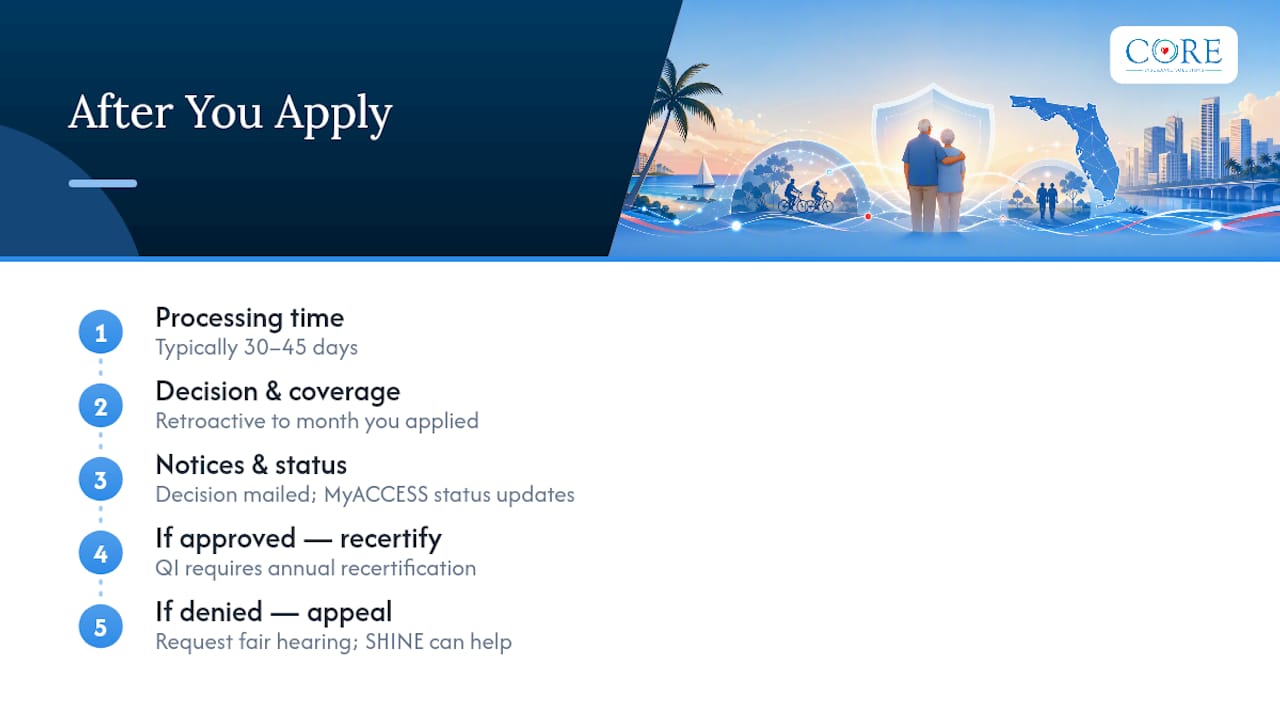
Florida typically processes MSP applications within 30 to 45 days. If approved, coverage is often retroactive to the month you applied, so premium payments you already made may get reimbursed. DCF mails a decision notice and also posts status updates inside your MyACCESS account, which you can check anytime instead of waiting on a letter.
QI requires annual recertification since its funding is capped each year, so mark your calendar. If denied, you have the right to request a fair hearing. The denial notice explains the deadline and process, and SHINE counselors can help you prepare an appeal at no cost.
Does Qualifying for an MSP Get You Part D Extra Help Too?
Yes, and this is the part most applicants miss. Enrolling in QMB, SLMB, or QI automatically qualifies you for full Part D Extra Help, with no separate application required.
- Extra Help typically covers your Part D premium up to a benchmark amount.
- It caps what you pay for generic and brand-name prescriptions.
- It removes the Part D late enrollment penalty concern for many enrollees.
Once Extra Help kicks in, it’s worth comparing Part D plans again, since your lowest-cost option may change now that copay structures shift under the subsidy.
How Core Insurance Solutions Helps Florida Seniors Navigate MSPs
Free help exists, and you should use it. SHINE and DCF caseworkers give unbiased, no-cost guidance on eligibility and applications, and that’s often the right first stop. Where Core Insurance Solutions adds value is afterward: once you know your MSP status, choosing the right Part D plan or Medicare Advantage plan around it gets complicated fast, and that’s where our document prep support and MyACCESS application assistance come in. We’ve helped over 2,000 families sort through exactly this kind of decision, comparing carriers without bias toward any single insurer. A broker adds the most value once your MSP paperwork is filed and you’re ready to lock in a drug plan that actually fits your prescriptions.
— Core Insurance Solutions
Get Free Help Comparing Your Medicare Options in Florida
Core Insurance Solutions gives you something MyACCESS and SHINE don’t: a side-by-side comparison of every Medicare Advantage, Medigap, and Part D plan available to you in Florida, matched against your actual medications and doctors. Our Unbiased Carrier Comparison and Prescription Cost Optimization services cost you nothing directly. We’re paid by the carriers when you enroll, the same way most Medicare brokers work, so there’s never a bill from us for the consultation itself.
If you’ve just applied for an MSP or you’re still figuring out where you stand, watch our free Medicare 101 webinar replay for a plain-English walkthrough of how MSPs, Part D, and Medicare Advantage fit together. Or use our Medicare Premium Estimator to see how an MSP approval would change your monthly costs before you even hear back from DCF. Reach out to Core Insurance Solutions to schedule a free consult and get a second set of eyes on your Part D plan choice once your MSP is approved.
This article is general information, not a substitute for advice from a qualified financial advisor. Consult a qualified financial professional about your own circumstances before acting on anything here.
Sources
- Medicare Savings Programs
- What Are the Florida Medicare Savings Programs?
- 2026 Medicare parts B premiums and deductibles (CMS fact sheet)
FAQ
Who Qualifies for the Medicare Savings Program in Florida?
You qualify if you’re enrolled in Medicare Part A, live in Florida, and your countable monthly income and resources fall under the limit for QMB, SLMB, or QI. For 2026, QMB’s single limit is $1,350 a month, with higher limits for SLMB and QI.
Is the Medicare Savings Program Legitimate?
Yes. MSPs are federally authorized and administered by Florida’s Department of Children and Families as part of the state’s Medicaid system, not a private or third-party benefit. They’re the same programs referenced directly on Medicare.gov.
What Will the Florida Medicare Savings Program Look Like in 2026?
The core structure stays the same: QMB, SLMB, QI, and QDWI, applied through DCF MyACCESS with processing typically taking 30 to 45 days. The 2026 Part B premium used to calculate savings is $202.90 a month.
What Is the Income Limit for the Medicare Savings Program in 2026?
For a single applicant in 2026, the QMB limit is $1,350 a month, SLMB is $1,616, and QI is $1,816. Couples get higher limits: $1,824 for QMB, $2,184 for SLMB, and $2,455 for QI.
Does Applying for an MSP Also Get Me Help With Prescription Costs?
Yes. Qualifying for QMB, SLMB, or QI automatically enrolls you in Part D Extra Help, which lowers your Part D premium and caps your prescription copays without a separate application.


