

Medicare MSA Plans: How They Work and Who They Fit
A Medicare MSA plan pairs a high-deductible Medicare Advantage plan with a Medicare-funded medical savings account. Medicare deposits money into the account each year, and you use those funds to pay for care until you hit the plan’s deductible. After that, the plan covers Medicare-approved Part A and Part B services.
The trade-off is straightforward: you get a deposit to spend, but the deductible sitting behind it is high, often higher than the deposit itself. That structure works best for someone who either has the cash cushion to cover a gap between deposit and deductible, or who expects a light year of medical use and wants to bank the leftover funds. Two things trip people up early: MSA plans never include Part D drug coverage, and you can only enroll during specific windows.
- No monthly plan premium, but you still pay your Part B premium.
- The deposit doesn’t always cover the full deductible.
- You’ll need a separate Part D plan if you want drug coverage.
- Enrollment is limited to specific periods, not any time of year.
Key Takeaways
Medicare MSA plans work best for seniors with the cash flow to cover a deductible gap or a light year of expected medical use ahead.
| Point | Details |
|---|---|
| Two-part structure | An MSA plan combines a high-deductible Medicare Advantage plan with a Medicare-funded savings account. |
| Deposit rarely equals deductible | Common examples show deposits of $1,500 to $2,500 against deductibles of $3,000 to $4,000. |
| No Part D included | You need a separate Prescription Drug Plan, and MSA-funded copays don’t count toward your deductible. |
| Enrollment windows are fixed | You can join during your ICEP or the fall Annual Enrollment Period from October 15 to December 7. |
| Local guidance matters | Core Insurance Solutions offers holistic assessments and annual audits to help Lakeland-area seniors weigh MSA plans against their actual spending. |
Table of Contents
- How Does a Medicare MSA Plan Actually Work?
- What Do Real MSA Deposit and Deductible Numbers Look Like?
- Who Can Enroll in a Medicare MSA Plan?
- What Will an MSA Plan Actually Cost You?
- How Do MSA Plans Interact With Part D, Medigap, and Medicaid?
- Is a Medicare MSA Plan Worth Considering?
- How Core Insurance Solutions Helps You Evaluate MSA Plans
- What We Think Seniors Get Wrong About MSA Plans
- Ready to Compare MSA Plans in Your County?
- Sources
How Does a Medicare MSA Plan Actually Work?
Every Medicare MSA plan has two moving parts working together. The first is a high-deductible health plan (HDHP) offered through Medicare Advantage. The second is a savings account, similar in spirit to a health savings account, that Medicare funds on your behalf.
Here’s the sequence in a typical year:
- Medicare deposits a lump sum into your MSA, usually once a year, sometimes split if you enroll partway through the year.
- You use that money, through a debit card or checks tied to the account, to pay for Medicare-covered Part A and Part B services.
- Once your spending (combining what Medicare deposited and what you’ve paid out of pocket) reaches the plan’s deductible, the coverage phase kicks in.
- From that point forward, the plan pays for Medicare-covered services directly, and many plans add extra benefits beyond original Medicare.
Deposit and deductible amounts vary by plan. Medicare’s own examples show deposits in the range of $1,500 to $2,500 paired with deductibles between $3,000 and $4,000, which means a meaningful gap can exist between what Medicare hands you and what you’d need to spend before full coverage starts.
If you join mid-year, both the deposit and the deductible get pro-rated based on how many months of the year remain. That detail matters if you’re turning 65 in, say, September. You won’t get a full year’s deposit, but you also won’t face a full year’s deductible.
What Do Real MSA Deposit and Deductible Numbers Look Like?
Numbers make this easier to picture. Medicare publishes side-by-side examples that show how deposit size and deductible size interact across different plans, and no two plans use identical figures.
| Plan Example | Annual Deposit | Annual Deductible | Gap Before Full Coverage |
|---|---|---|---|
| Plan A | $2,500 | $4,000 | $1,500 |
| Plan B | $1,500 | $3,000 | $1,500 |
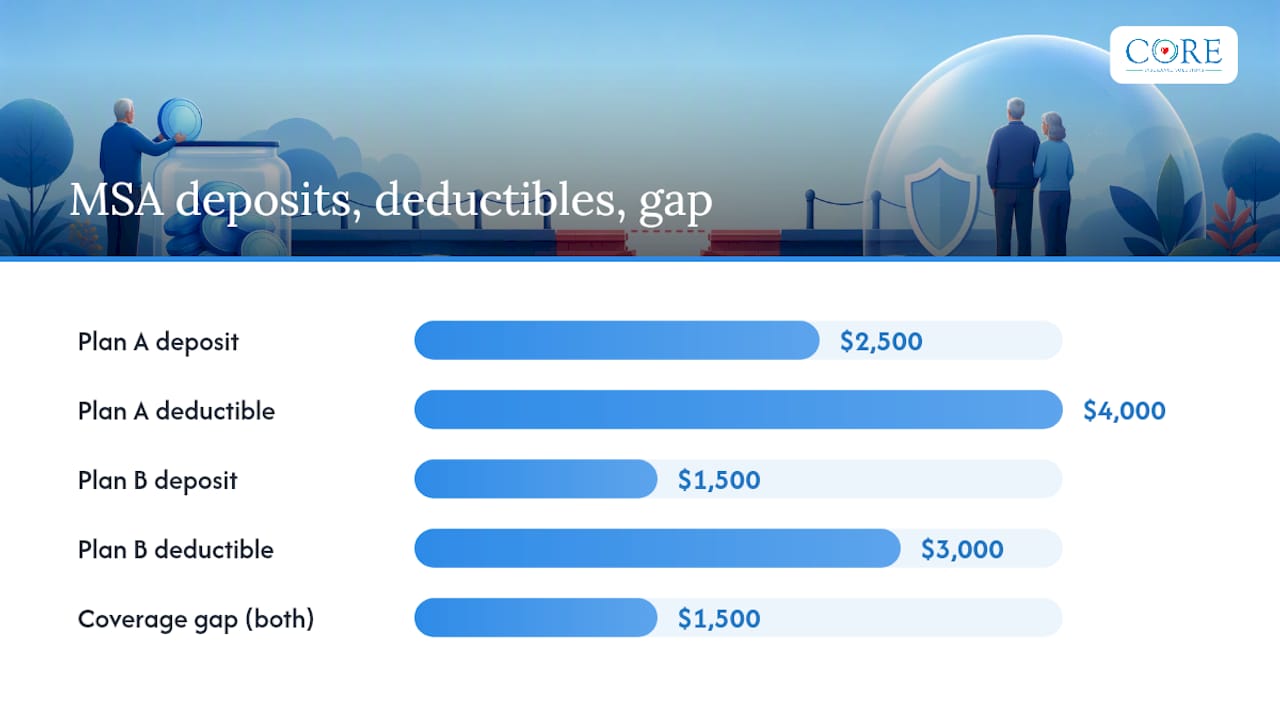
Both plans in Medicare’s published examples leave a $1,500 gap between what’s deposited and what’s required before the plan takes over. That gap is the number to focus on, not the deposit alone.
Picture two years side by side:
- Low-use year: you spend little on care, the deposit mostly sits untouched, and the balance rolls over into next year.
- High-cost year: a hospital stay or major procedure pushes you past the deductible fast, and you’re covering that $1,500 gap (or more) out of pocket before the plan’s coverage phase begins.
Plan terms differ by carrier and county, so treat these as illustrations, not your actual numbers. Pull your local plan’s Evidence of Coverage before assuming anything.
Who Can Enroll in a Medicare MSA Plan?
You generally need Medicare Part A and Part B to join, and you have to live in the plan’s service area for the full year. A handful of situations rule people out entirely.
- You’re not eligible if you already qualify for Medicaid.
- TRICARE and Federal Employee Health Benefits Program (FEHBP) coverage also disqualify you.
- Hospice care and certain end-stage renal disease situations create additional restrictions.
- Moving permanently out of the plan’s service area can trigger disenrollment and possible repayment of deposited funds.
Enrollment isn’t open year-round. You can join during your Initial Coverage Election Period (ICEP) when you first become eligible for Medicare Advantage, or during the fall Annual Enrollment Period running October 15 through December 7. Special election periods apply in certain life circumstances too.
To find plans available where you live, use Medicare’s Plan Finder tool or call 1-800-MEDICARE. Before your enrollment finalizes, you’ll typically need to set up the bank account the plan designates, since that’s where your deposit lands.
What Will an MSA Plan Actually Cost You?
There’s no separate monthly premium for the MSA plan itself, which surprises a lot of people the first time they hear it. But that doesn’t mean it’s free. You still pay your standard Part B premium every month, the same as anyone on original Medicare.
The real cost question is the deductible gap. Deposits commonly land between $1,500 and $2,500, while deductibles run $3,000 to $4,000 in Medicare’s published examples, leaving a real out-of-pocket exposure most years, not a hypothetical one.
A few coverage details matter more than they seem:
- Only Medicare Part A and Part B services count toward your MSA deductible.
- If you use MSA funds to pay a Part D copay, that payment doesn’t count toward the deductible.
- Unused funds in your MSA roll over year to year, so a light year builds a cushion for a heavier one later.
That rollover feature is arguably the most underrated part of the whole structure. It rewards patience over a multi-year stretch, even if any single year looks expensive on paper.
How Do MSA Plans Interact With Part D, Medigap, and Medicaid?
MSA plans don’t bundle drug coverage, full stop. If you want prescription coverage, you’ll need to enroll separately in a standalone Part D Prescription Drug Plan. You can use your MSA funds to pay Part D copays, but as noted above, those payments don’t reduce your MSA deductible.
Medigap gets trickier. While you’re enrolled in an MSA plan, you generally cannot buy a Medigap policy that covers your MSA deductible. Official guidance actually calls it illegal for anyone to sell you such a policy under those circumstances.
- Medicaid eligibility rules you out of an MSA plan entirely, making you ineligible to enroll.
- Employer retiree coverage can also affect your eligibility, depending on your specific employer plan’s structure.
- Rules vary by situation, so a call to your State Health Insurance Assistance Program (SHIP) or a licensed agent is worth the ten minutes.
Pro Tip: If you’re still holding a Medigap policy from before you turned 65, ask a licensed agent whether keeping it makes sense before you enroll in an MSA plan. Canceling it later isn’t always simple.
Is a Medicare MSA Plan Worth Considering?
The appeal and the risk both come from the same source: flexibility with a price tag attached.
- Provider flexibility — MSA plans typically don’t restrict you to a network the way HMOs do, so you can see most providers who accept Medicare.
- Rollover savings — unused funds carry forward, building a reserve for a costlier year down the road.
- Catastrophic protection — once you clear the deductible, Medicare-covered services get paid, capping your worst-case exposure.
- Real complexity trade-off — no built-in Part D, a deductible gap you may need to self-fund, and extra coordination if you carry other coverage.
Before you look further, ask yourself four questions: What did you spend on healthcare last year? Do you have savings to cover a $1,500 to $2,500 gap if a bad year hits? Are you comfortable tracking an account and receipts? And does your county even have an MSA plan available?
Pro Tip: Pull your last two years of medical bills before comparing plans. Your actual spending pattern tells you more than any plan brochure ever will.
How Core Insurance Solutions Helps You Evaluate MSA Plans
Reading about deposit and deductible math on a screen is one thing. Applying it to your own health history, medications, and county is another. Core Insurance Solutions has walked more than 2,000 families in the Lakeland, Florida area through exactly this kind of decision.
- Holistic health needs assessments before recommending any plan type
- Annual policy audits to catch cost changes before they surprise you
- Prescription cost optimization if you’re weighing Part D options alongside an MSA
- Claims advocacy if a Medicare-covered service gets disputed
Seniors rarely need more information. They need someone to translate the information against their own medical history and their own budget.
What We Think Seniors Get Wrong About MSA Plans
Most explainers treat MSA plans like a math problem: compare the deposit to the deductible and you’re done. That misses the point. The number that actually matters is your own healthcare spending pattern over the last two or three years, not the plan’s advertised deposit.
Conventional advice leans hard on the “flexibility” pitch, provider choice, no network restrictions, and undersells the cash-flow reality. A retiree living on a fixed income can find that $1,500 gap genuinely stressful in a bad year, even with rollover savings from prior years cushioning it. That’s not a flaw in the plan. It’s a mismatch between the plan and the person.

What we’d prioritize differently: don’t start with the plan brochure. Start with your own medical bills from last year, then work backward to whether an MSA’s math fits your actual life. A Medicare basics refresher helps if you’re still fuzzy on how Parts A, B, and C relate before adding MSA specifics on top.
Ready to Compare MSA Plans in Your County?
Core Insurance Solutions gives Lakeland-area seniors something a plan brochure can’t: a side-by-side look at how an MSA plan’s deposit and deductible actually line up against your real medical history, not a generic example. That’s the gap most people fall into when they shop plans alone.

If you’re weighing an MSA plan against a Medicare Advantage HMO or PPO, our team runs an unbiased comparison across major carriers so you’re not guessing at which structure fits your actual spending. We also handle the coordination questions, whether you need a standalone Part D plan or want to check if your current dentist accepts Medicare through a resource like CWD Dental Group’s provider guide. Start by comparing what’s available in your county using our plan shopping tool, or call our Lakeland office to schedule a plan review before your enrollment window closes.
This article is general information, not a substitute for advice from a qualified doctor. Consult a qualified healthcare professional about your own circumstances before acting on anything here.
Sources
- Medicare Medical Savings Account (MSA) Plans | Medicare
- Your Guide to Medicare Medical Savings Account (MSA) Plans (CMS booklet)


