

Stop a Coverage Cut: 5 Steps to Win Your U.S. Medicare Appeal
The Medicare appeal process has five levels, and your first move matters more than any of them: find your denial notice or Medicare Summary Notice (MSN) right now and write down the deadline. Every level runs on its own clock. If your health is at risk, you have the right to request a fast, expedited appeal, and free help is available through your State Health Insurance Assistance Program (SHIP) whether you use it or not.
TL;DR:
- Most Medicare denials, whether from Original Medicare or Medicare Advantage, can be challenged through up to five administrative levels, each with specific deadlines and procedures.
- Filing an appeal begins with the denial notice or MSN and involves submitting supporting evidence such as physician notes and test results within the designated timeframe; missing deadlines can sometimes be justified with proof of good cause.
- Expedited, or fast, appeals are available if services are ending prematurely or delaying decision-making jeopardizes health, and these reviews are handled within 72 hours by a specialized organization.
- Appointing a representative using Form CMS-1696 provides ongoing assistance at every level, especially helpful for beneficiaries with health or cognitive issues managing complex paperwork.
- Even if your appeal is denied, you can usually move to the next level within 60 days, and small claims may require combining multiple cases to meet minimum thresholds for higher review stages.
Table of Contents
- What Is the Medicare Appeal Process and How Does It Flow?
- How Do You Appeal Original Medicare Denials at Each Level?
- What Are the Appeal Steps for Medicare Advantage and Part D Plans?
- When Can You Request a Fast (Expedited) Medicare Appeal?
- What Documents Do You Need to Start a Medicare Appeal?
- How Do You Appoint a Representative for a Medicare Appeal?
- What Happens If Your Medicare Appeal Is Denied?
- Where Can You Find Official Medicare Appeal Forms and Contacts?
- Our Take: Why Advocacy Matters in the Medicare Appeal Process
- Get Help Navigating Your Medicare Appeal
- Official Resources for Medicare Appeals
- Sources
What Is the Medicare Appeal Process and How Does It Flow?
Every Medicare denial, whether it’s a rejected claim, a service cut short, or a drug coverage refusal, moves through the same basic structure, though the names of the first two stops change depending on your coverage type. In Original Medicare, you start with a Medicare Administrative Contractor (MAC). In Medicare Advantage or Part D, you start with your plan directly, and if it upholds the denial, the case moves automatically to an Independent Review Entity (IRE), a version of what Original Medicare calls the Qualified Independent Contractor (QIC).
From there, both tracks converge onto the same three remaining levels:
- Level 1: MAC redetermination (Original Medicare) or plan reconsideration (Medicare Advantage/Part D)
- Level 2: QIC reconsideration (Original Medicare) or IRE review (Medicare Advantage/Part D)
- Level 3: Hearing before the Office of Medicare Hearings and Appeals (OMHA)
- Level 4: Review by the Medicare Appeals Council
- Level 5: Judicial review in federal district court
Timeframes vary by claim type. MACs generally decide redeterminations within about 60 days, but pre-service requests (asking permission before you get care) move faster than post-service claims (billed after the fact), and Part B drug appeals carry their own shorter clock. In the plan-based track, denials that aren’t overturned get forwarded automatically, so you don’t have to re-file. The reviewer at each stage works from an “administrative record,” meaning whatever documentation you submitted earlier travels with the case.
How Do You Appeal Original Medicare Denials at Each Level?
If your denial came through Part A or Part B, your MSN is the document that drives everything. It lists the claim, the reason for denial, and your filing deadline.
- Redetermination (Level 1): Circle the disputed item on your MSN, attach supporting evidence, and mail or fax it to the MAC address printed on the notice. You typically have a few months to file the appeal, and decisions usually come back within 60 days.
- Reconsideration (Level 2): If the MAC upholds the denial, you have a few months to request review by a QIC. Include everything you submitted before, plus any new medical records, and the QIC aims for a 60-day decision.
- OMHA hearing (Level 3): You can request an Administrative Law Judge (ALJ) hearing, typically by phone or video, or ask for an on-the-record decision if your file is already strong. Your claim must meet OMHA’s minimum dollar threshold to qualify. An on-the-record request can resolve a case faster when the paperwork speaks for itself.
- Appeals Council (Level 4): If OMHA denies your claim or you believe the process was mishandled, you can request Council review, generally within 60 days of the OMHA decision.
- Federal court (Level 5): Available only once you clear the dollar minimum and file within 60 days of the Council’s decision, this is where cases go when every administrative option has been exhausted.
What Are the Appeal Steps for Medicare Advantage and Part D Plans?
Medicare Advantage and Part D denials don’t go to a MAC first. They go back to the plan that denied them, using the denial notice the plan sent you, and you generally have 65 days to file that first-level reconsideration.
If the plan sticks with its decision, it’s required to forward your case automatically to an IRE for the second-level review; you don’t file a separate request. From there, IRE timeframes differ by claim type:
- Pre-service requests (you’re asking before getting care): plan decisions are often due within 30 days
- Post-service claims (already-provided care, now billed): reviews typically run longer, with some extension allowed for good cause
- Part B drug appeals: administered through your plan under expedited or standard tracks depending on urgency
Expedited plan appeals must be decided quickly, often within a few days. when a standard timeline could jeopardize your health. One detail people miss: because the plan controls the record at level 1, missing evidence at this stage is the single biggest reason overturns get harder later. Anyone reviewing their Medicare Advantage plan options should keep this appeals structure in mind before enrollment season, not after a denial arrives.
When Can You Request a Fast (Expedited) Medicare Appeal?
You qualify for a fast appeal when a covered service is ending sooner than you think it should, or when waiting for a standard decision could put your health at serious risk. This applies to hospital discharges, skilled nursing stays, home health, and hospice care that’s about to be cut off.
Your provider is required to give you written notice before services end, and that notice explains exactly how to request expedited review. A Beneficiary and Family Centered Care Quality Improvement Organization (BFCC‑QIO), not the MAC or your plan, handles these reviews and must decide within 72 hours. While the review is pending, your services generally continue, so you’re not left without care while the decision is made.
What Documents Do You Need to Start a Medicare Appeal?
Start by making a copy of the denial notice or MSN before you write anything on it. Circle the disputed charge, note the date of service, and highlight the filing deadline in the margin so it doesn’t get buried in paperwork.
Your evidence packet should include:
- Physician notes explaining why the service or item was medically necessary
- Relevant test results or imaging reports
- Prior authorization records, if one was issued
- A short cover letter stating plainly why the denial should be reversed
If you missed your deadline, you can sometimes still file by documenting “good cause,” such as a hospitalization or a notice that arrived late. Keep dates and any proof you have.
Pro Tip: Send everything by trackable mail or fax with a confirmation receipt, and log every phone call you make, including the date, the representative’s name, and what was said. If your case reaches a hearing later, that log becomes evidence that you acted in good faith and on time.
Reviewers rely on the administrative record built at level one, so an incomplete file early on makes every later level harder to win.
How Do You Appoint a Representative for a Medicare Appeal?
You can name a family member, caregiver, attorney, or advocate to handle your appeal by filing Form CMS-1696 or a written statement with equivalent information. Once appointed, that person can receive notices, submit evidence, and speak for you at every level, which matters most when illness makes the paperwork itself hard to manage.
- File CMS-1696 with the same office handling your appeal
- Contact your local SHIP office for free, one-on-one counseling on filing and documentation
- Call the Medicare Beneficiary Ombudsman if you believe your rights during the process were violated
- Consider paid legal aid or elder law attorneys for complex, high-dollar, or multi-level disputes
SHIP counselors help beneficiaries avoid the procedural errors that sink otherwise valid appeals, and their help is always free.
What Happens If Your Medicare Appeal Is Denied?
A denial at one level isn’t the end. You generally have 60 days to move to the next level, and each stage builds on the last, so a denial at OMHA still lets you request Appeals Council review with the same file.
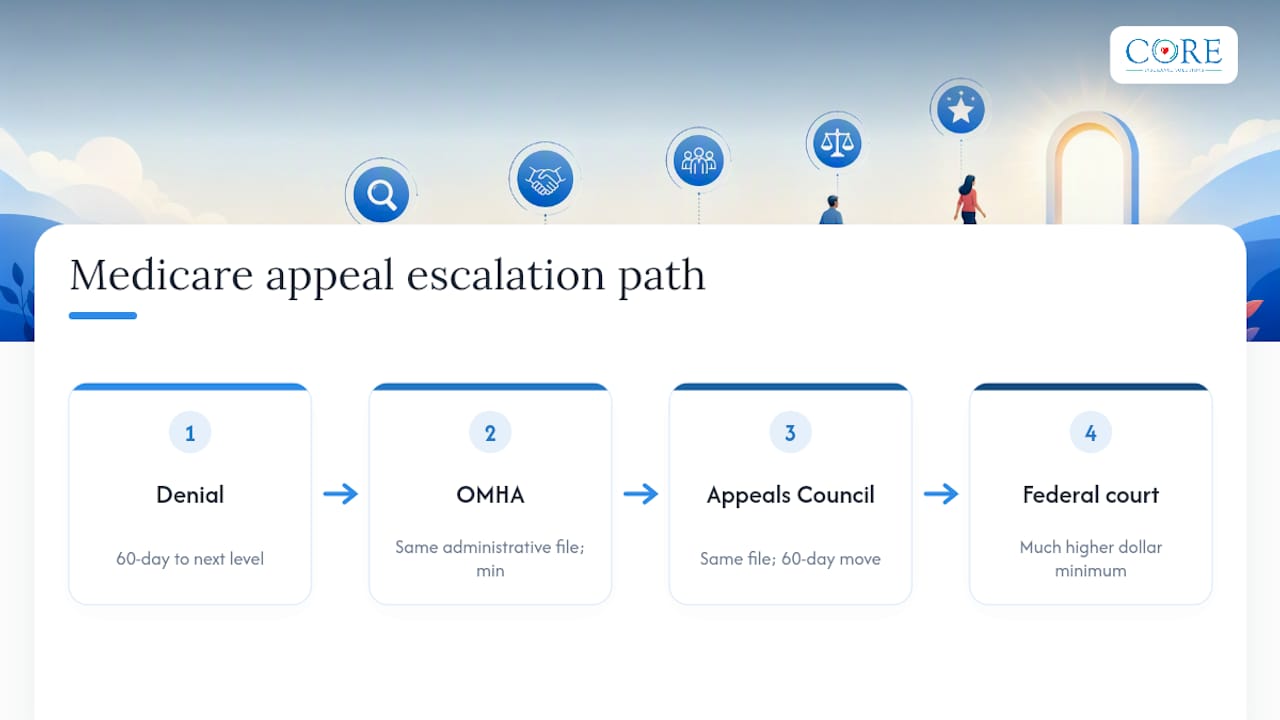
Dollar minimums apply as you climb. For 2026, your claim generally needs to meet OMHA’s minimum threshold to qualify for a hearing, and federal district court requires a considerably higher amount. If your individual claim falls short, you may be able to combine similar claims to reach the minimum. Before hiring an attorney for a court-level appeal, weigh the legal cost against the amount actually in dispute. Some cases are worth fighting on principle; others simply aren’t financially worth the escalation.
Where Can You Find Official Medicare Appeal Forms and Contacts?
Your MSN and plan denial notices list the exact MAC or QIC address you need. Beyond that:
- Medicare’s appeals overview for redetermination and reconsideration forms
- OMHA’s site for ALJ hearing request forms
- CMS-1696 for appointing a representative
- The official Medicare appeals guide (PDF) for sample cover letter language
Our Take: Why Advocacy Matters in the Medicare Appeal Process
Most denials aren’t fraud or bad faith. They’re paperwork gaps, missing physician notes, a form filed to the wrong address, a deadline that slipped by. We’ve built our approach around catching those gaps before they cost someone their coverage, through holistic needs assessments, hands-on claims advocacy, and prescription cost reviews, work that’s helped guide more than 2,000 families through Medicare decisions. Start with free SHIP counseling. If you want a second set of eyes organizing your evidence or representing you at a hearing, that’s where hands-on advocacy earns its place.
— Core Insurance Solutions
Get Help Navigating Your Medicare Appeal
Filing an appeal alone means learning five levels of federal procedure while you’re already dealing with a denied claim, no small task on top of a health issue. Core Insurance Solutions built its claims advocacy service specifically for this moment: organizing your evidence, tracking deadlines across levels, and representing your case so the paperwork doesn’t fall on you alone.

Free help through SHIP is always your right, and we’d rather you use it than go without support. But if you want a partner who already knows the MAC and QIC process inside out, our team works alongside you at every level. Start by watching our free Medicare 101 webinar replay to understand where your coverage stands, then reach out through our Medicare plans and services page to talk through your specific denial and what comes next.
Official Resources for Medicare Appeals
- Medicare for filing steps by claim type
- OMHA’s appeals process guide for hearing procedures
- Download the official Medicare appeals PDF guide for forms and sample language
This article is general information, not a substitute for advice from a qualified doctor. Consult a qualified healthcare professional about your own circumstances before acting on anything here.


