

U.S. Medicare Advantage Out of Network: Rules, Costs, and What to Do
Generally, no. Medicare Advantage plans require in-network providers for routine care, and coverage for Medicare Advantage out-of-network services kicks in only for specific exceptions: emergencies, urgent care while traveling, some dialysis situations, and certain plan-specific allowances. Costs, protections, and your options all hinge on which type of plan you carry, so verifying network status before an appointment matters more than most people realize.
TL;DR:
- Out-of-network coverage under Medicare Advantage plans is limited to emergencies, urgent care outside your area, and certain dialysis scenarios.
- Plan type determines out-of-network payment rules, with HMOs typically requiring in-network care for all non-emergency services and PPOs offering more flexibility but at higher costs.
- Federal rules override plan networks for emergencies, urgent care outside the area, and temporary out-of-area dialysis, often requiring documentation and pre-authorization.
- Out-of-network coinsurance rates for PPOs can be double in-network rates, and plans may exclude out-of-network costs from annual out-of-pocket maximums.
- Verifying provider network status before appointments is crucial, as directories often become outdated; expert help can assist with appeals and plan comparisons.
Core Insurance SolutionsGet Guidance On Medicare NetworksCore Insurance Solutions compares Medicare options, reviews health needs, and supports seniors with claims and prescription cost questions.Explore Medicare guidance
Table of Contents
- Understanding Medicare Advantage Network Rules by Plan Type
- When Federal Rules Force Coverage Regardless of Network
- What Out-Of-Network Care Actually Costs Under Medicare Advantage
- Your Provider Left the Network: What to Do Right Now
- How to Verify a Provider Is Actually In-Network
- When Original Medicare Plus Medigap Makes More Sense
- How Core Insurance Solutions Helps When Networks Change
- Get Help Resolving Your Network Coverage Questions
- A Practical Take on Network Access and Peace of Mind
- Sources
- FAQ
Understanding Medicare Advantage Network Rules by Plan Type
Not every Medicare Advantage plan treats out-of-network care the same way. The rules depend almost entirely on which plan structure you’re enrolled in, and knowing yours changes how you should shop for care.
- HMO plans typically require you to stay in-network for everything except emergencies and urgent care. Step outside that network for a routine visit, and the plan usually won’t pay a cent.
- PPO plans offer more flexibility. They’ll often cover out-of-network visits, but you’ll pay noticeably higher coinsurance or copays for the privilege.
- PFFS plans (Private Fee-for-Service) may let you see any provider who agrees to the plan’s payment terms, though many providers decline to participate at all.
- SNP plans (Special Needs Plans) are usually the strictest, built around a narrow network tailored to a specific condition or care setting.
Most Medicare Advantage plans require in-network providers for non-emergency care, and even plans that pay for out-of-network services apply steeper cost-sharing when they do. Your Evidence of Coverage document, not the marketing brochure, spells out your plan type and its exact out-of-network terms. Check the “Medical Benefits Chart” section first. That’s where the network rules actually live.
When Federal Rules Force Coverage Regardless of Network
Certain situations override your plan’s network rules entirely, and knowing them can save you a fight with a claims department later.
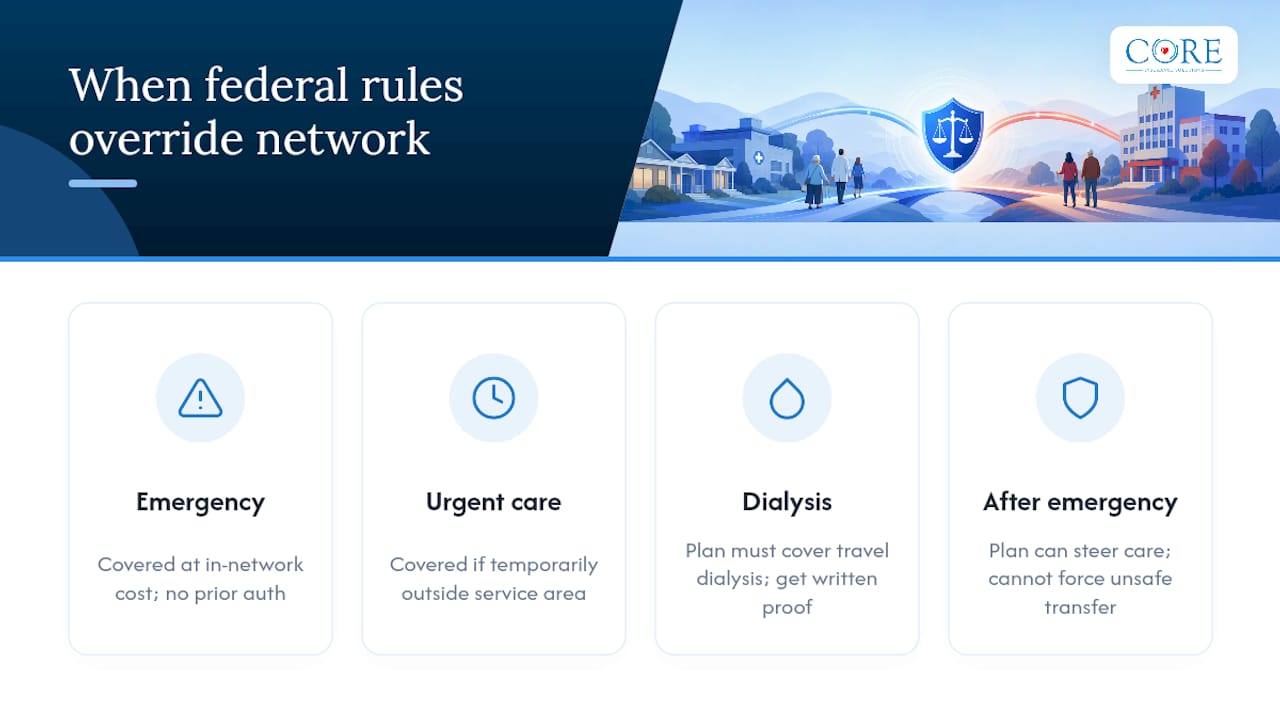
Emergency care is the clearest case. Federal rules require every Medicare Advantage plan to cover emergency services at in-network cost-sharing no matter where the emergency happens or who treats you, and no prior authorization is required. Urgent care follows similar logic when you’re temporarily outside your plan’s service area, such as visiting grandchildren in another state.
Temporary out-of-area dialysis gets its own protection too. If you’re traveling and need dialysis, your plan generally has to cover it. Get the treating facility to document the date, service type, and reason for treatment in writing. That paperwork becomes your evidence if a claim gets questioned later.
Statistic to know: A study of Medicare Advantage Cost plan enrollees found that 69% used non-emergency out-of-network care in 2018, a sign that broader provider access matters to a large share of beneficiaries, not just a niche group.
Post-stabilization care after an emergency also has its own rules. Once you’re stable, the plan can direct your ongoing care to an in-network facility, but it can’t force an unsafe transfer.
What Out-Of-Network Care Actually Costs Under Medicare Advantage
The bill you get after an out-of-network visit depends heavily on plan type, and the differences add up fast. HMO enrollees who go outside the network for non-emergency care often face full financial responsibility. PPO enrollees usually get some coverage, but at a much higher coinsurance rate than an in-network visit would carry.
A few cost patterns show up consistently across Medicare Advantage plans:
- Out-of-network coinsurance for PPOs commonly runs well above in-network rates, sometimes doubling what you’d pay for the same service in-network.
- Some HMO plans process out-of-network claims as if no coverage exists at all, leaving you responsible for the full charge.
- Annual out-of-pocket maximums may apply separately to in-network and combined in-network-plus-out-of-network spending, meaning your out-of-network costs might not even count toward the cap that protects you.
- Medigap policies apply only to Original Medicare. Medigap can’t reduce your out-of-network costs under a Medicare Advantage plan, a distinction that surprises a lot of people who assume supplemental coverage travels with them everywhere.
That last point trips up more beneficiaries than any other misconception on this list. Medigap and Medicare Advantage don’t mix. You have one or the other, not both.
Your Provider Left the Network: What to Do Right Now
Finding out your longtime doctor dropped out of your plan’s network is stressful, but a clear sequence of steps protects both your access to care and your appeal rights.
- Confirm the change with both sides. Call your provider’s office and your plan’s member services line separately. Get names, dates, and reference numbers for each call.
- Request an organizational determination before you receive care if you’re unsure whether a visit will be covered. This forces the plan to give you a written answer in advance, rather than a denial after the fact.
- Ask about a Special Enrollment Period. CMS has sometimes granted SEPs when a major provider or hospital system exits a network, but this is discretionary and depends on CMS finding the change “significant.” One doctor leaving usually doesn’t qualify.
- Contact your State Health Insurance Assistance Program (SHIP) for free, unbiased help navigating an appeal or SEP request.
Pro Tip: Save every notice your plan sends about network changes. Plans generally must notify members 30 to 45 days before a primary care doctor or specialist leaves the network, and that notice is often the strongest evidence in an appeal.
How to Verify a Provider Is Actually In-Network
Provider directories go stale faster than most people expect, and relying on an outdated PDF is one of the most common reasons beneficiaries end up with surprise bills.
Start with your plan’s official website, since printed directories often lag behind real-time changes. From there:
- Call member services directly and ask them to confirm network status for your exact plan, not just the carrier’s plans in general.
- Call the provider’s office separately. Ask specifically whether they accept your plan by name, not just “Medicare Advantage” generally, since a provider may accept one carrier’s plan but not another’s.
- Write down who you spoke with, the date, and any reference number given. This becomes your paper trail if a bill later gets disputed.
- If you’re traveling, call ahead to confirm whether urgent care or temporary out-of-area coverage applies before you need it, not after.
Pro Tip: Screenshot the provider directory page showing your doctor listed as in-network, with the date visible. Directories change, and screenshots are far easier to produce during a dispute than trying to recreate what a page said months ago.
Plans are required to maintain provider directories and explain network rules clearly, but the responsibility to verify still falls on you before the appointment happens.
When Original Medicare Plus Medigap Makes More Sense
Some beneficiaries are better served by leaving Medicare Advantage behind entirely. Original Medicare lets you see nearly any provider nationwide who accepts Medicare, and a Medigap policy can cover the excess charges some providers add on top of Medicare’s approved amount.
This combination costs more in monthly premiums, but it buys freedom that Medicare Advantage networks simply don’t offer. Consider it seriously if:
- You split your time between two states, a common situation for retirees who winter in Florida and summer elsewhere.
- You need specialists who don’t participate in your area’s Medicare Advantage networks, particularly for rare or complex conditions.
- Your prescription needs are stable enough that a separate Part D plan makes financial sense alongside Original Medicare.
Compare the network tradeoffs between Medicare Advantage and Medigap carefully before committing to either path, since switching later isn’t always guaranteed.
How Core Insurance Solutions Helps When Networks Change
Network disruptions are the kind of problem insurance brokers that specialize in Medicare guidance often handle daily for many families seeking better coverage. When a provider drops out of your network, that expertise translates into practical support: verifying whether your specific plan still covers a provider, helping determine if you qualify for a Special Enrollment Period, and comparing Medigap options if Original Medicare turns out to be the better fit.
Annual policy audits can catch network shifts before they become a crisis, and claims advocacy may help when a bill comes back denied. A consultation often starts with a review of your current plan documents and specific provider needs. From there, the path forward becomes a lot clearer than trying to decode plan materials alone.
Get Help Resolving Your Network Coverage Questions
If your provider left your network, or you’re just not sure whether a specialist you need is covered, sorting through plan documents alone eats hours you probably don’t have. Specialized Medicare brokers can assist with network troubleshooting for seniors, matching medical history and provider preferences against major carriers’ actual networks, not just marketing summaries.
That means assistance with Special Enrollment Period eligibility, provider verification before booking appointments, and side-by-side comparisons between staying on Medicare Advantage or shifting to Original Medicare with a Medigap policy. If you’d rather start with a broader overview before diving into your specific situation, the free Medicare 101 webinar replay walks through exactly these tradeoffs. Ready to get a plan reviewed directly? Reach out to a licensed Medicare broker to get your provider network checked before your next appointment, not after the bill arrives.
A Practical Take on Network Access and Peace of Mind
Verification beats assumption every time in this business. Call before you go, keep the paper trail, and review your plan every year rather than waiting for a bill to force the issue. Network changes happen quietly, often with just a 30 to 45 day notice, and the beneficiaries who fare best are the ones who treat that notice as a deadline for action, not a footnote. Professional help exists for a reason. Use it when an SEP or appeal is on the line.
— Core Insurance Solutions
This article is general information, not a substitute for advice from a qualified doctor. Consult a qualified healthcare professional about your own circumstances before acting on anything here.
Sources
- Medicare
- Out‑Of‑Network Utilization and Plan Selection Among Medicare Advantage Cost Plan Enrollees (PMC/NCBI)
- What to Know When Hospitals and Medicare Advantage Plans Split (KFF Health News)
FAQ
Does Medicare Advantage cover out-of-network care?
Only in limited situations, generally emergencies, urgent care while temporarily outside your service area, and certain out-of-area dialysis. Routine non-emergency care outside the network usually isn’t covered, and when it is covered, cost-sharing runs higher.
What is happening to Medicare Advantage plans in 2026?
Network adjustments continue to be common as carriers renegotiate contracts with hospitals and provider groups each year. CMS requires plans to notify members before a primary care doctor or specialist exits the network, typically 30 to 45 days in advance.
Why do people say to stay away from Medicare Advantage plans?
Critics point to network restrictions and prior authorization requirements as the main friction points, since a plan can require in-network care for everything except protected exceptions. That said, the right plan fit depends entirely on your specific providers, medications, and travel habits, which is why an unbiased comparison matters.
Can Medicare Advantage plans be used out of state?
Coverage while traveling is generally limited to emergencies and urgent care, since most plans require in-network providers for routine services within their service area. If you split time between states regularly, Original Medicare with a Medigap policy often provides more consistent access.


