

One Change for U.S. Enrollees: Medicare Advantage Open Enrollment
If you’re already enrolled in a Medicare Advantage plan, you get one more shot each year to fix a bad plan choice. The Medicare Advantage Open Enrollment Period runs January 1 through March 31, and during those three months you can make exactly one change: switch to a different Medicare Advantage plan or drop MA entirely and return to Original Medicare. That’s it. No second change, no third option.
TL;DR:
- You can only make one Medicare Advantage plan change during the open enrollment period from January 1 to March 31, either switching plans or returning to Original Medicare.
- Switching back to Original Medicare requires immediate enrollment in a standalone Part D plan to avoid late penalties and may complicate obtaining Medigap coverage due to underwriting.
- Changes take effect on the first of the month after your request is received, so timely submission and simultaneous enrollment actions prevent coverage gaps or errors.
- Confirm your eligibility by checking your current plan’s documents and ensure your state offers guaranteed-issue rights for Medigap before making any moves.
- Enlisting an experienced agent for drug cost analysis and underwriting scenarios can help avoid costly mistakes during this narrow three-month window.
Core Insurance SolutionsMake Your Medicare Change CarefullyGet personalized guidance, unbiased plan comparisons, prescription cost support, and claims advocacy from Core Insurance Solutions.Get Medicare guidance
Table of Contents
- What Can You Actually Do During Medicare Advantage Open Enrollment?
- Who Qualifies for Medicare Advantage Open Enrollment?
- When Does a Plan Change Take Effect?
- What Happens to Your Drug Coverage and Medigap Options?
- How Do You Submit a Change During the OEP for Medicare Advantage?
- Why an Agent’s Second Opinion Matters More Than It Seems
- What the Rules Get Wrong About “Second Chances”
- Get Help Making Your MA OEP Decision
- Where to Verify the Rules Yourself
- Sources
What Can You Actually Do During Medicare Advantage Open Enrollment?
The Medicare Advantage open enrollment period gives you two doors, not a hallway of options. You either move to another MA plan or you leave MA altogether.
Here’s what’s on the table:
- Switch to a different Medicare Advantage plan, with or without built-in drug coverage
- Drop Medicare Advantage and return to Original Medicare (Part A and Part B)
- If you return to Original Medicare, add a standalone Part D prescription drug plan
Each enrollee gets one MA OEP change per year, full stop. Once you’ve made your move, whether that’s switching carriers or going back to Original Medicare, you’re locked in until the next enrollment window opens. There’s one narrow exception worth flagging: if you happen to carry a separate standalone Part D plan alongside your MA plan, an unusual setup, the rules around what you can change get more restrictive. Check your specific plan documents if that applies to you.
Who Qualifies for Medicare Advantage Open Enrollment?
This period isn’t open to everyone with Medicare. You need to already be enrolled in a Medicare Advantage plan on January 1, and you need to live in that plan’s service area. People still in Original Medicare, or those who haven’t yet enrolled in any Medicare coverage, don’t get access to this window at all. That’s a different process entirely, and it runs on a different calendar.
Not every MA plan qualifies, either. Coverage that commonly falls outside MA OEP includes:
- Medicare Medical Savings Account (MSA) plans
- Certain Medicare Cost plans
- Programs of All-Inclusive Care for the Elderly (PACE)
Verification matters here more than people assume. Plan exclusions trip up a fair number of enrollees who assume every MA plan works the same way.
Pro Tip: Pull out your plan’s Annual Notice of Change or Evidence of Coverage before you assume you’re eligible. If you can’t find it, call your plan directly or check your plan type on Medicare.gov’s Plan Finder tool.
When Does a Plan Change Take Effect?
The timing catches a lot of people off guard, because it doesn’t work the way the Annual Enrollment Period does. During AEP, every change takes effect January 1, regardless of when you submitted it in October, November, or December. MA OEP runs on a rolling monthly clock instead.
Your new coverage kicks in on the first day of the month after your plan receives your request. Two examples make this concrete:
- You submit your request on January 15. Your new coverage starts February 1.
- You submit your request on February 20. Your new coverage starts March 1.
That means a request filed on the last day of March still counts, as long as the plan actually receives it before the window closes. Cutting it that close is risky, though, since mailed forms and phone system delays can eat several days without you knowing it.
One detail that matters more than it seems: submit your enrollment into the new plan and your disenrollment from the old one at the same time, through the same channel if possible. Doing them separately, or through different systems, is a common source of processing errors that can leave you with a gap or a conflicting record. Filing them together closes that gap before it opens.
What Happens to Your Drug Coverage and Medigap Options?
Switching plans during MA OEP has consequences that don’t show up until weeks or months later, and they’re the ones that trip people up most.
If you drop Medicare Advantage and go back to Original Medicare, you need to enroll in a standalone Part D plan right away. Going an extended period without creditable drug coverage can trigger a late enrollment penalty that sticks with your premium for as long as you have Part D. Our Part D penalty calculator can show you what that gap might cost before you make the switch.
Medigap is the bigger trap. Plenty of enrollees assume that leaving MA guarantees them a Medigap policy at a fair rate. It usually doesn’t. In most states, Medigap insurers can medically underwrite your application unless you qualify for a specific guaranteed-issue right, like a trial right tied to your first year on MA. Get denied, or priced out, and you could be stuck without supplemental coverage.
Before you switch, check three things:
- Your state’s specific Medigap underwriting and guaranteed-issue rules
- The Part D formulary and pharmacy network for any plan you’re considering
- Whether your current Medigap trial rights, if any, are still active
Pro Tip: Call Medigap insurers directly and ask about underwriting before you disenroll from MA, not after. Getting a conditional yes in writing beats finding out the hard way.
If you’re weighing this exact move, our guide on switching from Medicare Advantage to Medigap walks through the underwriting math in more detail.
How Do You Submit a Change During the OEP for Medicare Advantage?
A clean paper trail saves you from headaches in April. Here’s the sequence that works:
- Compare plans using the Medicare Plan Finder, sorted by total annual cost and your actual drug list, not just premium
- Call 1-800-MEDICARE or the new plan directly to confirm the plan is accepting enrollments in your area
- Submit your enrollment form and, if applicable, your disenrollment request on the same day
- Ask for written or emailed confirmation of both actions
- Record the confirmation number, the date, and the name of whoever you spoke with
- Call back within a week to confirm your effective date is on file correctly
| Step | What to save |
|---|---|
| Comparing plans | Screenshot or printout of drug costs and network from Plan Finder |
| Submitting the request | Confirmation number and submission date |
| Verifying enrollment | Representative’s name and callback confirmation |
Our step-by-step enrollment guide covers the paperwork side in more depth if this is your first time making a switch outside AEP.
Why an Agent’s Second Opinion Matters More Than It Seems
A plan’s summary of benefits rarely tells you what a specific drug will cost at a specific pharmacy. That’s where a lot of MA OEP decisions go sideways. An experienced agent can check drug-tier placement against your actual prescriptions, run total out-of-pocket scenarios across your top plan choices, and flag Medigap underwriting risk before you disenroll from anything.

Core Insurance Solutions builds this into annual policy audits, prescription cost optimization, and direct advocacy if a claim or enrollment issue comes up later. If your drug regimen is complicated, you’ve had a recent health change, or you’re unsure how Medigap underwriting works in your state, that’s when a phone call beats a solo Plan Finder session. Straightforward switches between two MA plans in the same network, without drug changes, are often fine to handle on your own.
What the Rules Get Wrong About “Second Chances”
The biggest misconception about Medicare Advantage open enrollment is that it functions like a universal reset button. It doesn’t. It’s a narrow, one-time correction mechanism for people already inside the MA system, and treating it like a second Annual Enrollment Period leads to rushed decisions.
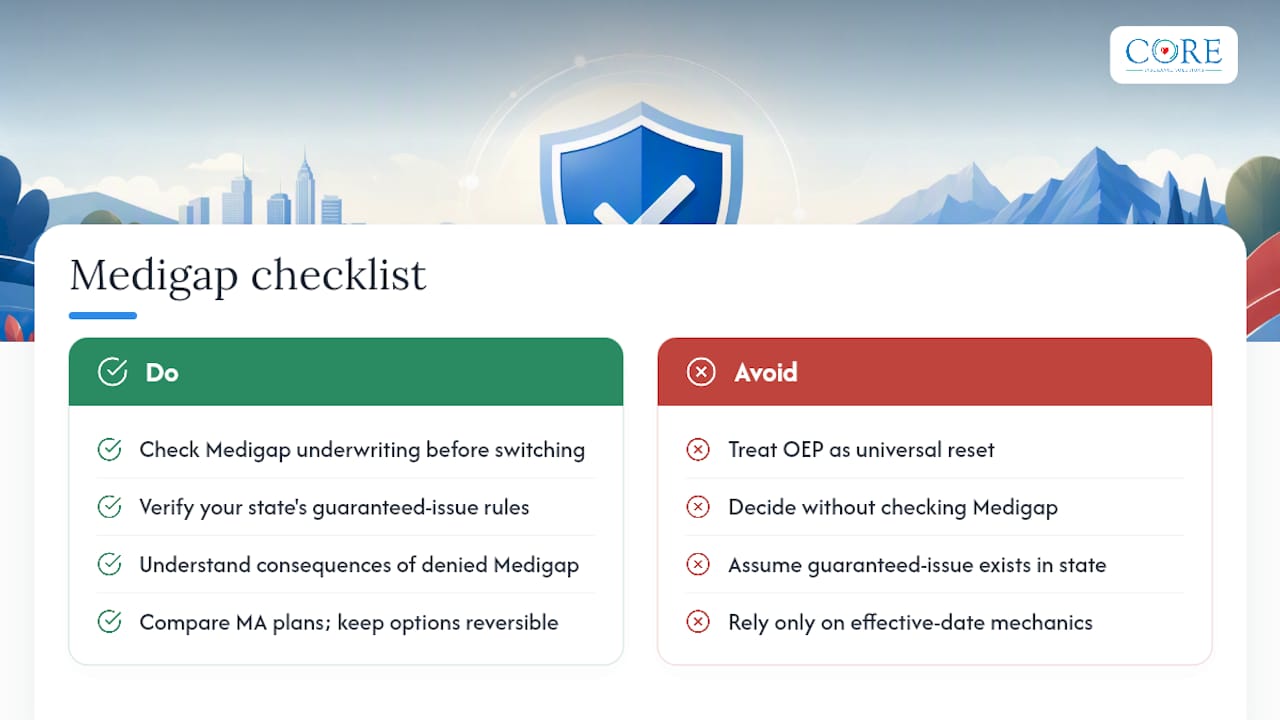
Most explainers spend their energy on the calendar dates and skip the part that actually costs people money: the Medigap underwriting gap. Enrollees who joined MA straight out of their Initial Enrollment Period, and later want to leave, often discover they have no guaranteed-issue right waiting for them. That’s not a footnote. It’s the single biggest financial risk in this entire window, and it deserves more attention than the effective-date mechanics that dominate most guides.
If there’s one thing worth prioritizing, it’s this: check your Medigap underwriting status in your state before you touch your MA enrollment, not after. The plan comparison is reversible. A denied Medigap application, in a state without strong guaranteed-issue protections, is not always something you can undo.
— Core Insurance Solutions
Get Help Making Your MA OEP Decision
Comparing drug formularies, running underwriting scenarios, and tracking effective dates is a lot to manage in a three-month window, especially if you’re doing it alone for the first time. Local Medicare brokerage firms have helped many families in Lakeland, Crystal Lake, Plant City, and the surrounding Central Florida area work through exactly this kind of decision, matching plan details against real prescription lists instead of generic summaries.

Start with our free Medicare 101 webinar replay, which walks through enrollment timelines and the trade-offs behind switching plans. If you already know you want to compare options, you can shop Medicare Advantage plans directly or schedule a consultation through our services page to get a second opinion on drug costs and Medigap underwriting before you submit anything. If you also manage diabetes and need to understand device coverage under a new plan, this diabetic device coverage guide is worth a look before you switch.
Where to Verify the Rules Yourself
Before you submit any change, confirm the details directly through official channels. The Medicare Plan Finder lets you compare plan costs and networks, and Medicare’s enrollment period guidance lays out the full calendar for the year. For deeper explainers on switching rules and Medigap underwriting, the Medicare Rights Center and KFF’s Medicare FAQ series are both reliable, plain-language resources. Our own breakdown of Medicare’s enrollment periods can help you see how MA OEP fits alongside AEP and Special Enrollment Periods.
This article is general information, not a substitute for advice from a qualified financial advisor. Consult a qualified financial professional about your own circumstances before acting on anything here.
Sources
- Joining a plan | Medicare
- How and when can I switch from Medicare Advantage to traditional Medicare? | KFF
- Medicare Advantage enrollees have until March 31 to make certain coverage changes | Medicare Rights Center


