

Close $1,676 Part A Gap With Hospital Indemnity Insurance for Medicare
Hospital indemnity insurance pays you a fixed cash benefit, daily or per admission, when you’re hospitalized, and you can spend it on anything from deductibles to groceries. It works best for Medicare Advantage enrollees facing daily copays, people on high-deductible plans, and fixed-income households with little emergency savings. In the U.S., it’s designed to run alongside Medicare or private coverage, not replace it.
TL;DR:
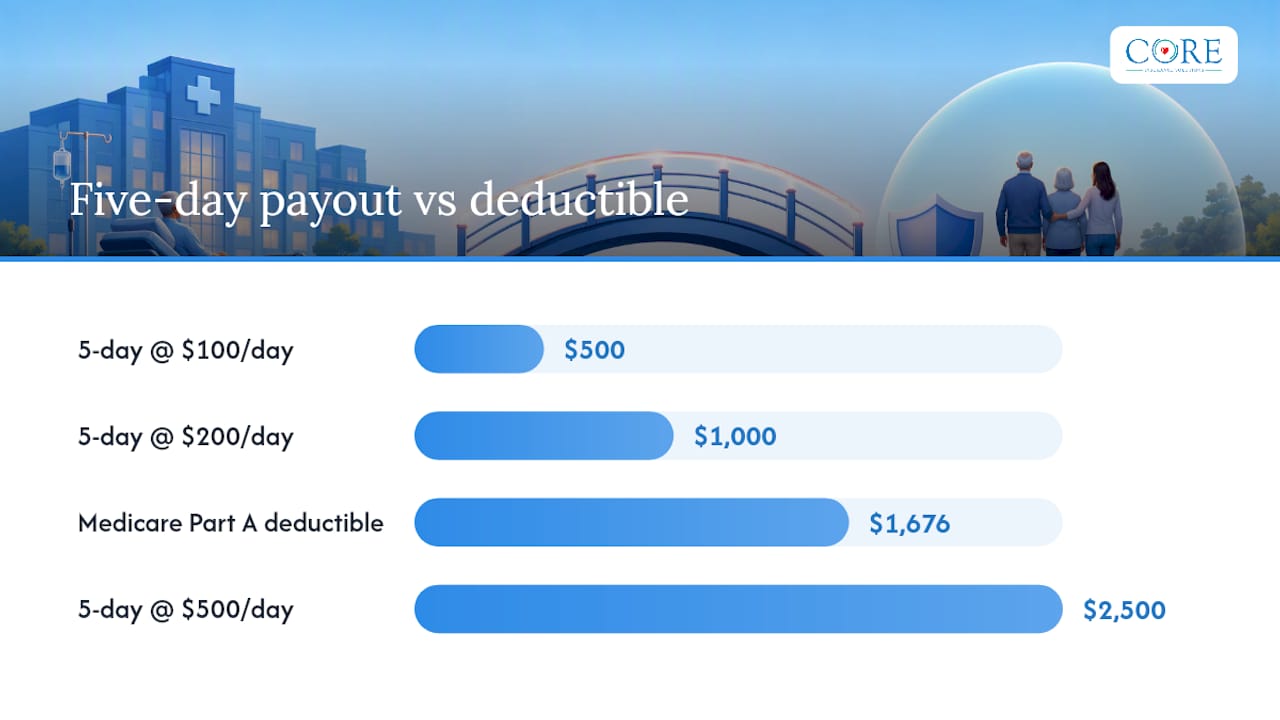
- A policy paying $200 per day for a five-day hospital stay provides a $1,000 payout, which covers most of the 2026 Medicare Part A deductible of $1,676.
- Benefits are capped by annual limits, often 30 to 90 days, meaning extended stays may result in no further payouts when most needed.
- For Medicare Advantage enrollees facing daily copays of up to $400, indemnity payments can offset out-of-pocket hospital costs effectively.
- Choosing between hospital indemnity and Medigap depends on your existing coverage, with indemnity filling gaps not covered by comprehensive Medigap plans.
- Before buying, verify if the policy covers observation stays, has suitable caps, and includes or offers riders for ICU, outpatient surgery, or skilled nursing benefits.
Table of Contents
- What Is Hospital Indemnity Insurance and How Does It Pay Out?
- Who Actually Benefits From a Hospital Indemnity Policy?
- How Much Does It Cost and What’s the Real Payout Math?
- Hospital Indemnity vs. Medigap: How Do They Work Together?
- What Should You Check Before Buying a Policy?
- How Do You Enroll and File a Claim?
- How Core Insurance Solutions Helps You Evaluate Hospital Indemnity Coverage
- Our Take: Why the Numbers Matter More Than the Sales Pitch
- Get Personalized Help Choosing the Right Coverage
- Where to Verify These Figures
- Sources
What Is Hospital Indemnity Insurance and How Does It Pay Out?
Hospital indemnity insurance is a supplemental policy that pays you a set cash amount when you’re admitted to a hospital, regardless of what the actual bill turns out to be. Insurers structure benefits three ways: a daily rate, a lump sum per admission, or a blend of both.
Payouts land in your bank account, not the hospital’s. That means you decide where the money goes, whether that’s your Medicare Part A deductible, a copay, a car payment, or a caregiver’s flight home, since the payout goes directly to the policyholder rather than a provider.
Typical policies pay $100 to $500 per day, with premiums scaling based on age and benefit level. A 70-year-old choosing a modest daily benefit pays far less than someone stacking riders for ICU stays or outpatient surgery.
Statistic Callout: A five-day hospital stay at a $200-per-day benefit generates a $1,000 payout, often enough to cover a full Medicare deductible with room to spare.
Common add-ons include:
- ICU riders that pay a higher daily rate for intensive care
- Outpatient surgery benefits for procedures that don’t require admission
- Skilled nursing facility (SNF) riders for post-hospital rehab stays
Who Actually Benefits From a Hospital Indemnity Policy?
Not everyone needs this coverage, but a few groups get outsized value from it. If you recognize yourself in one of these situations, it’s worth running the numbers.
- Medicare Advantage enrollees facing daily copays. Many MA plans charge $250 to $400 per day for the first several days of a hospital stay, and a cash benefit offsets that directly.
- People on Original Medicare without Medigap. Without supplemental coverage, you’re exposed to the full Part A deductible and any coinsurance beyond day 60.
- Fixed-income households with thin emergency savings. A predictable check during a hospitalization can be the difference between paying a bill on time and falling behind, especially since medical debt disproportionately affects people already managing chronic stress or limited income.
How Much Does It Cost and What’s the Real Payout Math?
Numbers make this easier to evaluate than marketing language ever does. Here’s what the range looks like in practice.
- Daily benefits: $100 to $500 per day, depending on the policy and rider selection
- Premiums: roughly $20 to over $100 per month, scaled by age and benefit amount
- Annual caps: many policies limit paid days per year, often 30 to 90 days
Statistic Callout: The 2026 Medicare Part A inpatient deductible is $1,676. A policy paying $200 per day for a five-day stay ($1,000) covers most, but not all, of that exposure, so the gap matters when you’re comparing policies.
Caps are where the fine print earns its reputation. A policy that caps benefits at 30 days a year sounds generous until you hit an extended stay, at which point the cash stops flowing exactly when you need it most. Read the annual limit before you look at the daily rate. The daily number is the headline; the cap is what actually determines your expected value in a bad year.
Hospital Indemnity vs. Medigap: How Do They Work Together?
These two products solve different problems, and confusing them leads to either redundant coverage or a dangerous gap. Medigap standardizes cost-sharing across specific plan letters (A through N) and pays providers directly for coinsurance and deductibles. Hospital indemnity pays you a flat cash amount regardless of the actual bill, and benefit structures vary by carrier since indemnity policies aren’t standardized the way Medigap is.
- If you already have a robust Medigap plan (like Plan G), a hospital indemnity policy may be redundant for hospital costs specifically, though it can still help with non-covered expenses like transportation or home modifications.
- If you’re on Medicare Advantage, where supplemental daily copays are common, indemnity coverage fills a real gap Medigap doesn’t touch because MA and Medigap aren’t compatible.
- Enrollment timing differs too. MA-embedded riders follow the Annual Enrollment Period (AEP), while standalone hospital indemnity policies are often available year-round, subject to medical underwriting.
If you’re still working out how Medigap fits your overall Medicare picture, it’s worth reviewing how Medicare Supplement plans function before deciding whether indemnity coverage adds value or overlaps with what you already have.
What Should You Check Before Buying a Policy?
Every hospital indemnity policy reads differently, because carriers aren’t required to standardize language the way Medigap carriers are. That freedom is exactly why the fine print deserves your full attention.
- Does the policy pay for observation stays, or only formal inpatient admission? This distinction trips up more claimants than any other single clause.
- How long is the waiting period before coverage kicks in, and does it apply to pre-existing conditions?
- Is the benefit structured per day, per admission, or a combination?
- What’s the maximum number of paid days per year, and is there a lifetime cap?
- Are ICU, outpatient surgery, or skilled nursing riders included, or sold separately?
- Is the policy guaranteed renewable, and does it travel with you if you move states?
- What documentation does the insurer require to process a claim, and how fast do they typically pay?
Vague trigger language (“hospitalization” without defining inpatient status), waiting periods longer than a few months, and exclusions buried in dense policy riders are all worth flagging before you sign anything.
Pro Tip: Before buying, call your State Health Insurance Assistance Program (SHIP) office. Their counselors review policy wording for free and have no incentive to steer you toward any particular carrier.
How Do You Enroll and File a Claim?
Getting covered depends on which route you take. Employer group plans, MA-embedded riders tied to AEP, and standalone policies (often available year-round but subject to underwriting) each work a little differently.
Filing a claim generally follows the same pattern regardless of carrier:
- Gather your hospital admission and discharge paperwork, which most insurers require as proof of the stay
- Submit the claim form along with itemized records showing dates and inpatient status
- Expect processing within one to two weeks for most straightforward claims
The most common delay happens when a hospital classifies a stay as “observation” rather than formal admission. Ask the hospital for written confirmation of your admission status before you’re discharged. It’s a five-minute conversation that can save weeks of claim disputes later.
How Core Insurance Solutions Helps You Evaluate Hospital Indemnity Coverage
Comparing hospital indemnity policies means reading fine print most people never see until they’re filing a claim. Core Insurance Solutions has helped more than 2,000 families across Lakeland, Crystal Lake, Plant City, Winter Haven, and surrounding Central Florida communities work through exactly that process.
- A holistic needs assessment that looks at your existing Medicare coverage, health history, and budget before recommending any policy
- Unbiased comparisons across major carriers, so the recommendation isn’t tied to a single company’s product line
- Annual policy audits to confirm your coverage still matches your health and financial situation
- Help minimizing prescription costs alongside your broader Medicare strategy
- Claims advocacy if a payout gets delayed or disputed
Concretely, that means modeling a sample hospitalization against your specific deductible exposure, checking a policy’s waiting period against your enrollment timeline, and confirming whether observation stays are actually covered before you sign anything.
Our Take: Why the Numbers Matter More Than the Sales Pitch
Most hospital indemnity marketing leans on fear: what if you can’t pay your deductible? That’s the wrong starting point. The right question is a math problem: what’s your realistic exposure, and does a specific policy’s daily rate and annual cap actually close that gap?
Conventional advice treats hospital indemnity as a blanket recommendation for anyone over 65. It isn’t. Someone with a strong Medigap Plan G has different exposure than someone on Medicare Advantage facing a $350 daily copay for the first five days of a stay. The policy that helps one person is close to worthless for the other.
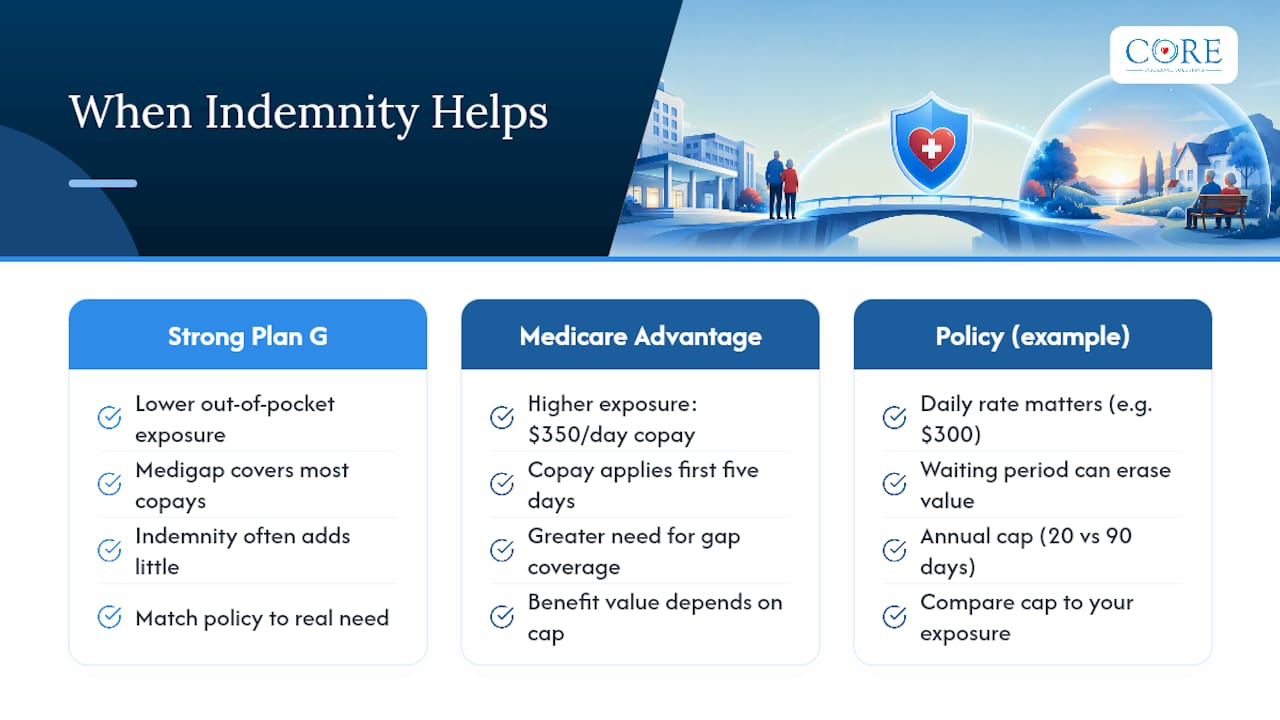
What gets underrated is the waiting period and the annual day cap, because both quietly erase value that the headline daily rate promises. A $300-a-day benefit capped at 20 days a year is a very different product than the same rate with a 90-day cap.
Run your own numbers before you run to a sales call. Compare your deductible, your plan’s daily copay structure, and the policy’s actual cap. That’s the calculation that tells you whether this coverage earns its premium.
— Core Insurance Solutions
Get Personalized Help Choosing the Right Coverage
Reading policy fine print is one thing. Knowing which numbers actually apply to your Medicare situation is another, and that’s where a local, unbiased comparison beats a generic online quote every time. Core Insurance Solutions builds every recommendation around your specific health history, current Medicare plan, and budget, not a single carrier’s product catalog.

If you’re still getting oriented, start with the free Medicare 101 webinar replay, which walks through how Medicare, Medigap, and supplemental coverage like hospital indemnity actually fit together. When you’re ready for a personalized review, a consultation covers your existing coverage, models your realistic hospitalization exposure, and compares hospital indemnity options across major carriers, no pressure to buy anything before you understand the numbers. Visit the hospital indemnity insurance page to see current options for Florida residents, or check overall Medicare plans and services in Lakeland to schedule time with an advisor.
Where to Verify These Figures
For the official 2026 Medicare Part A deductible and coverage rules, check Medicare. To find free, unbiased counseling in your area, contact your local SHIP office. For carrier-specific policy details, review insurer explainers like Mutual of Omaha’s hospital indemnity guide.
This article is general information, not a substitute for advice from a qualified financial advisor. Consult a qualified financial professional about your own circumstances before acting on anything here.
Sources
- Hospital indemnity insurance 101: Coverage, costs and key benefits | Mutual of Omaha
- What Is Hospital Indemnity Insurance? A Guide | eMedicare
- Adults with depression or anxiety more likely to have medical debt, delay care | Johns Hopkins Bloomberg School of Public Health


