

3 Medicare Triggers for Home Health Every Lakeland Family Needs
Yes, Medicare covers home health care, but only when you meet three specific triggers: you’re homebound, you need intermittent skilled care, and a physician or allowed provider certifies your eligibility. When those boxes are checked, Medicare pays the full cost of covered home health agency services, so beneficiaries typically owe $0 for skilled visits. Durable medical equipment is billed separately and generally requires a coinsurance payment after meeting your Part B deductible.
TL;DR:
- Medicare covers home health services only if you are homebound, need intermittent skilled care, and have certified eligibility within the required timeframes.
- Covered services include skilled nursing, therapy, speech-language pathology, part-time home health aide, and medical social services, but not private-duty aides or custodial care.
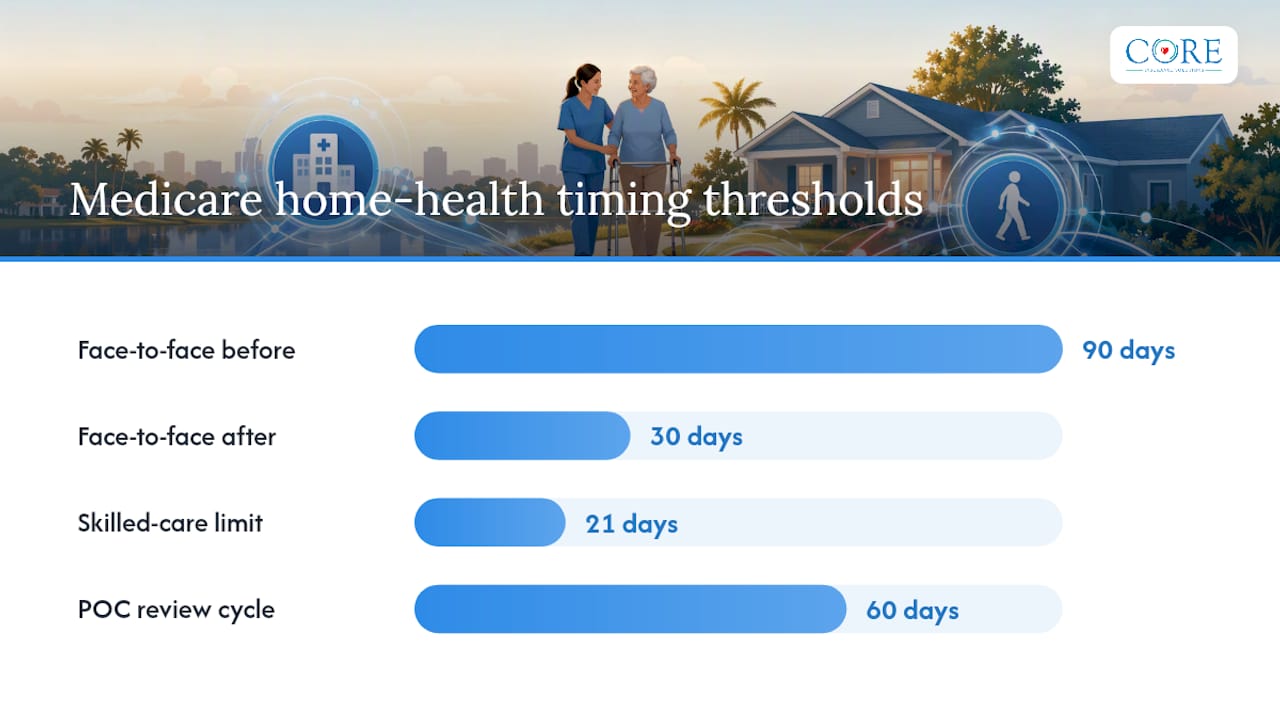
- The typical recertification occurs every 60 days, with a face-to-face encounter conducted within 90 days before or 30 days after starting care.
- Durable medical equipment is billed separately under Part B, with beneficiaries responsible for 20% coinsurance after meeting the deductible, unlike skilled visits that are usually covered fully.
- Proper documentation of medical necessity, specific clinical justifications, and timely face-to-face certification significantly influence claim approval and reduce denial risk.
Table of Contents
- Home Health Coverage Medicare Beneficiaries Can Actually Use
- Homebound Status, Face-to-Face Certification, and the Plan of Care
- What Medicare Pays, What You Pay, and Why the Rules Keep Shifting
- Starting Home Health Care and Finding a Certified Agency
- What Medicare Won’t Pay For, and Your Appeal Rights
- How Long Medicare Pays and How Many Visits to Expect
- Why Home Health Claims Get Denied, and How to Prevent It
- How Core Insurance Solutions Supports Seniors Through the Home Health Process
- A 72-Hour Checklist for Families Facing a New Home Health Need
- Get Direct Help Confirming Your Home Health Coverage
- Where to Verify These Rules Yourself
- Sources
Home Health Coverage Medicare Beneficiaries Can Actually Use
Home health coverage under Medicare isn’t a single benefit so much as a bundle of services tied together by one requirement: you need skilled care, not just help around the house. Understanding what falls inside that bundle, and what falls outside it, is where most families get tripped up.
Medicare covers the following when a doctor orders them and a Medicare-certified agency provides them:
- Skilled nursing care for wound care, injections, catheter management, and monitoring of unstable conditions.
- Physical therapy to restore mobility after surgery, a fall, or a stroke.
- Occupational therapy to help you relearn daily tasks like dressing or bathing safely.
- Speech-language pathology for swallowing difficulties or communication loss.
- Home health aide services, but only part-time and only when you’re already receiving skilled nursing or therapy. An aide alone, without skilled care attached, does not qualify.
- Medical social services, which help coordinate community resources or address emotional and social factors affecting recovery.
- Certain medical supplies, such as wound dressings, catheters, and other items used during a skilled visit.
That last item trips people up constantly. Supplies used during a covered visit, like gauze or a catheter, get folded into the home health payment. Durable medical equipment, on the other hand, meaning a hospital bed, wheelchair, or walker, gets billed separately under Part B. If your mother’s nurse changes a wound dressing, that dressing is covered as part of the visit. If she also needs a wheelchair, that’s a separate Part B claim with its own coinsurance. Our guide on what Medicare Part B covers breaks down that DME cost-sharing in more detail.
Every service also has to pass Medicare’s “reasonable and necessary” test, and it has to come from an agency that’s Medicare-certified, meaning it’s been surveyed and approved to bill the program directly. A home health aide hired privately through a staffing agency, however well-qualified, doesn’t generate Medicare-covered visits unless that agency carries certification.
One nuance worth flagging: Part B typically pays for home health without requiring a prior hospital stay, while Part A can cover home health following certain inpatient admissions. For most beneficiaries living at home and receiving ongoing skilled care, Part B is the operative benefit, which matters when you’re trying to figure out which part of your coverage is actually paying the bill.
Homebound Status, Face-to-Face Certification, and the Plan of Care
Medicare’s eligibility rules sound bureaucratic until you realize they exist to answer one question: does this person genuinely need care delivered at home, or could they get it in a clinic instead? Three pieces determine the answer.
The homebound test has two parts, and both have to be true. First, you need help from another person or medical equipment (like a walker, wheelchair, or special transportation) to leave home, or your doctor believes leaving home could worsen your condition. Second, leaving home takes considerable and taxing effort. Neither part means you’re confined to bed or that you can never leave the house. Medicare Interactive’s homebound guidance notes that infrequent, short outings, a haircut, a religious service, a family gathering, don’t disqualify you. Regular medical appointments don’t count against homebound status either. The documentation just needs to describe the effort involved in leaving, not claim total isolation.
Intermittent skilled care is the second trigger, and it has an exact definition:
- Skilled nursing provided fewer than 7 days per week, or
- Less than 8 hours per day for periods of 21 days or less
- Extensions beyond 21 days are possible when the need is predictable and finite (a specific, time-limited treatment course, for example).
Pro Tip: If your care needs look like they’ll stretch past three weeks, ask the agency’s clinical team to flag that early. Reviewers want to see the finite, predictable nature of the extension documented in the plan of care, not discovered after the fact.
Face-to-face certification is the third piece, and timing matters here. A physician, nurse practitioner, physician assistant, clinical nurse specialist, or certified nurse midwife must conduct this encounter no more than 90 days before home health starts, or within 30 days after it begins. This provider then certifies that you meet the homebound and skilled-care requirements. Miss that window, and the whole episode risks denial regardless of how legitimate the clinical need actually is.
The plan of care (POC) ties it together. It documents diagnoses, the services ordered, frequency and duration of visits, and measurable goals. The certifying physician or allowed practitioner signs it, and it gets reviewed, typically every 60 days, to confirm continued eligibility. This 60-day rhythm is why families sometimes see a gap or a reassessment visit right around the two-month mark; it’s not an oversight, it’s the recertification cycle doing its job.
What Medicare Pays, What You Pay, and Why the Rules Keep Shifting
Here’s the number that surprises most families: covered home health agency services cost the beneficiary nothing, typically requiring no copay, deductible, or coinsurance for skilled visits like nursing or therapy. Medicare pays the agency directly for the full approved amount of covered services.

Durable medical equipment works differently. DME ordered as part of your home health plan runs through Part B, where Medicare typically covers 80% of the approved cost after you’ve met your Part B deductible, leaving you responsible for the remaining 20%. That split explains why two people receiving nearly identical home health care can end up with very different out-of-pocket totals, depending on whether one of them also needs a hospital bed or oxygen equipment.
Billing runs through what’s called consolidated billing. The home health agency bills Medicare for a payment period, currently structured as 30-day units under the Patient-Driven Groupings Model, and that payment is meant to cover the services and supplies furnished during that window. The agency is generally responsible for furnishing or arranging the supplies tied to your care within that period, with DME as a notable exception billed separately.
Payment policy isn’t static, either. CMS has proposed CY2026 Home Health PPS adjustments, including a proposed permanent adjustment near negative 4.059% and a temporary reduction near negative 5.0% to the base payment rate. Those numbers sound like inside baseball, but they filter down to real decisions: agencies facing tighter margins sometimes adjust visit frequency, staffing, or which cases they accept. It’s worth knowing this context exists even if you never see the rate itself on a bill.
A few things to ask an agency before care starts:
- What will I be billed for, and what’s covered outright?
- How do you handle DME orders, and who submits that separately?
- If you think something won’t be covered, will you issue an Advance Beneficiary Notice before providing it?
Readers juggling home insurance questions alongside Medicare coverage may also find our piece on integrating Medicare and home insurance useful for sorting out where equipment coverage overlaps.
Starting Home Health Care and Finding a Certified Agency
Getting home health started usually begins with someone else noticing the need before you do, a hospital discharge planner, your primary care doctor, or a specialist managing a chronic condition.
- Get a referral. This typically comes as a doctor’s order, either from your regular physician or from a hospital discharge planner if you’re leaving an inpatient stay. No order, no covered care.
- Verify Medicare certification. Use Medicare’s Care Compare tool to confirm the agency is Medicare-certified before you commit. Care Compare also shows quality scores drawn from patient outcomes and survey results, which is worth a few minutes of comparison shopping even under time pressure.
- Complete the start-of-care assessment. A clinician from the agency conducts a comprehensive evaluation (the OASIS assessment) covering functional status, medications, and safety risks. This visit generates the plan of care.
- Gather your documents. Have your medication list, recent discharge summary, insurance cards, and a list of your other providers ready for that first visit. It speeds everything up.
- Ask about communication. Confirm how the agency will keep your physician updated and how often you’ll see the same care team versus rotating staff.
If you’re mapping out timing around a recent Medicare enrollment or a birthday milestone, the turning-65 Medicare checklist walks through the broader enrollment calendar that home health eligibility sits inside.
What Medicare Won’t Pay For, and Your Appeal Rights
Home health coverage has real limits, and knowing them upfront prevents a lot of frustration later.
Medicare does not cover:
- 24-hour-a-day care at home, under any circumstances.
- Homemaker services like cleaning or grocery shopping when they’re the only service needed.
- Meal delivery.
- Custodial care, help with bathing or dressing, when that’s the sole need and no skilled care is involved.
When an agency believes Medicare won’t pay for a specific service, it must issue an Advance Beneficiary Notice (ABN), or a Home Health Change of Care Notice (HHCCN) in related situations, explaining why and estimating your cost. You have three real options: agree to pay out of pocket, decline the service, or ask the agency to bill Medicare anyway so you get an official determination. That third option matters more than people realize. Even with an ABN on file, you retain the right to have the claim submitted and to appeal a denial, and plenty of appeals succeed.
If home health services are ending sooner than you expected, you can request a fast appeal through your Beneficiary and Family Centered Care Quality Improvement Organization before discharge takes effect. For general questions, call 1-800-MEDICARE, or contact your local State Health Insurance Assistance Program (SHIP) counselor for free, unbiased guidance specific to your situation.
How Long Medicare Pays and How Many Visits to Expect
Medicare home health isn’t a subscription with a fixed hour count. It’s need-based and episodic, which means coverage continues only as long as you continue to meet the homebound and intermittent skilled care criteria, not for a preset number of weeks.
A few things shape what “typical” looks like in practice:
- Visits are intermittent by design: think a few times a week for nursing or therapy, not daily custodial help.
- The 21-day intermittent care window (with possible extensions for predictable, finite needs) sets the general rhythm reviewers expect to see.
- Reviewers evaluate objective clinical need, functional decline, wound status, therapy progress, rather than approving or denying based on diagnosis alone. Two people with the same diagnosis can have very different coverage outcomes depending on documented severity.
- Recertification happens roughly every 60 days, when the physician reviews and re-signs the plan of care to confirm continued eligibility.
That 60-day recertification is worth planning around. If your loved one’s condition is improving, the recertification visit may be where the care team starts discussing a step-down in services. If it’s declining, it’s often the moment additional needs get documented and added to the plan.
Why Home Health Claims Get Denied, and How to Prevent It
The single biggest reason home health claims fail isn’t fraud or ineligibility. It’s paperwork. CMS compliance reporting found that insufficient documentation accounted for 51.4% of improper payments for home health services, with medical necessity issues responsible for another 33.7%. Put simply: most denials trace back to what got written down, not what actually happened clinically.
That’s good news in one sense. It means documentation, not just clinical severity, is often the fixable variable.
A few things that consistently strengthen a claim:
- A clear description of the taxing effort involved in leaving home, not a vague “patient is homebound” checkbox.
- Specific clinical justification tied to the skilled service ordered (why nursing, why therapy, why now).
- A plan of care with concrete, measurable goals rather than generic language.
- A face-to-face encounter note that’s completed within the required window and clearly supports the certification.
Pro Tip: Keep your own running folder, medication changes, mobility setbacks, hospital discharge paperwork, and dates of any falls or ER visits. When a claim gets questioned, families who can hand over a clean timeline resolve appeals faster than those reconstructing events from memory.
Families can genuinely help this process along by keeping an updated medication list, noting specific mobility limitations (not just “trouble walking” but “needs assistance for all transfers”), and collecting discharge summaries the moment they’re issued rather than months later.
How Core Insurance Solutions Supports Seniors Through the Home Health Process
Home health coverage rarely comes with a single question. It comes with a dozen, usually asked at a stressful moment right after a hospital stay or a hard diagnosis. Core Insurance Solutions built its approach around that reality, starting with a holistic health needs assessment rather than a generic plan pitch, so recommendations reflect your actual medical history instead of a one-size-fits-all script.
That groundwork matters for home health specifically. Because Medicare Advantage plans can structure home health referrals and network rules differently than Original Medicare, knowing which type of plan you carry, and how it handles home health, changes what you should expect from an agency. Core Insurance Solutions’ annual policy audits catch these gaps before they turn into denied claims or surprise bills.
Practically, that support looks like: reviewing your eligibility factors before you call an agency, confirming a prospective agency’s Medicare certification status, helping you and your physician’s office organize documentation ahead of the face-to-face encounter, and advocating on your behalf if a claim gets denied or an ABN raises questions you don’t know how to answer.
Core Insurance Solutions has helped more than 2,000 families across Lakeland, Crystal Lake, Plant City, Gibsonia, Winter Haven, Eagle Lake, Auburndale, Polk City, and Bartow sort through exactly these kinds of coverage decisions.
A 72-Hour Checklist for Families Facing a New Home Health Need
When a doctor first mentions home health, most families freeze for a day, then scramble. Here’s what actually needs to happen in the first 72 hours, drawn from the patterns that consistently separate smooth starts from denied claims.
Pull together the doctor’s order, any hospital discharge summary, and a current medication list before you call anyone. Then call 1-800-MEDICARE or your local SHIP counselor with specific questions about your situation, not general ones. Verify the agency’s Medicare certification through Care Compare before signing anything, not after the first visit.
Ask your doctor directly to document the homebound factors, the taxing effort involved in leaving home, in the chart, and confirm the face-to-face encounter gets scheduled within the required window. Ask the agency upfront how they handle ABNs, so there are no surprises if a service falls outside coverage.
If you want a second set of eyes on eligibility or help pushing back on a denial, that’s exactly the kind of review Core Insurance Solutions handles for families across our service area.
— Core Insurance Solutions
Get Direct Help Confirming Your Home Health Coverage
Reading the rules is one thing. Applying them to your specific diagnosis, your specific agency, and your specific Medicare plan is another. Core Insurance Solutions works directly with seniors across Lakeland and the surrounding communities to review eligibility, confirm whether a prospective agency carries proper Medicare certification, and help organize the documentation your physician needs for a clean face-to-face certification, before a denial happens instead of after.
This isn’t a sales call disguised as advice. It’s the same unbiased, carrier-neutral comparison approach Core Insurance Solutions applies to every Medicare Advantage, Medigap, and Part D decision, extended to the home health questions that don’t show up on a plan brochure. All guidance follows Medicare marketing guidelines, so what you get is factual coverage information, not pressure.
If you’d rather start with education before a conversation, watch the free Medicare 101 webinar replay to see how home health fits into the bigger Medicare picture. If you’re ready to talk through your specific situation, visit our Medicare plans and services page to schedule a review with a Lakeland-based advisor.
Where to Verify These Rules Yourself
Every home health rule in this article traces back to a handful of primary sources, and it’s worth bookmarking them directly.
- Medicare covers the basics of what’s covered, cost-sharing, and how to search for certified agencies through Care Compare.
- The CMS home health compliance guidance details documentation standards and the most common reasons claims get denied.
- The “Medicare and Home Health Care” booklet (publication 10969) walks through ABNs, consolidated billing, and your rights as a beneficiary in plain language.
- Medicare Interactive’s homebound explainer clears up the most common misunderstanding about what “homebound” actually requires.
For anything specific to your own claim or situation, call 1-800-MEDICARE or reach out to your local State Health Insurance Assistance Program counselor. Both are free and unaffiliated with any insurance carrier.
This article is general information, not a substitute for advice from a qualified doctor. Consult a qualified healthcare professional about your own circumstances before acting on anything here.
Sources
- Medicare
- CMS — Home Health Services (MLN compliance tips)
- Medicare
- CMS fact sheet — CY 2026 Home Health PPS proposed rule (CMS-1828-P)
- Medicare Interactive — The homebound requirement


