

$2,100 Cap at Stake: When GoodRx Beats Medicare Part D in 2026
You cannot combine GoodRx with Medicare in one transaction, but you can use GoodRx instead of your Part D benefit whenever the cash price beats your copay. The catch: GoodRx payments never count toward your Part D deductible or the 2026 $2,100 out-of-pocket cap, so leaning on it too often can cost you more over a full year. A Medicare advisor can help you weigh that tradeoff before it becomes an expensive habit.
TL;DR:
- Using GoodRx can be cheaper for low-cost generics or drugs not covered by your formulary, but it won’t count toward your deductible or out-of-pocket cap.
- Repeatedly relying on GoodRx instead of Medicare Part D claims can delay reaching the $2,100 out-of-pocket limit, potentially increasing annual costs.
- Always ask the pharmacist to price prescriptions both ways and monitor your progress toward deductibles and caps before choosing between GoodRx and Part D.
- Specialty drugs and prescriptions close to your out-of-pocket limit favor Part D claims because they help you reach catastrophic coverage faster.
- Consider a Medicare plan review or consultation if frequent cash payments with GoodRx suggest your current coverage does not meet your medication needs cost-effectively.
Core Insurance SolutionsFind Coverage That Fits Your MedicationsCore Insurance Solutions compares Medicare options, reviews prescription needs, and helps Lakeland seniors make informed coverage decisions.Explore Medicare guidance
Table of Contents
- How GoodRx Works vs. Medicare Part D
- What GoodRx Doesn’t Count Toward: The 2026 Deductible and Cap
- How to Decide: GoodRx or Part D at the Counter
- 2026 Part D Changes and the Medicare Prescription Payment Plan
- Real Scenarios: When GoodRx Wins and When It Doesn’t
- When a Medicare Broker Recommends GoodRx (And When They Don’t)
- Get a Second Opinion on Your Part D Costs
- Sources
- FAQ
How GoodRx Works vs. Medicare Part D
GoodRx is a discount program, not insurance. It negotiates cash prices with pharmacy benefit managers and shows you what a pharmacy will charge if you pay out of pocket with a coupon. GoodRx confirms it operates outside Medicare entirely, which is exactly why the two can’t be processed together on the same purchase.
Medicare Part D is structured completely differently. Your plan has a formulary that sorts drugs into tiers, a yearly deductible you pay before coverage kicks in, and phases that move from initial coverage into catastrophic coverage once you hit your spending cap.
A pharmacy claims system can only process one payment method per transaction. Running a prescription through Part D triggers an insurance claim with your plan’s specific pricing rules; running it through GoodRx is a straight cash sale. Mixing the two would violate claims processing rules and create coordination problems the systems simply aren’t built to handle. In practice, this means:
- You pick one or the other for each individual fill, not both at once.
- The pharmacist can price it both ways and hand you the cheaper option.
- Your choice on one prescription doesn’t lock you into that choice for the next refill.
What GoodRx Doesn’t Count Toward: The 2026 Deductible and Cap
Here’s the part most people miss. When you pay cash with GoodRx, that purchase never touches your Part D accumulators, because it isn’t processed as an insurance claim at all.
By the numbers: For 2026, the standard Part D deductible is $615 and the annual out-of-pocket cap is $2,100. Every dollar you pay through your plan (copays, coinsurance, deductible payments) moves you closer to that cap. Every dollar you pay through GoodRx does not.
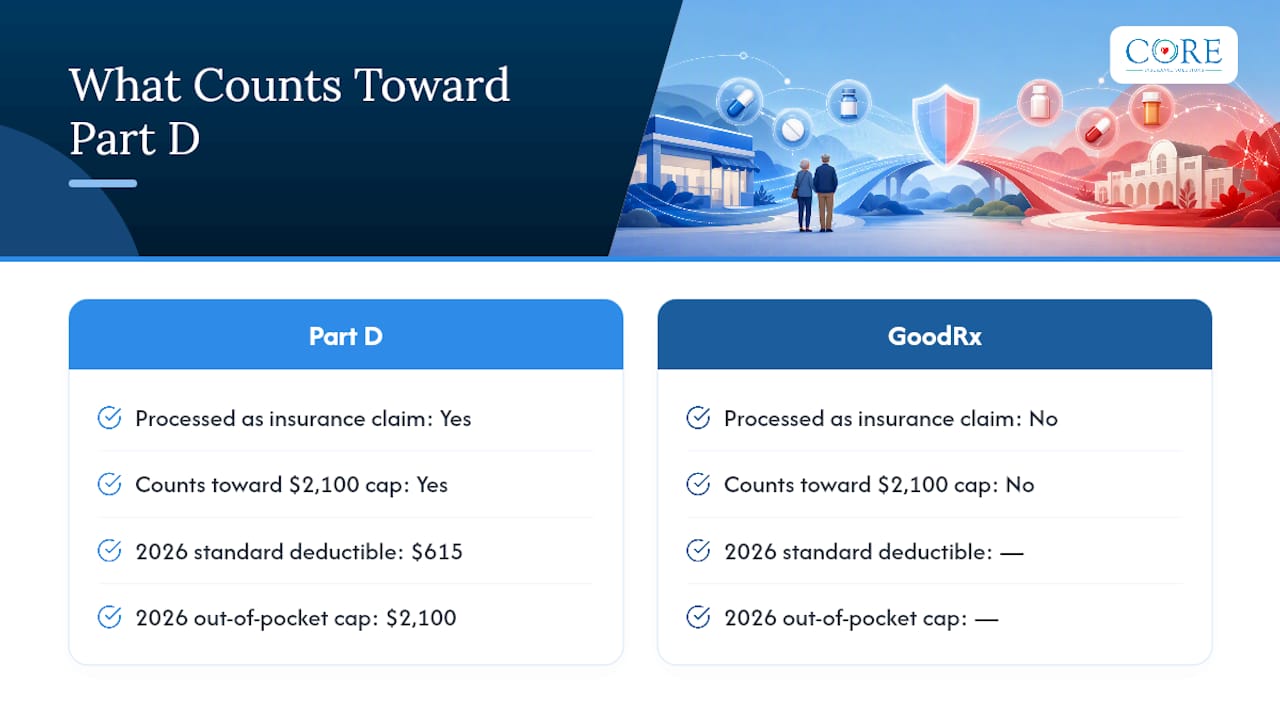
For someone on one or two cheap generics, this rarely matters. But for a beneficiary managing several prescriptions or a costly specialty drug, using GoodRx repeatedly instead of running claims through Part D can delay the moment you hit the $2,100 cap and reach catastrophic coverage, where your covered drugs cost you nothing for the rest of the year. That delay can mean paying full price longer than necessary. GoodRx typically doesn’t offer a way to retroactively submit receipts toward your Part D total, so this is not a choice you can undo later in the year.
How to Decide: GoodRx or Part D at the Counter
Work through this checklist each time you fill a prescription, especially early in the year or when starting a new medication.
- Ask the pharmacist to price it both ways. Pharmacies can typically run the price with your Part D plan and with a GoodRx coupon and tell you which is cheaper on the spot.
- Check your formulary. If the drug isn’t covered by your plan at all, GoodRx may be your only affordable option for that fill.
- Track your deductible progress. If you’re close to the $615 deductible or the $2,100 cap, running the claim through Part D usually pays off more over the rest of the year, even if GoodRx looks cheaper today.
- Watch for specialty and mail-order exceptions. Specialty drugs and mail-order prescriptions often have different pricing structures where the math shifts in Part D’s favor once you’re past the deductible phase.
Pro Tip: If you use GoodRx more than occasionally, keep a simple running log, even a notes app entry works, of what you paid versus what your Part D copay would have been. At year’s end, you’ll know whether GoodRx actually saved you money or just delayed hitting your out-of-pocket cap.
2026 Part D Changes and the Medicare Prescription Payment Plan
Two 2026 policy details change how this decision plays out. First, the numbers themselves: the $615 standard deductible and $2,100 out-of-pocket cap define exactly how much you’d need to spend through Part D before hitting catastrophic coverage.
Second, there’s the Medicare Prescription Payment Plan, a separate option that lets you spread your out-of-pocket drug costs into monthly installments instead of paying them as they come due at the pharmacy counter.
A few things to keep straight about it:
- It doesn’t lower your total drug costs. It just spreads the same amount across the year.
- You still pay your regular plan premium on top of the payment plan installments.
- Enrollment can start any time during the year, and participation renews annually unless you opt out.
This matters for the GoodRx decision because if you’re already managing costs through the payment plan, paying cash with GoodRx on the side adds a second, separate spending track that doesn’t feed into either system. With the $2,100 cap now the ceiling, beneficiaries who expect to hit it should think twice before routing high-cost fills through GoodRx instead of their plan.
Real Scenarios: When GoodRx Wins and When It Doesn’t
- Cheap generic, early in the year, deductible unmet. A $12 GoodRx price beats paying full cash toward a $615 deductible you haven’t touched yet. GoodRx wins here, plain and simple.
- Specialty medication, already close to the cap. If you’ve paid $1,800 of your $2,100 cap already, running that fill through Part D gets you to catastrophic coverage, where the rest of your covered drugs cost nothing for the year. GoodRx would reset that progress to zero for this fill.
- Drug not on your formulary at all. If your plan won’t cover it, there’s no Part D claim to compare. GoodRx becomes the practical choice by default.
Each scenario maps directly back to the checklist: check the price both ways, check the formulary, check your deductible position, and factor in the cap before you swipe your card.
When a Medicare Broker Recommends GoodRx (And When They Don’t)
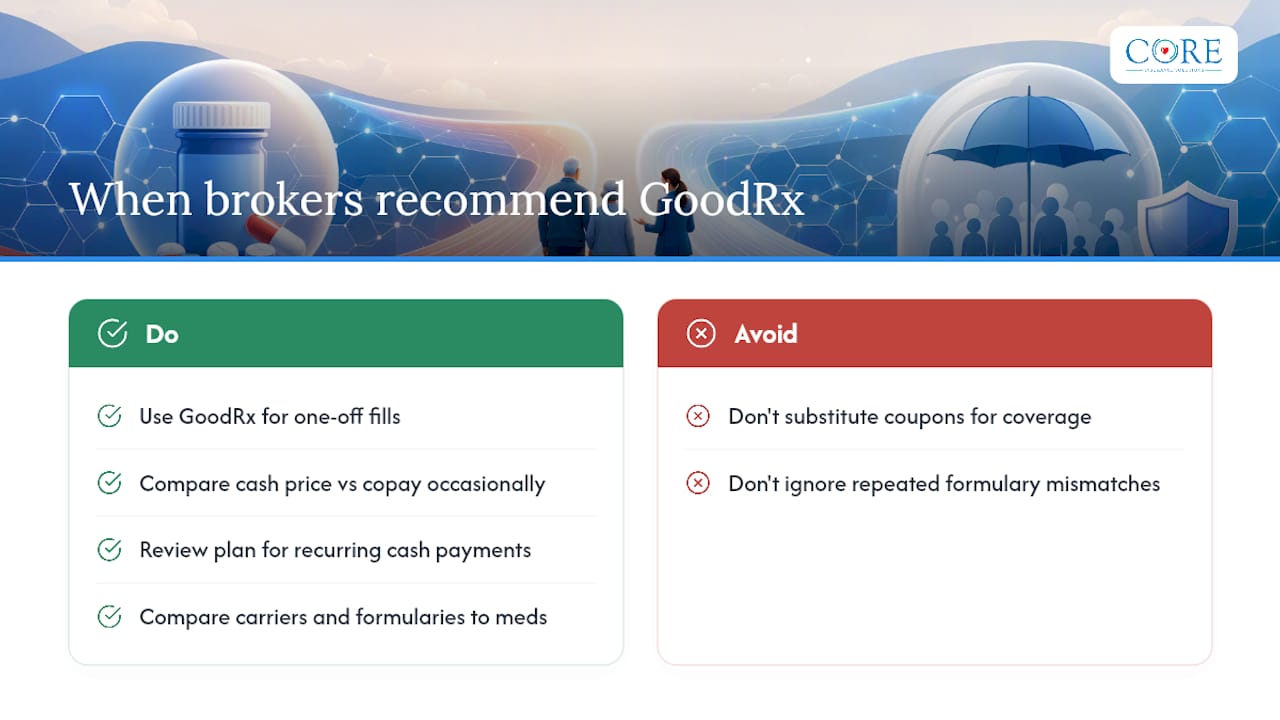
Advisors generally point clients toward GoodRx for one-off situations: a drug that’s excluded from the formulary, or a rare month where the cash price genuinely undercuts the copay. It’s a useful pressure valve, not a substitute for good coverage.
What changes the conversation is a pattern. When someone is routinely paying cash for the same maintenance drugs, or their formulary consistently mismatches their prescriptions, that’s a signal to review the plan itself rather than keep patching it with coupons. Core Insurance Solutions has guided over 2,000 families through exactly this kind of assessment, comparing carriers and formularies against what someone actually takes, not just what a plan claims to cover.
— Core Insurance Solutions
Get a Second Opinion on Your Part D Costs
If you’re reaching for GoodRx more often than feels right, that’s usually a sign your Part D plan needs a second look, not just a coupon. Specialized Medicare advisory services offer local, unbiased comparisons across major carriers, plus annual policy audits and prescription-cost reviews built around what you actually take.
Our services cover Part D selection, ongoing plan audits, and claims advocacy when something gets denied that shouldn’t have been. If you’re new to Medicare or just want the fundamentals explained plainly, watch the free Medicare 101 webinar replay, or go straight to comparing Part D plans in Lakeland, FL with a licensed advisor who will run the numbers with you, not for you.
Sources
- Medicare
- How to Use GoodRx With Medicare Part D to Lower Drug Costs (U.S. News)
- Yes, You Can Use GoodRx If You Have Medicare (GoodRx)
- GoodRx and Medicare Part D: How to Use GoodRx to Save Money on Prescriptions (WTOP)
FAQ
Can you use GoodRx even if you’re on Medicare?
Yes. Being enrolled in Medicare doesn’t disqualify you from using GoodRx, but you must choose GoodRx or your Part D benefit for each individual prescription, not both at once.
What’s the catch in using GoodRx?
The catch is that GoodRx payments are cash transactions that don’t count toward your Part D deductible or the 2026 $2,100 out-of-pocket cap, which can slow your progress toward catastrophic coverage if used often.
Can I use GoodRx if I’m over 65?
Yes, age and Medicare enrollment don’t affect eligibility for GoodRx. Anyone can use a GoodRx coupon at a participating pharmacy regardless of what insurance they carry.
Is GoodRx cheaper than Medicare Part D?
Sometimes. For low-cost generics or drugs not on your formulary, GoodRx’s cash price can beat your Part D copay. For higher-cost drugs, especially once you are close to your deductible or the out-of-pocket cap, running the claim through Part D often provides more savings over the full year. A licensed Medicare advisor can run both scenarios for your specific medications.


