

How to Choose a Medicare Plan That Fits Your Health and Budget
If you expect frequent doctor visits, ongoing treatment, or plan to travel often, Original Medicare plus Medigap and Part D is usually the safer path, since it caps your exposure through predictable premiums instead of variable copays. If you’re generally healthy, want lower monthly costs, and don’t mind using a local network, Medicare Advantage often makes more financial sense. The right way to choose a Medicare plan starts with an honest look at your health, not the flashiest ad you saw on TV.
Two 2026 numbers explain why this split matters. The Medicare Advantage in-network maximum out-of-pocket can run as high as $9,250, while the Part A hospital deductible sits at $1,736 and is often covered outright by a Medigap policy.
Two things to do right now:
- Enter your ZIP code and every prescription into Medicare.gov’s Plan Finder to see real, local numbers.
- Call your State Health Insurance Assistance Program (SHIP) or schedule a consult if you want a second set of eyes before you commit.
Key Takeaways
Choosing the right Medicare plan means matching your actual health needs and expected care use to either Original Medicare with Medigap or Medicare Advantage, then verifying the numbers before you enroll.
| Point | Details |
|---|---|
| Match profile to path | Frequent care or travel favors Medigap; lower premiums and local networks favor Medicare Advantage. |
| Watch the 2026 numbers | Part A deductible is $1,736; Medicare Advantage MOOP can reach $9,250. |
| Enroll on time | Use your seven-month Initial Enrollment Period to avoid permanent Part B and Part D penalties. |
| Model both scenarios | Estimate costs under a low-use and high-use year, not just the monthly premium. |
| Get local, unbiased help | Core Insurance Solutions offers free assessments comparing major carriers for Lakeland-area seniors. |
Table of Contents
- What Original Medicare, Medicare Advantage, Medigap, and Part D Actually Do
- What Will This Actually Cost You in 2026?
- When Should You Enroll and How Do You Actually Sign Up?
- A Step-by-Step Checklist to Compare Plans in Your Area
- How Do You Pick the Right Drug Coverage?
- What Should You Ask Before You Sign Anything?
- How Core Insurance Solutions Helps You Choose the Right Plan
- Why Getting This Decision Right Matters More Than the Marketing Suggests
- Get Personalized Help Choosing Your Medicare Plan
- Where to Verify Enrollment Rules and Current Figures
- Frequently Asked Questions
- Sources
What Original Medicare, Medicare Advantage, Medigap, and Part D Actually Do
Original Medicare (Parts A and B) covers hospital stays and doctor visits with no network restrictions and includes coverage for durable medical equipment. You can see any provider nationwide that accepts Medicare, which matters if you split time between Florida and another state or travel frequently. The tradeoff is that Parts A and B alone leave you exposed to 20% coinsurance with no annual cap, which is why most people pair it with a supplement.

Medicare Advantage (Part C) bundles hospital, medical, and often drug coverage into one plan, usually through an HMO or PPO network, frequently with a $0 premium. You trade some provider flexibility and add prior authorization requirements in exchange for lower monthly costs and often extra benefits like dental or vision.
Medigap (Medicare Supplement) works alongside Original Medicare to cover deductibles, coinsurance, and copays, depending on the plan letter you pick. One limitation catches people off guard: Medigap cannot be combined with Medicare Advantage. You choose one path or the other.
Part D covers prescription drugs and is either standalone (paired with Original Medicare and Medigap) or bundled into your Medicare Advantage plan.
- Original Medicare + Medigap + Part D: best for travel, specialist access, predictable costs.
- Medicare Advantage: best for lower premiums, local care, extra benefits like dental or vision.
Medigap enrollment timing carries real consequences. You typically get a six-month open enrollment window when you first sign up for Part B, and after it closes, insurers in most states can medically underwrite you, which can mean higher costs or denial altogether, as AARP’s comparison of Medigap and Medicare Advantage explains.
What Will This Actually Cost You in 2026?
Premiums are only half the picture. To compare plans honestly, add your monthly premium to your expected copays, coinsurance, and deductibles based on how much care you actually use in a typical year.
Three 2026 figures anchor this math:
- The Part A hospital deductible is $1,736, often absorbed entirely by a Medigap plan.
- Medicare Advantage’s in-network maximum out-of-pocket can reach $9,250, which sounds capped but is far higher than most people expect to pay in a single year.
- Part B premiums and Part D costs vary by income and plan, so pull your specific numbers directly from Medicare.gov rather than relying on a national average.
A $0 premium Medicare Advantage plan looks appealing until you need a hip replacement, chemotherapy, or a long hospital stay. Copays, coinsurance, and prior authorization delays can stack up fast for heavy users. Analysis from KFF on 2026 Medicare Advantage costs shows that Original Medicare paired with Medigap tends to produce more predictable annual spending, even though the monthly premium is higher upfront. If you expect to use a lot of care, that premium often pays for itself.
When Should You Enroll and How Do You Actually Sign Up?
Your Initial Enrollment Period spans seven months: three months before your 65th birthday, your birthday month, and three months after. Miss it, and you risk permanent late enrollment penalties on Part B and Part D that follow you for as long as you have coverage.
Beyond that first window, three other periods matter:
- Annual Open Enrollment (October 15 to December 7): switch plans, drop or add Part D, or move between Medicare Advantage and Original Medicare.
- Medicare Advantage Open Enrollment (January 1 to March 31): if you’re already in an Advantage plan and it’s not working, you get one switch.
- Special Enrollment Periods: triggered by moving, losing employer coverage, or other qualifying life events.
To actually enroll, gather your Medicare card, current prescriptions, and preferred providers, then use Plan Finder to compare options and enroll directly online or through the plan itself. If you get stuck, call 1-800-MEDICARE or your local SHIP office. For a full breakdown of which window applies to your situation, this enrollment periods guide walks through each one in detail.
A Step-by-Step Checklist to Compare Plans in Your Area
Running this checklist with your actual ZIP code turns an overwhelming decision into a short, defensible shortlist.
- Enter your ZIP code and every prescription into Medicare.gov’s Plan Finder and save the results for reference.
- Check whether your current doctors and hospitals are in-network for any Advantage plan you’re considering. A plan that excludes your cardiologist isn’t a good fit no matter what it costs.
- Model two scenarios: a low-use year and a high-use year. Add the premium to expected copays and deductibles under each scenario, following the NCOA’s five-step framework for realistic cost comparison.
- Verify prior authorization rules and specialty drug coverage, and confirm your maintenance medications are accessible at a nearby or mail-order pharmacy.
- Compare extras last. Dental, vision, and gym memberships are nice, but only after the core medical and drug coverage actually matches your needs.
Pro Tip: Run the high-use scenario even if you feel healthy today. A single hospital stay or new diagnosis can flip the math on which plan actually costs less over a full year.
If you want a second opinion before locking in a decision, a free session with SHIP or a licensed agent costs nothing and can catch mistakes before they become expensive.
How Do You Pick the Right Drug Coverage?
Every Part D plan and Medicare Advantage drug plan uses a formulary, a list of covered drugs sorted into tiers that determine your copay. Some drugs require prior authorization or step therapy, meaning you try a cheaper drug first before the plan covers a pricier one. Specialty drugs, common for conditions like rheumatoid arthritis or certain cancers, often sit in the highest tier with the steepest cost sharing.
- Enter your exact drug names, dosages, and preferred pharmacy into Plan Finder. A generic search won’t catch formulary differences between plans.
- Check whether your pharmacy is preferred, standard, or out-of-network, since the same drug can cost dramatically different amounts depending on where you fill it.
- Ask about mail-order options for maintenance medications, which often lower costs for 90-day supplies.
- If your income is limited, ask about the Extra Help program, which can significantly reduce Part D premiums and copays.
What Should You Ask Before You Sign Anything?
Before committing to a plan, ask directly: How many specialists are in-network within 10 miles? What’s the prior authorization process for common procedures? Which tier is my specific medication in? Can you show me a written cost estimate for a high-use year, not just the monthly premium?
Watch for these red flags:
- An agent who pressures you to decide on the spot instead of letting you compare in writing.
- Vague or shifting answers about drug tier placement or network coverage.
- Refusal or inability to walk through a total annual cost estimate.
- Enrollment steps that don’t match what Medicare.gov describes.
Always verify that the agent you’re working with is licensed in your state, and use your local SHIP office to cross-check anything that feels off before you sign.
How Core Insurance Solutions Helps You Choose the Right Plan
Core Insurance Solutions has helped more than 2,000 families across Lakeland, Crystal Lake, Plant City, and nearby communities find Medicare coverage that actually fits their health needs and budget.
- Personalized health needs assessment before any plan recommendation
- Unbiased comparison across major carriers, not just one company’s plans
- Prescription cost optimization and annual policy audits
- Claims advocacy when something goes wrong after enrollment
Why Getting This Decision Right Matters More Than the Marketing Suggests
Most Medicare marketing leads with the premium, because $0 is an easy number to sell. It’s the wrong starting point. The research is consistent on this: KFF’s cost analysis and NCOA’s framework both point to the same conclusion, that total annual cost, not the monthly bill, is what separates a good plan from an expensive mistake.
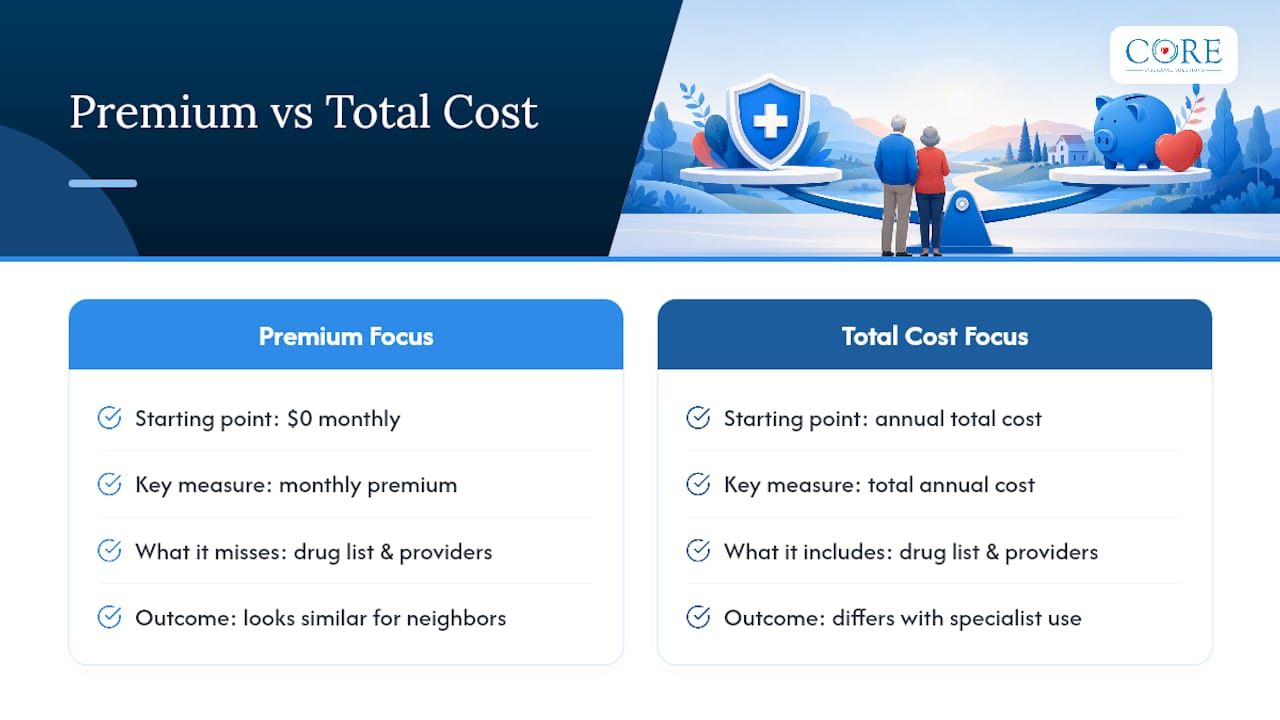
The conventional advice to “just compare a few plans online” undersells how much your specific drug list and provider relationships change the math. Two neighbors with the same ZIP code and similar budgets can land on completely different plans once you factor in one person’s specialist visits versus the other’s clean bill of health.
If there’s one thing worth prioritizing first, it’s running the high-use scenario before you fall for a low premium. Assume something goes wrong, then check whether the plan protects you or exposes you. That single exercise, more than any star rating or brochure, tells you whether a plan actually fits your life.
Get Personalized Help Choosing Your Medicare Plan
Comparing plans on your own through Plan Finder gets you data, but it won’t tell you which plan actually fits your specific prescriptions, doctors, and health history the way a local, licensed conversation can. Core Insurance Solutions offers exactly that: a free, no-pressure assessment where an unbiased comparison across major carriers replaces guesswork with a plan built around your actual medical needs, not a sales quota.
If you’re new to Medicare or reconsidering your current plan, start with the free Medicare 101 webinar replay to see the full decision process explained step by step. Ready to talk through your specific situation? Explore Medicare plans and services in Lakeland and schedule a consult before your next enrollment window closes.
Where to Verify Enrollment Rules and Current Figures
Confirm details directly through Medicare.gov’s Plan Finder for plan comparisons, CMS fact sheets for official 2026 figures, and your local SHIP office for free, unbiased counseling.
Frequently Asked Questions
What’s the fastest way to choose a Medicare plan? Enter your ZIP code and prescriptions into Medicare.gov’s Plan Finder first. It narrows dozens of options down to a handful that actually cover your doctors and drugs.
Is Medicare Advantage or Original Medicare with Medigap better? Neither is universally better. Original Medicare plus Medigap tends to suit people who travel or expect heavy care use, while Medicare Advantage often works well for healthy people who want lower premiums and don’t mind a local network.
Can I switch from Medicare Advantage back to Medigap later? You can, but Medigap insurers can medically underwrite you outside your initial six-month enrollment window, which may raise your cost or limit your options depending on your state.
What happens if I miss my Initial Enrollment Period? You may face permanent late enrollment penalties on Part B and Part D, and you might have to wait for the next general enrollment period to sign up.
Do I need a separate Part D plan if I have Medicare Advantage? Usually not. Most Medicare Advantage plans bundle drug coverage, but always confirm your specific medications are on the plan’s formulary before enrolling.
This article is general information, not a substitute for advice from a qualified doctor. Consult a qualified healthcare professional about your own circumstances before acting on anything here.
Sources
- 2026 Medicare Parts B premiums and deductibles fact sheet
- Medicare Advantage in 2026 — premiums, out-of-pocket limits, supplemental benefits and prior authorization | KFF


